
On Wednesday night, February 25th, community members and City representatives gathered in the cafeteria at Atkinson Elementary School for District 3’s local transportation funding open house. This is one in a series of four in-person events led by the Portland Bureau of Transportation (PBOT) to help inform the Portland City Council, which will consider new ways to fund the maintenance and operation of Portland’s streets. Mayor Keith Wilson spoke at the event, summarizing some of the alternative funding options under consideration. People interested in learning more and contributing their perspective can visit the online open house and take a post-open house survey.

The two-hour event at 5800 SE Division Street saw visitors drop in between 6:30 and 8:30 p.m. as they moved through a self-guided arrangement of poster boards, with City staff available to ask questions and take notes. Portland transportation leaders have spent years warning the community and elected officials that its funding is overburdened by project-based restrictions, preventing 70% of PBOT’s budget from reducing a $6 billion maintenance backlog that impacts road conditions, sidewalks, bridges, signs, lights, and other infrastructure. Much of the funding sourced from Federal and Oregon State sources is for specific projects, such as new crossings or other safety infrastructure, and cannot directly fill potholes or repave roads. Even if a one-time grant were sourced to repair all of Portland’s transportation infrastructure to a “fair” condition, without an updated maintenance revenue source, PBOT assets would decline over the following decades, and a new generation of Portlanders would face the same systemic problem with infrastructure upkeep. In Wilson’s remarks, he painted a troubling picture of Portland’s $85 billion in street assets. “65% of our roads are in a state of not good repair. Most of the nation isn’t above 35%. So we’re in trouble.”

The primary reason for the funding shortfall is inflation, with the presentation material noting that the costs of transportation, construction labor, and materials have increased rapidly while general funding sources have not kept pace. The mayor also pointed to the inequity and ineffective nature of a fixed gas tax that federal legislators have not increased since 1993. “I think we all know that fossil fuels and liquid fuels are going out of style. I drive an electric vehicle myself, and I don’t pay gas taxes. So when we think about paying our fair share, we have to think about the new generation, the new century, and not look to the last century for a failed taxing policy,” said Wilson. He explained the City is looking at “dozens of different options from around the country and the State” to evaluate for Portland transportation funding.

In the open house materials, PBOT has surfaced several proposals that may lay the groundwork for future street funding. Visitors read information about a possible “Street Damage Restoration Fee” that would be charged to utility companies, contractors, or other entities that excavate or trench in the public right-of-way, damaging streets and sidewalks. These crews, including other Portland bureaus, must repair the damage. However, that work often fails to adequately restore the full integrity of a street or sidewalk, and those assets can fail prematurely, a decade or decades earlier than expected.
Presentations also asked attendees to consider a “Transportation Utility Fee” as a funding source, as 31 other Oregon cities have implemented. It could be a monthly fee added to existing public utility bills, which residents and businesses pay. That money collected would support basic road maintenance, such as fixing potholes, and requested safety improvements. A “Retail Delivery Fee” concept would require major retailers to pay a fee for packages delivered to customers through the city’s transportation network. This would come from companies like Amazon, Walmart, Home Depot, Target, and eBay. Colorado and Minnesota have programs like this, but Portland could be the first city to enact this if the City Council adopts this idea. This approach could cover prepared-food transportation in addition to, or in place of, packages with a “Third-Party Food Delivery Fee” similarly proposed.
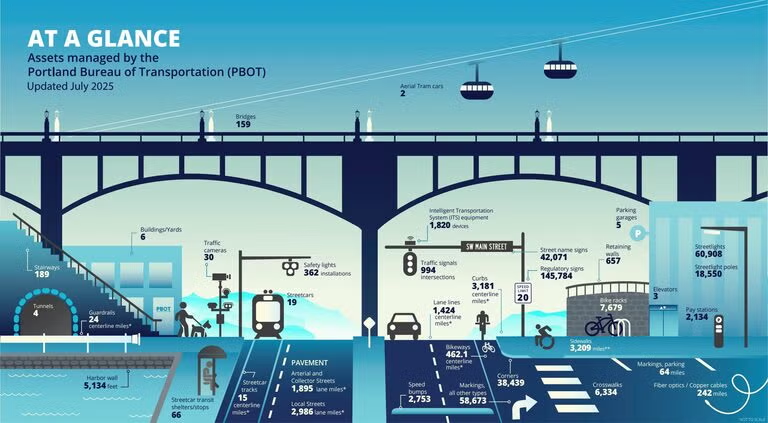
The open house materials also stressed accountability through audits and transparency. Mayor Wilson’s remarks also centered on shifting taxes rather than simply layering new revenue sources on residents. “The one that we’re gonna be talking about is the transportation utility fee that is going to be a replacement for a gas tax… It’s a real fair way that all houses and/or businesses will pay a portion. My promise to you is if council passes this, I will work to phase out your gas tax for fixing our streets because it’s just not fair, and we have to start rethinking how we’re gonna move our city forward.

PBOT encourages people to visit portland.gov/pbotfunding for more information and share feedback by noon on Wednesday, March 4th, 2026. After that date, extending into May, Portland City Council members will deliberate on the presented materials and community feedback.

Promotion: Montavilla News is supported by contributions from businesses like Otter Wax, a neighborhood producer of small-batch specialty goods handcrafted in Portland. Using only natural ingredients, they make modern care products that are steeped in tradition. We thank them for their support.