Portland is recognized as a bikeable city that invests in infrastructure that makes this transportation and recreation activity more accessible to new or vulnerable riders. On Wednesday, September 30th, the New to Portland 2026 Rides series will gather in the Montavilla Plaza at SE 79th Avenue and SE Stark Street for a 5:30 to 7:30 p.m. moderate-paced 6- to 8-mile bicycle ride. The event is geared towards people who are new to town, new to cycling, or want to explore low-stress bike routes on the east side of Mount Tabor.
This Jade District and Montavilla ride is free and open to everyone, and people without a bike can ride free on a BIKETOWN e-assist bike. People interested in that offer will need to ask the ride leader for a free ride code to cover the cost of the bike ride and download the BIKETOWN app or the Lyft app. Participants can expect to roll past several neighborhood parks along current and future bikeways while discovering lesser-known features of the area.
This is a slower-paced ride, and participants can expect to travel in the group at 8 to 10 mph. Event organizers want to direct people to one of Portland’s bike shops to rent or buy a bike if they are interested in this event or in adopting cycling as one of the many ways to navigate the city. This Portland Bureau of Transportation-hosted event is made possible with support from Oregon Metro and the Federal Transit Administration. People are encouraged to check the BIKETOWN map for station locations near the event if they plan to use the program. The City also offers a checklist to help you get started on a bike and prepare for a ride on city streets.
Promotion: Check out East Portland News as it continues to advocate for and report on outer East Portland. You will find frequently updated articles and an archive of more than 5,000 stories written over the past 20+ years alongside a robust Community Calendar of events.
This week, crews with the Portland Bureau of Transportation (PBOT) will continue road work that began on August 19 along NE Glisan Street between NE 82nd and NE 92nd avenues. Drivers in the area are encountering new traffic patterns and slower speeds as re-striping teams add painted bike lanes on completed segments of the project site and new signage arrives from NE 81st to NE 92nd Avenues. Workers have not restored all lane markings to the repaved half of the project site closest to NE 82nd Street. Road users should use extra caution until work is completed and anticipate delays during the 7 a.m. to 6 p.m., Monday through Thursday work schedule.
New eastbound bike lane segment started on NE Glisan St near NE 83rd Ave (Jacob Loeb)
This Fixing Our Streets-funded project included substantial updates to sidewalk corner curb ramps, bringing crossings in this area up to Americans with Disabilities Act (ADA)- compliant standards. In addition to creating a smoother driving surface for vehicles, this new phase of work will reconfigure the street to remove time-shifting outer lanes used for parking or as an auxiliary travel lane. Collisions occurred on this street where motorists parked cars during allotted times, but drivers may have assumed the outer lane was clear. PBOT engineers anticipate that removing that conflict point will yield significant safety improvements with minimal impact on vehicle throughput.
The new NE Glisan bike lanes will connect NE 81st Avenue and NE 93rd Avenue. Early concepts for the cycling infrastructure showed the bike lane extending west to NE 80th. However, area business concerns over losing frequently used street parking on that block prompted a design that still helps connect side-street bike routes for people crossing NE 82nd Avenue outside a car, while minimizing impacts to adjacent commercial property users. PBOT planners anticipate further improving the bike infrastructure in 2030 with hardscape concrete dividers and flex posts to protect cyclists riding next to cars. The reconfiguration is happening during this repaving project to save money. Otherwise, contractors would need to grind off existing street markers and repaint as part of the 2030 work.
NE Glisan St existing crossing at NE 87th Ave that crews will upgrade
NE Glisan Street, from Interstate 205 to 82nd Avenue, is a notoriously challenging roadway to cross with vehicles driving quickly between the two points. Without any fully signalized intersections on this stretch and with a large hill blocking visibility, it can take an extended period to find a safe break in traffic to cross. Crews working with PBOT will install two new pedestrian crossings with concrete median islands at NE 84th and 90th avenues, along with enhancements to an existing crossing at NE 87th Avenue. These in-roadway waypoints allow pedestrians to cross in two phases, focusing on one direction of traffic at a time, and help drivers better see a person waiting at the high-visibility infrastructure.
In the coming days, crews will grind down the eastern segment of the roadway and lay a fresh road surface. Cyclists should consider safer routes until NE Glisan is fully re-striped, and all street users should plan extra travel time as people adjust to the new configuration and speed limits on this segment of NE Glisan.
Article and photos by
Jacob Loeb
Promotion: Montavilla News is supported by contributions from businesses like Catalyst Construction & Kitchen Remodeling, a top-rated general contractor specializing in kitchen, bathroom, basement, and garage remodeling, as well as ADU construction and home additions. We thank them for their support.
The 10th Jade International Night Market is this Saturday, August 29th, from 4 to 10 p.m. within the Portland Community College’s Southeast campus at 2305 SE 82nd Avenue. Since 2014, this evening event has offered food, entertainment, and vendor booths from area groups while providing a space for the community to gather and celebrate the people who make up the multicultural district.
Jade International Night Market 2025
The one-day community gathering focuses its family-friendly events earlier in the afternoon, including a free plant-potting booth for youth sponsored by Portland Nursery. People ages 20 and younger can decorate a free pot and fill it with a selection of donated plants, while supplies last. Event organizers have added a scavenger hunt and brought back the Luminous Together’s Art Grove. “The Art Grove is back again and expanded. It’s put on by a former APANO staff member who offers forest bathing, therapy, and interactive art,” explained APANO Community Development Director and lead Jade Night Market organizer Alisa Kajikawa. The Grove will include a meditative arts workshop, exhibition tours, and the Our Little Free Diverse Library. People can find this part of the market west of the food vendors in the wooded area where the PCC Learning Garden is located.
Jade International Night Market 2025
For the first time, attendees can participate in a Jade District-themed scavenger hunt. To win a prize, people need to find nine spots around the Night Market that feature placards highlighting the people and history of the Jade. The quest begins at the APANO booth where participants can get the details. Scavenger hunt materials are available in simplified Chinese, Vietnamese, and English. “There are questions about what they read, and they’ll just write down their answer. We’re not looking for the correct answer… but people need to write down what they think the answer is,” remarked Kajikawa. Completed forms are brought back to the booth for a reward.
Jade International Night Market 2025
Activities are optional, and many people attend specifically for the unique food and shopping experience. This year, 38 food vendors and drink specialists will sell tasty treats to attendees throughout the event. Over 90 other booths feature people selling arts, distinctive items, or offering information to the community. Scheduled speakers and performers will begin the entertainment on the main stage at 5 p.m., with a program that runs until 10 p.m.
5:00pm
Portland Taiko
PACC Dance Team
Cambodian Dance Troupe of Oregon
KOICO Vietnamese Fan Dance
6:00pm
Ballet Papalotl
McDaniel High School Cheer
Nattasinh Lao PDX
7:00pm
Summit Wushu
White Lotus on Jong
8:00pm
At the Edge of Chinatown
Hula Halau ‘Ohana Holo’oko’a
9:00pm
Rachel Wong
White Lotus Blacklight Dragon Dance
The performances are always free to watch; still, event organizers wanted to make sure everyone has access to the cuisine and products available at the Night Market. Last year, the event’s leaders launched a program called Jade Dollars to lower financial barriers by giving out vouchers for both food and retail. “Everyone belongs [at the Night Market], and we do this for the community. There are tons of things that you don’t need money for to enjoy. At the same time, it’s still about commerce, and it’s still about supporting our small business owners. So we’ll have five-dollar increments of Jade Dollars that we will give out to folks in two different ways,” said Kajikawa. People can receive $10 worth of food vendor vouchers at the market information booth by showing government benefits like SNAP, WIC, or OHP cards. They only need to show the cards or prove enrollment; no individual data is collected. People can also complete a demographic survey to receive a $5 voucher towards retail items and participating booths.
Jade International Night Market 2024
Last year’s Jade International Night Market had an estimated 20,000 attendees, and they anticipate similar interest this year. The market will maintain last year’s layout, with food vendors along the west edge of the campus in the parking lot and booths lining the inner courtyard walkways. Unlike other fairs, Night Market organizers provide canopies, offering consistency and convenience to participants. “It looks nice because it’s all uniform with three different colors,” said Kajikawa. The main stage is north of the booths next to Tabor Hall.
People interested in attending the Jade International Night Market should plan on large crowds and limited parking options. Organizers recommend people take public transit via the TriMet 72 bus line or the SE Division FX 2 bus rapid transit system. People who bike, walk, or ride transit to the Night Market could earn a $10 gift card from the Portland Bureau of Transportation (PBOT) by stopping by their booth to claim the reward. Visitors who rent a bike to get to the Night Market will have a $25 credit from BIKETOWN by using code JADENIGHTMKT26 for applicable rides that start or end at the PCC campus during the event. Late August often brings warm temperatures. The campus has many shade-providing trees, but anticipate significant sun exposure while walking around. The Night Market’s web page and social media offer current updates about the event schedule and other information.
Promotion: Montavilla News is supported by contributions from businesses like Otter Wax, a neighborhood producer of small-batch specialty goods handcrafted in Portland. Using only natural ingredients, they make modern care products that are steeped in tradition. We thank them for their support.
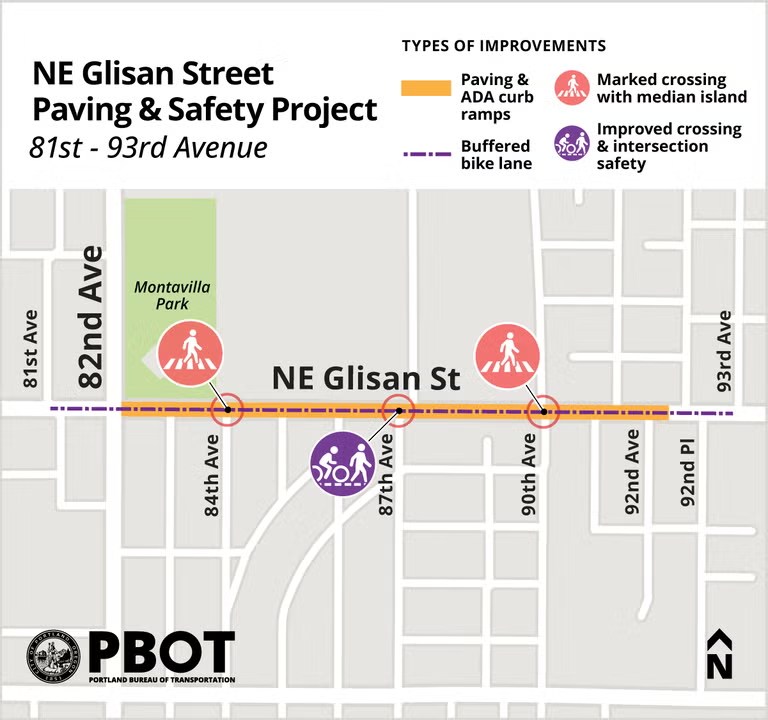
Road crews will begin repaving NE Glisan Street between NE 82nd and NE 92nd avenues on Wednesday, August 19th. The approximately two-lane-miles of resurfacing work will take an estimated twelve business days to complete as heavy equipment grinds off the damaged top layer of asphalt and lays down a fresh mixture of crushed stone and bitumen. The Portland Bureau of Transportation’s (PBOT) re-striping plans will create a paint-buffered bike lane next to a single travel lane in each direction and recreate the center turn lane. Cement masons will add two new pedestrian crossing islands along the busy High Crash Street, with an existing crossing at NE 87th Avenue updated to prevent some left turns while better protecting pedestrians and cyclists.
Existing RRFB on NE Glisan St at 87th Ave
This Fixing Our Streets-funded project included substantial updates to sidewalk corner curb ramps, bringing crossings in this area up to Americans with Disabilities Act (ADA)- compliant standards. Starting in May, Crews working with Portland’s Bureau of Environmental Services (BES) installed modern stormwater management sump drains under NE Glisan Street at the intersections of NE 91st and 92nd Avenues. In addition to creating a smoother driving surface for vehicles, this new phase of work will reconfigure the street to remove time-shifting outer lanes used for parking or as an auxiliary travel lane. Collisions occurred on this street where motorists parked cars during allotted times, but drivers may have assumed the outer lane was clear. PBOT engineers anticipate that removing that conflict point will yield significant safety improvements with minimal impact on vehicle throughput.
Project map courtesy PBOT
The new NE Glisan bike lanes will add a connection between NE 81st Avenue and NE 93rd Avenue. Early concepts for the cycling infrastructure showed the bike lane extending west to NE 80th. However, area business concerns over losing frequently used street parking on that block prompted a design that still helps people riding outside a car cross NE 82nd Avenue to meet up with side-street bike routes while minimizing impacts to adjacent commercial property users. PBOT planners anticipate further improving the bike infrastructure in 2030 with hardscape concrete dividers and flex posts to protect cyclists riding next to cars. The reconfiguration is happening during this repaving project to save money. Otherwise, contractors would need to grind off existing street markers and repaint as part of the 2030 work.
NE Glisan Paving and Safety Project 30% Design Concept illustration of NE 84th Ave. Courtesy PBOT
NE Glisan Street, from Interstate 205 to 82nd Avenue, is a notoriously challenging roadway to cross with vehicles driving quickly between the two points. Without any fully signalized intersections on this stretch and with a large hill blocking visibility, it can take an extended period to find a safe break in traffic to cross. In 2021, PBOT lowered the speed limit to 30 mph, but that still did not significantly improve crossing safety for people inside or outside a vehicle. The two new pedestrian crossings with concrete median islands at NE 84th and 90th avenues should help pedestrians cross in two phases, where they can focus on one direction of traffic at a time, and drivers can better see a person waiting at the high-visibility infrastructure.
NE Glisan Paving and Safety Project 30% Design Concept illustration of NE 90th Ave. Courtesy PBOT
The NE 87th Avenue crossing already features street-adjacent buttons that activate Rectangular Rapid Flashing Beacons (RRFB) to signal to drivers that bikes or pedestrians will cross soon. The updates will extend an existing concrete median island east with cutouts for cyclists crossing. This extended mid-street infrastructure will prevent northbound and westbound drivers from turning left at this intersection.
Updated median at NE 87th Ave with left turns prohibited for north and west automotive travel. Courtesy PBOT
PBOT notes that paving and painting work is weather-dependent, so that project work dates may change. Drivers can expect rougher roads during the grinding and resurfacing process and should anticipate traffic delays with detours from 6 a.m. to 5 p.m. weekdays, with some weekend work. Parking on NE Glisan in the project area will end a few days before work begins, but pedestrian access will remain open. Anyone traveling through the worksite should follow all traffic control signs and flaggers and use heightened caution.
Article and photos by
Jacob Loeb
Promotion: Montavilla News is supported by contributions from businesses like Otter Wax, a neighborhood producer of small-batch specialty goods handcrafted in Portland. Using only natural ingredients, they make modern care products that are steeped in tradition. We thank them for their support.
On Tuesday, August 11, and Wednesday, August 12, road crews will close the Interstate-84 Entrance and Eastbound traffic on the overpass above NE 82nd Ave and I-84 for microsurfacing work. Contractors working for the Portland Bureau of Transportation (PBOT) will apply a fast‑curing asphalt treatment to the road surface, filling minor ruts and improving the pavement’s condition. During the application process, motorists will need to use temporary detours.
Portland Maps image with MV News notation of detour routes. Red for I-84 Westbound and blue for eastbound Halsey
PBOT recommends eastbound drivers on NE Halsey use NE 81st Avenue at the Halsey Street roundabout, then turn onto NE Wasco Street. Next, people can use northbound NE 82nd Avenue to then turn onto NE Jonesmore Street, which reconnects with NE Halsey. Travelers intending to use I‑84 westbound should continue west on NE Halsey, turning south onto NE 60th Avenue, then take a right at NE Glisan Street to access the I‑84 westbound on‑ramp at NE 59th Avenue. Contractors will keep the I‑84 on‑ramp open during peak travel hours, but drivers should be prepared to use the detour if directed to by the onsite crew or signage.
New two‑way protected bike infrastructure on NE Halsey St
The two-day project work is just one phase of the overpass updates needed to complete this leg of improvements. Future installation of protective fencing over the bridge, striping of a new two-way bike facility over the bridge, and vertical separation of the two-way bike lane are tentatively anticipated in October 2026. That work will also require temporary lane closures. This activity is part of the NE Halsey Street (80th to 92nd Avenues) – Safety and Access to Transit Project, which aims to improve safety for those traveling outside of cars along this busy High Crash street. The new two‑way protected bike infrastructure on NE Halsey provides a continuous connection from the new mini-roundabout at NE 81st Avenue to NE 92nd Avenue. This upgrade links cyclists directly to existing bike infrastructure and creates new sidewalks for people walking to the NE 82nd Avenue MAX station from the business corridor and nearby residential neighborhoods.
Work schedules are subject to change. PBOT will update reader boards positioned along NE Halsey Street and the project website with the latest schedule information.
Promotion: Montavilla News is supported by contributions from businesses like Otter Wax, a neighborhood producer of small-batch specialty goods handcrafted in Portland. Using only natural ingredients, they make modern care products that are steeped in tradition. We thank them for their support.
Crews recently prepared concrete forms in the center turn lane of SE Division Street at SE 64th Avenue. This work replaces a temporary pedestrian island installed in 2024 at a high-visibility enhanced crosswalk that connects to a Portland Parks & Recreation (PP&R) created paved bike path and pedestrian access way leading to Mt. Tabor Park. Cement masons will next pour concrete to create the raised protective infrastructure and construct a level pedestrian holding area at street level.
Pedestrian Refuge Islands are a nationally recognized tool for transportation engineers looking to assist people crossing a multilane road. It allows a pedestrian or cyclist to focus on one direction of cross traffic at a time and puts a person in a more visible space for drivers who may not notice someone waiting at the far left edge of their field of view. The in-street safety infrastructure also helps slow traffic making turns and causes passing motorists to reduce travel speed as the street narrows. Over the last few years, crews working with the Portland Bureau of Transportation (PBOT) have installed similar pedestrian islands at many locations on this street and 82nd Avenue.
Mt. Tabor Park SE Division St at SE 64th Ave paved bike path and pedestrian path near crossing
At the time of the PP&R path opening in April 2024, PBOT installed a temporary pedestrian island at SE 64th Avenue and Division Street, created from plastic delineator wands serving as a visual indicator to motorists of frequent pedestrian activity. Still, it did not provide curb-height infrastructure to further deter vehicles from driving through the space. Funding for this project comes from the Fixing Our Streets program, which allocates funds to replace temporary safety materials with permanent street elements through the Community Street Services category. This is an example of a case where temporary street safety infrastructure serves to prove a concept design and later to secure funds for a more significant investment.
SE Division St at SE 64th Ave crosswalk with temporary pedestrian island in 2024
People should anticipate ongoing construction in the area, which may cause brief delays. The pedestrian crosswalk is currently closed during the construction phase. Previous project work in this area reconstructed two curb ramps at the southeast corner of SE 64th Avenue and Division Street to the current Americans with Disabilities Act (ADA) standards. The median island work began on July 13th and will continue for another couple of weeks. People using the street should use caution and follow crew instructions.
Promotion: Montavilla News now offers audio recordings of articles produced by ElevenLabs, powered by artificial voice technology. We thank our paid subscribers for their financial support, which helps pay for features like this, and special thanks to Weston Ruter for technical assistance in integrating this feature across the back catalog of articles. Please send any feedback to info@montavilla.net
Contractors working with the Portland Bureau of Transportation (PBOT) began intermittent night painting on NE Halsey Street between NE Jonesmore Street and NE 92nd Avenue the week of July 13th. Crews will use a blowtorch to adhere the green and white bike lane markings needed to activate the new raised concrete protected cycling path. PBOT says drivers should not encounter changes to travel patterns or restricted driveway access during the work, and that the work will not extend through the entire night.
Recently applied green and white bike lane markings on the south side of NE Halsey St
This activity is part of the NE Halsey Street (80th to 92nd Avenues) – Safety and Access to Transit Project, which aims to improve safety for those traveling outside of cars along this busy High Crash street. Work follows the recent eastbound nighttime closure of NE Halsey Street over Interstate 84 and NE 82nd Avenue on July 8th and 9th. This week’s work will involve painting the two-way bicycle lanes on the south side of NE Halsey. Some crew activities will create noise; however, PBOT explained in its work notice that the night schedule is necessary due to daytime heat, which can warm the asphalt to a point where the paint cannot properly adhere.
The new two‑way protected bike infrastructure on NE Halsey provides a continuous connection from the new mini-roundabout at NE 81st Avenue to NE 92nd Avenue. This upgrade links cyclists directly to existing bike infrastructure and creates new sidewalks for people walking to the NE 82nd Avenue MAX station from the business corridor and nearby residential neighborhoods.
Completed new sidewalk west of 92nd Ave on the north side of NE Halsey St
People can expect this round of overnight work to conclude on July 17th. Pedestrians and cyclists traveling through the area have access to much of the new infrastructure, even as crews install markings to help drivers identify potential conflict points with other street users. Until this project is completed later this year, travelers should use heightened caution on this section of NE Halsey Street, looking for collision points and obeying construction signs or barricades.
Promotion: Consider visiting Montavilla New’s supporter East Portland News as it continues to advocate for and report on outer East Portland. You will find frequently updated articles and an archive of more than 5,000 stories written over the past 20+ years alongside a robust Community Calendar of events.
Road Crews will shut down eastbound NE Halsey Street over Interstate 84 and NE 82nd Avenue from 8 p.m. to 5 a.m. on Wednesday, July 8th, and Thursday, July 9th. At the same time, vehicles will need to detour around a closure on westbound NE Jonesmore Street between NE Halsey and 82nd Avenue. Workers will shut down a traffic signal for updates, including pavement marking specialists removing and replacing lane striping at the NE Jonesmore and Halsey Street intersection.
Portland Maps image with MV News illustrations of Nighttime shutdown July 8th to 10th. Green arrowed lines indicate allowed travel durning closure while red shows prohibited paths
During overnight closures, eastbound drivers on NE Halsey Street will need to detour onto NE 81st Avenue, turn onto NE Wasco Street, then turn left onto NE 82nd Avenue. To return to NE Halsey, drivers can turn right onto NE Jonesmore Street. Westbound drivers on NE Halsey Street trying to access 82nd Avenue can cross over I-84 and then use the mini-roundabout to take the detour on NE 81st Avenue to NE Wasco Street.
PBOT provided map showing the NE Halsey
This phase of road closures will be completed on July 10th. Crews working on this project will implement future lane closures around October 2026, when Microsurfacing work to smooth the I‑84 overpass bridge pavement begins. That closure will also allow the installation of protective fencing on the overpass bridge, lane striping of a new two-way bike track over the bridge, and vertical separation of the two-way bike lane.
PBOT is scheduling this July work during the night to minimize daytime traffic impacts, and driveway access will remain open for all properties in the project area.
Promotion: Montavilla News is supported by contributions from businesses like Otter Wax, a neighborhood producer of small-batch specialty goods handcrafted in Portland. Using only natural ingredients, they make modern care products that are steeped in tradition. We thank them for their support.
In the latter half of June, road crews reopened NE Halsey Street to bidirectional automotive traffic after months of work creating a new mini-roundabout near Interstate 84 and NE 82nd Avenue. Additionally, drivers regained full use of NE 80th and NE 81st avenues at the worksite intersections. Starting on February 16th, westbound motorists on NE Halsey Street were prevented from fully crossing the I-84 overpass as cement masons created the second half of a new mini-roundabout and other contractors built additional street improvements.
NE Halsey mini-roundabout approach from NE 81st Avenue.
As this work nears completion, the Portland Bureau of Transportation (PBOT) recently scaled back plans for the NE Halsey Street Safety and Access to Transit Project, postponing a planned intersection improvement at NE 69th Avenue and removing a 150-foot section of new sidewalk and street trees from the project’s scope. PBOT says the $380,000 in cost savings is necessary to meet reduced funding for this project while still maintaining core improvement goals of filling gaps in walking and biking connections on NE Halsey Street from NE 80th to NE 92nd avenues.
Rendering of NE Halsey roundabout post 2026 update to remove sidewalk section, courtesy PBOT
The newly renamed NE Halsey Street (80th to 92nd Avenues) – Safety and Access to Transit Project contains many safety improvements for people walking and biking through the area. Future work will create a dedicated bidirectional cycle path from the mini-roundabout to 92nd Avenue through a challenging section of the City’s street grid carved up by freeway construction decades ago. Work on this project could help reconnect communities cut off by car-focused street infrastructure, while reducing injuries on an identified High Crash street.
Drivers and other street users should use caution around this new infrastructure, as the adjusted traffic pattern could confuse people unfamiliar with the change. The raised concrete center circle is designed with sloped edges so that long vehicles, such as first-responder trucks or buses, can drive over it, treating it as a speed bump when necessary. Look for continued road work east of the mini-roundabout as contractor Interlaken and its subcontractors work along the length of the NE Halsey job site.
Promotion: Montavilla News is supported by contributions from businesses like Catalyst Construction & Kitchen Remodeling, a top-rated general contractor specializing in kitchen, bathroom, basement, and garage remodeling, as well as ADU construction and home additions. We thank them for their support.
Drivers on SE Thorburn Street merging into SE Washington Street up to I-205 will see a new 25 miles per hour (mph) speed limit. The Portland Bureau of Transportation (PBOT) reduced speeds on the roadway from 30 mph in June as its contractors began work creating approximately 355 feet of new sidewalk on the north side of SE Thorburn Street, between SE 73rd Avenue and SE 74th Avenue, filling a sidewalk gap. This work follows a 2025 lane reconfiguration in the area that reduced the number of travel lanes in each direction and added improved bike and walking infrastructure.
New 25 mph speed limit sign on SE Washington st
PBOT changes speed limits regularly to improve street user safety. The 2025 redesign made space for increased pedestrian access on both sides of the roadway and created dedicated bike lanes. The slightly reduced vehicle speeds will help those outside a motorized vehicle remain safe and lessen the injury caused by a crash. People walking or rolling on the south side of SE Thorburn Street use an on-roadway path, as the sloped topology and mature tree line of the adjacent properties make sidewalk expansion more involved. The north side of the street has some sidewalks that are narrow and curb tight—lacking a buffer space between the pedestrian zone and the raised curb.
SE Thorburn Street sign showing old speed of 30 mph
In a section of SE Thorburn Street where people walk through grassy, undeveloped land and gravel paths near SE 74th Avenue, contractors working for PBOT will build a 7-foot-wide sidewalk, with some sections reduced to 5 feet wide, to preserve existing street trees. During that work, cement masons will create new curb ramps at the intersection of SE 74th Avenue and reshape the sidewalk corners to make the intersection more perpendicular, which can slow turning vehicles and lessen the pedestrian crossing distance.
Project desing imag courtesy PBOT
This work is part of the Jade and Montavilla Multimodal Improvements Project and is funded by general transportation revenue, House Bill 2017, with a budget of $371,000. Crews working in the area will periodically close one lane of vehicle traffic on SE Thorburn Street between SE 73rd and 74th avenues through June 30th. Street users should anticipate some delays and detours as construction continues in the area. Drivers should also note the new, slower speeds on these streets.
Promotion: Montavilla News is supported by contributions from businesses like Catalyst Construction & Kitchen Remodeling, a top-rated general contractor specializing in kitchen, bathroom, basement, and garage remodeling, as well as ADU construction and home additions. We thank them for their support.
Neighborhood news site focused on buildings and changing businesses