Category: Community

Community Food Pantry Sees Increasing Demand

Colise Johnson and her husband, James, run a small food pantry from their home, a few blocks east of the Leodis V. McDaniel High School athletics fields on the corner of NE 86th Avenue and Brazee Street. As economic pressures push more people into food insecurity, they say the number of people served at this privately funded community resource has increased to an estimated 400 per week. They fund a sizable portion of these efforts through can deposit redemption and donations from people who wish to support the weekend lunch program and their Thursday pantry boxes.

Illustration of a community pantry featuring a colorful house surrounded by various fruits, vegetables, and food items. Text reads 'Colise & James's Community Pantry! Corner of NE. 86th and Brazee.'
Social media graphic courtesy Colise Johnson

Johnson explained that her home is filled with a fluctuating amount of food ready for weekly pickup by individuals and groups who visit her white house with purple trim. “We’ve got a big freezer out in the back and what we call a mini Winco upstairs,” explained Johnson. Nearly an entire floor of the home is dedicated to stocking canned and dried goods. Stacks of empty produce boxes sit on the front porch waiting to transport food. The couple and around 15 volunteers serve the majority of people on weekends with lunches. “Mike and Faye just brought over 300 sandwiches because we do 300 lunches a week, and a hundred of those go to veterans at least every week,” said Johnson. “We put in a bottle of water, a snack, a bag of chips, and the little fruit snack bags. If we have fruit, we use that as well.”

The volunteer staff only includes a bottle of water in the lunch if the person is unhoused as a way to stretch a slim budget and reduce waste. Additionally, on Thursday pantry box days that operate from 9 a.m. to 2 p.m., they ask people what they want to eat instead of giving everyone the same items. “The reason I give them choices is because you see so many food boxes left on 82nd, or up on Glisan, or on Halsey because they take what they want out of the food box, then leave it,” remarked Johnson.

An open freezer stuffed with numerous zip-lock bags containing frozen food, a cardboard box labeled 'PACKER', and various bottles of condiments and dairy products on shelves.
Pantry refrigerator filled with hundreds of sandwiches for lunch kits

Most of the food they give out is first-come, first-served. “There have been days that I’ve opened up at 9 o’clock, and our breads have been gone by 11:30 a.m,” Johnson said. But in those cases, they tap into reserves upstairs and give people anything they want so they will not leave hungry. “I’ll give them whatever I have here and just make the best of it.” The only time people need to sign up for food is on special holiday meals that require more planning. “For Thanksgiving and Christmas last year combined, we did 88 total dinners. We fed 537 people, and almost $2,000 of that was pop can money,” said Johnson.

In addition to accepting donated cans, Colise Johnson traverses the neighborhood in her motorized chair to pick up discarded cans. However, recent changes to the Green Bags bottle and can deposit redemption program limit people to 30 sacks per account per calendar quarter. This policy change has hampered the food pantry’s funding efforts, limiting its ability to scale up operations. Johnson has limited fundraising options, but the deposit collection has supported the feeding efforts for 27 years. “I have cerebral palsy and epilepsy. I can’t work, but I want to do something,” said Johnson.

A collection of cardboard boxes filled with packaged snacks and other food items, including various brands of chips and treats.

The couple explained that funding restrictions will not prevent the pantry from continuing its work. They are thankful for the support of volunteers who keep the efforts going. “We’ve got Faye and Mike, we’ve got Corey and Garrett, we’ve got Terrence and his crew, and Don. We’ve probably got 15 volunteers. People come over and help me restock upstairs; they don’t think twice about coming over and donating their time,” recalled Johnson. “Danny comes in from the VFW and picks up the vets’ lunches and hands them out at Fort Kennedy.”

Johnson says they make a special effort for veterans who experience food insecurity. However, they serve all people and create a safe space by not tolerating abusive language directed at themselves or guests. Their goal is to be easy to access for people in need, and they are willing to give whatever they can source from private donations. “We don’t ask for ID. We don’t ask for any of that. We just give them the food,” said Johnson. “We give out school supplies, we give out sleeping bags, tents, we give out clothes, shoes, we make personal care kits.”

A red container filled with several boxes of Rice-A-Roni, stacked and partially open.

The community food pantry accepts donations to keep the program running. “We can’t take anything that’s open. We can’t take anything that’s expired. But we gladly accept donations,” explained Johnson. “If they do happen to bring donations of any cans and bottles, please bring them up to the porch. If you just set them over the fence, they’re going to get stolen.” The couple has dealt with theft of items from their property and some violence over the years. Overall, people are just grateful they are there year after year.

Colise Johnson explains that this multi-decade effort to feed people is her way of contributing to the support she received earlier in her life. “It was done for me when I was a single mom with two kids. People helped me, and we were able to start giving out what we had. We always tell everyone it’s a hand up, not a hand out.” What began as a simple way to pay support forward has only grown year over year as demand has increased. “The economy sucks, and the worse the economy gets, the more people we get. Grocery prices, gas prices, rent prices; you name it, it contributes to hunger,” remarked Johnson. She explained that some people who are not accustomed to needing support sometimes come in with the wrong attitude and need to adjust to current circumstances. “When you’ve got food insecurity, and you’ve got financial insecurity, we’re seeing a lot of entitlement. And it’s getting more and more as the times get tougher.”

A well-stocked pantry with various food items including jars of peanut butter and jelly, stacked boxes of ramen noodles, and paper bags, organized on metal shelves.

This is a small community food pantry run out of a home in a residential area. They limited hours by locking their gate and had to shut down their self-service option due to abuse. Even with the added visitors to the area due to their efforts, Johnson says they have the support of the people around them and hope to keep doing this work as long as they are able. “We’ve got great neighbors. They have never had a problem with what we do.” Colise Johnson and James welcome donations of unopened food and personal care items. You can contact Colise on Nextdoor or Facebook to arrange drop-off times. Visitors are asked to wear a mask indoors for health reasons.


Promotion: Montavilla News is supported by contributions from businesses like Otter Wax, a neighborhood producer of small-batch specialty goods handcrafted in Portland. Using only natural ingredients, they make modern care products that are steeped in tradition. We thank them for their support.

The 20th Annual 82nd Ave Parade Apr 25

The 20th annual 82nd Avenue of Roses Parade returns on April 25th at 9:30, featuring over 70 groups, including many returning and several new participants. The event organizers will use the scaled-back route implemented last year, starting at Eastport Plaza and ending just short of Montavilla at SE Clinton Street. To celebrate its two-decade run, organizers are adding additional days of activities in the district on Friday, the 24th, and Sunday, the 26th.

A colorful clown riding a unicycle and waving, surrounded by people in a festive parade with a robot performer nearby.

The volunteer-led organization, 82 Roses Community Enrichment Coalition, produces the parade each year, having taken over the operation from the 82nd Avenue Business Association. For most of its run, the parade started at Eastport Plaza Shopping Center and ended on SE Yamhill Street. This year, the procession will start from SE Cora Street, across the road from Eastport retail complex, and march less than a mile north, ending right before SE Division Street. People can gather along the SE 82nd Avenue parade route to view the marchers and procession vehicles. However, with the parade no longer ending at SE Yamhill Street, Montavilla spectators will need to walk south past Portland Community College’s Southeast campus to watch the various groups walk, dance, or drive down the road.

Participants in a parade performing with a colorful dragon and lion dance, with spectators watching along the street.

Ken Turner started work on parade planning in 2006 when he served as the Eastport Plaza Manager and 82nd Avenue Business Association President. In 2007, the first parade participants marched along its route and quickly grew into a significant community event over the following years. It has been 20 years since the first event; however, they have had to skip the tradition four times during its run. Planned protests and safety concerns led organizers to cancel the parade in 2017. Leaders halted the in-person event during the pandemic and took the parade online for 2022. The traditional parade returned in 2023 to a crowd ready to see its revival. Volunteers bringing this East Portland event to fruition believe the parade shows appreciation for the diverse population that defines 82nd Avenue by celebrating the community’s art, music, and dance.

A collage of various logos, including Eilene Curtiss, Raimore-Sundt, Funtastic Traveling Shows, Meals on Wheels People, PBOT, Multnomah County Cultural Coalition, Hong Phat Supercenter, Marie Lamfrom Charitable Foundation, Chick-fil-A Mall 205, and others, representing community organizations and businesses.
Sponsor logos for the 2026 82nd Avenue of Roses Parade

The Regional Arts & Culture Council and the Office of Arts & Culture provided funding for this year’s parade, along with sponsorship by several area businesses. Funtastic Carnival will set up in the parking lot of Hong Phat Super Center, 4200 SE 82nd Avenue, for all three days as part of the celebration. The Impalas Car Show will start right after the parade at 11 a.m. on Saturday, April 25th. The parade features the Rose Festival Clown Prince, Rosarians, brass bands, premier Chinese dance groups, classic cars, America’s First Corps Band, City & Metro Councilors, costume characters, dance and theatrical groups, plus Middle and High school Marching and Jazz Bands.

A woman waves from the back of a black convertible car decorated with campaign signs during a parade. She is accompanied by another person in the front seat, and there's a crowd of spectators in the background.
Multnomah County Commissioner Julia Brim-Edwards and State Representative Thuy Tran in 2024

People looking for a front-row seat can volunteer as parade traffic monitors. One or two volunteers control every crossing along the 82nd Avenue route, and staff coordinators still need people. Volunteer applicants can complete a form at 82rosescec.com. A little before the parade starts, and to its conclusion, unauthorized vehicles are prohibited on SE 82nd Avenue from SE Holgate Boulevard to Division Street. People driving to destinations in the area during that time should select a different route. APANO and the Parade are also holding a SOLVE Oregon cleanup on Sunday, April 26th, from 9:30 a.m. through noon to clean up after the event. People interested in volunteering can sign up at volunteer.solve.org.

Disclosure: The author of this article is a SOLVE Oregon volunteer cleanup leader and organized the April 26th cleanup.

Harrison Community Village Shelter Preview April 24

On Friday, April 24th, Multnomah County’s Homeless Service Department (HSD) and site operator Do Good Multnomah invite the public to preview Harrison Community Village Shelter from 2 to 4 p.m. The newly completed sober-shelter site at 1818 SE 82nd Avenue will soon host 38 shed-style sleeping quarters for adult residents.

Event flyer for the Harrison Community Village Sneak Peek event on April 24, detailing location, time, and QR code for RSVP.
April 24th Harrison Community Village Shelter “Sneak Peak” invite courtesy Multnomah County

Multnomah County purchased the former recreational vehicle dealership at 1818 SE 82nd Avenue in December 2022 for $2 million. This 34,000-square-foot parcel was the second Montavilla location the County bought that year for temporary shelter services. The other shelter, Oak Street Village at 333 SE 82nd Avenue, opened in February 2025 and is currently operating at full capacity. The Joint Office of Homeless Services—now renamed the Homeless Services Department—has held several community meetings, including one in February where the nonprofit Do Good Multnomah staff elaborated on the site’s sober shelter model that aims for people to stay onsite from 90 days to three months as they work towards stable housing in a recovery supportive environment. Presenters explained that residents and staff are subject to drug testing, and policy strictly prohibits the possession of non-prescribed intoxicants on the property. Selecting a sober format meets community desires for the county-owned site, which is near two Portland Public Schools. Do Good Multnomah will conduct background checks on potential residents looking for past criminal history, and those with a record of abuse of vulnerable populations are directed to another, more appropriate shelter or resource. The site is also a weapons-free zone.

A row of metal temporary housing units with windows and air conditioning units, set along a pathway on a sunny day.
Interior view of a small, modern room featuring a black mattress on a wooden platform, a window showing an outdoor view, and an air conditioning unit mounted on the wall.
Inside LIT Homes 8 by 10.5-foot sleeping pod

HSD will contract with the operator to staff the alternative shelter site at all hours of the day. The residents will receive a private sleeping pod made by Portland-based LIT Homes, each offering an 8 by 10.5-foot room with heating and cooling. Six converted shipping container units will provide office space for staff, participant services, hygiene facilities, kitchenette amenities, and laundry facilities. Residents and their pets will have on-site access to a modest green space. The site will receive upgraded fencing with privacy inserts on all street sides and a wood fence between the adjacent residential property to the east. The site intends to offer more than short-term shelter. People in the program will have access to dedicated housing case management and abstinence-based recovery services to help with long-term substance use recovery and housing stability.

A modern kitchen space featuring two refrigerators, one silver and one black, along with a shelf equipped with several microwave ovens and a countertop in the background.
Kitchenette with refrigerators, microwaves, and a sink
A freshly installed patch of artificial grass bordered by wooden framing, surrounded by a black privacy fence on a sunny day.
Pet relief area for residents with dogs

People staying at Harrison Community Village will have access to a kitchenette with refrigerators, microwaves, and a sink, along with dining space. The site offers a pet relief area for residents with dogs, and residents are expected to keep their animals on leash in public spaces. However, not every person can have a pet. The site operator tries to limit the shelter to a total of five dogs and five cats. People can seek outdoor leisure away from the elements in a covered carport-style outdoor seating area. There are laundry facilities, shower rooms, and bathrooms in separate structures. All shared amenities are accessible to people with special mobility requirements, and select units are Americans with Disabilities Act (ADA)- compliant, with ramps and platforms, providing no-step entry.

Close-up view of overlapping metallic panels with a black wire securing them.
Enhanced privacy slats installed in the fence

The site is completely fenced, with a new chainlink barrier on three sides of the property using enhanced privacy slats installed in the fence. Unlike some other installations, these plastic inserts have wings on the side that better fill the gaps where the wire links connect, providing significant visual obstruction. Site designers also planted greenery along the SE Mill Street frontage to provide additional buffer between the newly updated sidewalk and the shelter space. The eastern edge of the property, abutting a residential lot, was fenced with wood. That neighbor had previously expressed concern because the County’s southern fence only follows the property line, leaving a gap between existing fences. The construction crews received permission from adjoining landowners to work beyond the property line and filled that gap.

A narrow pathway between two fences; on the left, a tall black wrought iron fence alongside a grassy area, and on the right, a wooden fence enclosure with a gate, surrounded by lush vegetation.
Gap between fences beyond the county’s property line filled at neighbor’s request

HSD estimates it will cost $107 per night to house and provide supportive services to each resident. This number includes utilities and staff time. This location is opening at a time when the City of Portland and Multnomah County are looking to reduce shelter space due to budget concerns. The two Montavilla shelters along SE 82nd Avenue are not under threat of closure, but other smaller shelters in the County are concerned about possible closure.

A sidewalk lined with newly planted trees and mulch, viewed along a street with parked cars, under a clear blue sky.
Planting buffer alon SE Mill St

The Harrison Community Village Shelter Preview may be the only opportunity some residents will have to see inside the shelter, thanks to the enhanced privacy fence. It is one of many public outreach efforts by HSD to involve the community, including a Good Neighbor Agreement that was crafted with input from Do Good Multnomah, the 82nd Avenue Business Association, African Youth & Community Organization, APANO, and the Montavilla Neighborhood Association. People wishing to attend the April 24th event should complete an online RSVP form.

View of several modular housing units lined up in a row, with clear blue skies overhead.
Jacob Loeb Avatar

Article and photos by


Promotion: Check out East Portland News as it continues to advocate for and report on outer East Portland. You will find frequently updated articles and an archive of more than 5,000 stories written over the past 20+ years alongside a robust Community Calendar of events.

Advocating for a Jade District Park

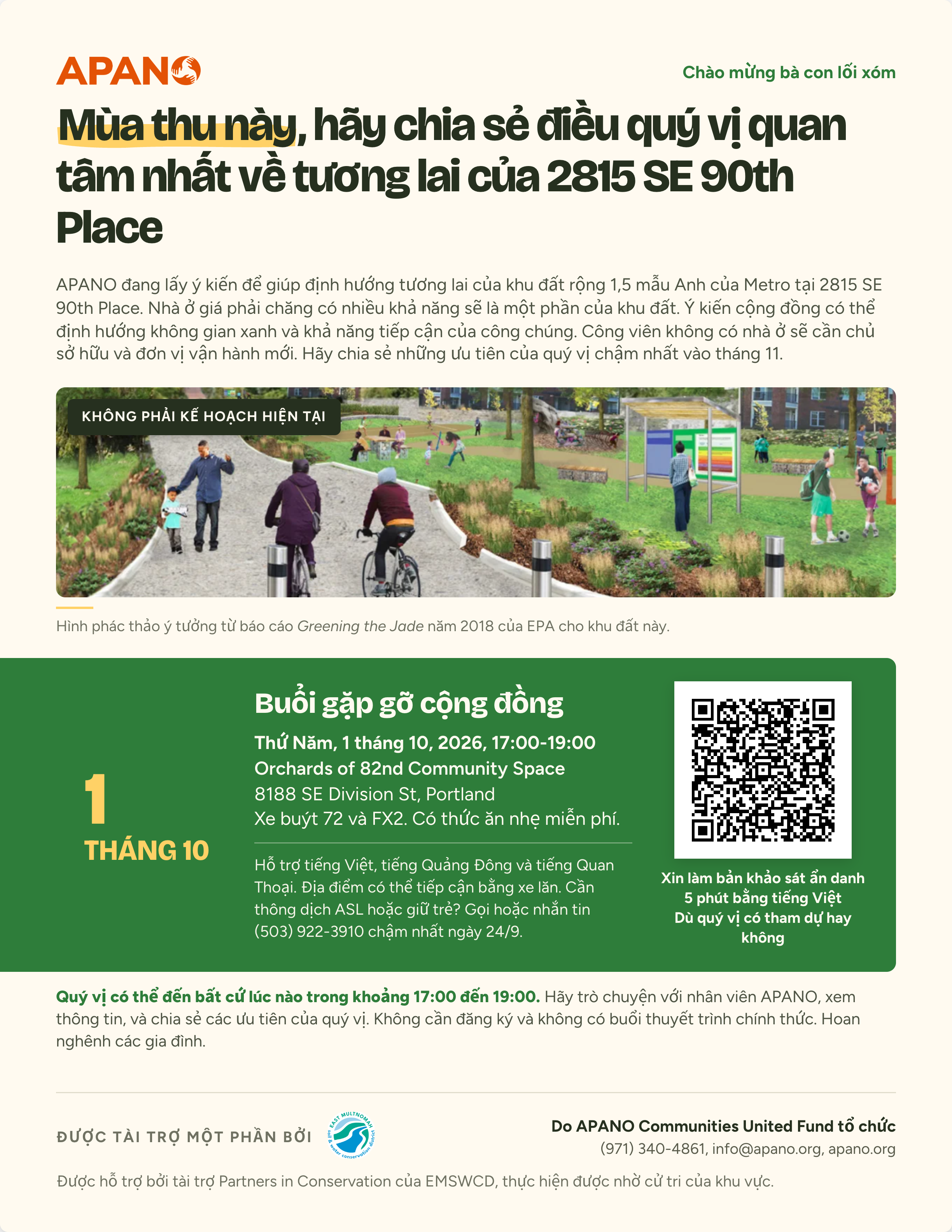
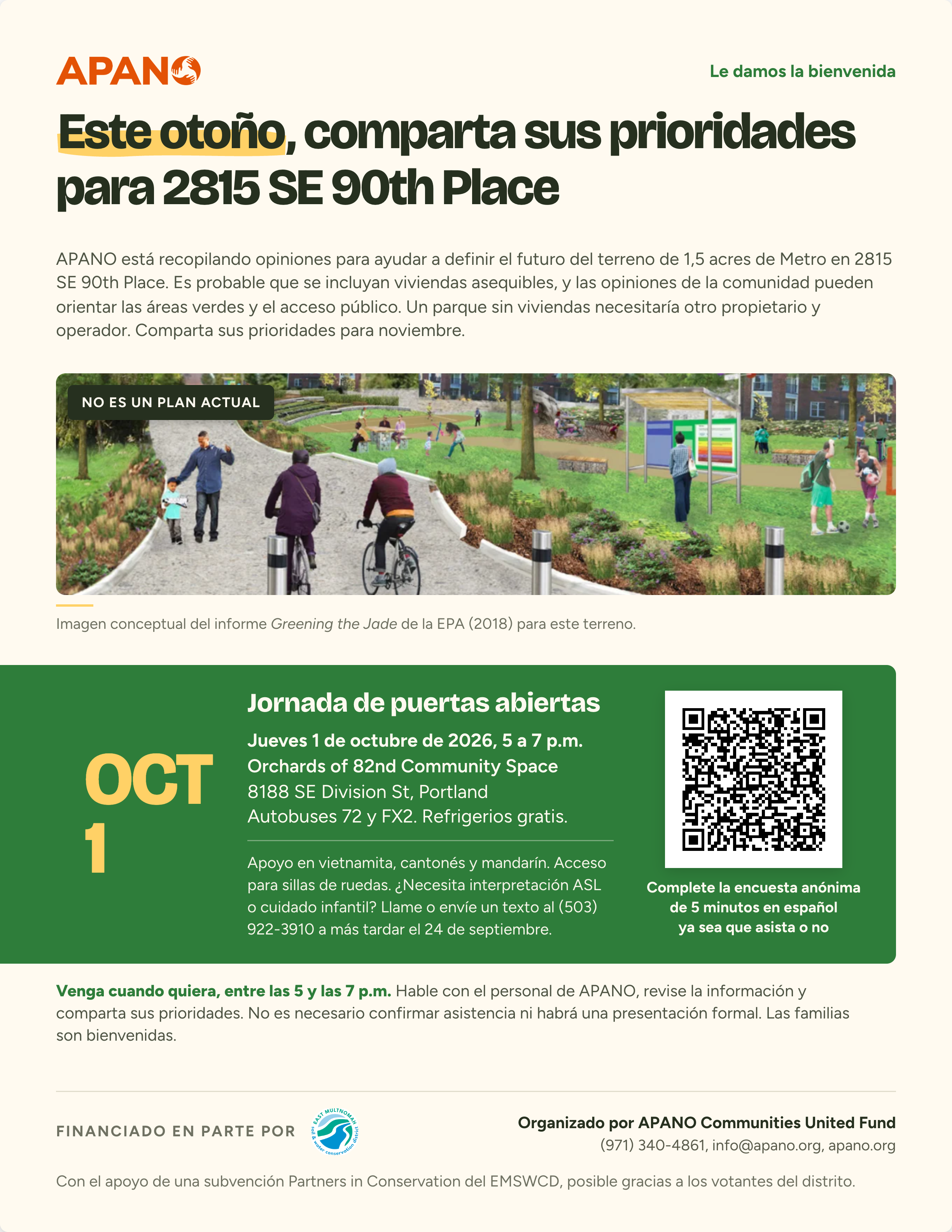
In July 2025, Oregon Metro purchased a 1.46-acre property at the intersection of SE 90th Place and SE 89th Avenue for planned Transit-Oriented Development (TOD). For over a decade, community advocates have envisioned the large, sloped property as a neighborhood park and are now seeking support for that project ahead of Metro’s RFP (Request for Proposals) this summer. Residents and interested parties can complete an Online Form to endorse a call for the City to purchase the lot from Metro and to direct Portland Parks and Recreation to create public green space for the expanding community in this area.

A vibrant community park scene featuring people riding bicycles, walking, and playing. In the background, families enjoy a picnic on the grass, while others engage in games. The landscape includes greenery, seating areas, and informational signage.
Park Rendering from the 2018 EPA Greening The Jade project document

Metro’s TOD team plans to introduce new affordable housing at the site with help from partner developers. The early concepts included open neighborhood greenspace, but not at the scale documented in the 2014 Jade District community visioning plan or the 2018 EPA Greening the Jade project. The community outreach recorded in those documents showed a desire and expressed need for green space across all groups in the neighborhood. The Metro-owned property at 2815 SE 90th Place is in the center of a community surrounded by busy city roadways, a State highway, and a freeway. Harrison Park is the closest park to this location, at over half a mile away, and often serves as an extension of the adjoining school’s campus rather than a neighborhood park.

A fenced lot with a grassy area and several structures, including a green shed and nearby houses, under a clear blue sky.
2815 SE 90th Place property with fence

Andrea Pastor, Metro’s Senior Development Project Manager of Housing and TOD, explained in a September 2025 interview that Metro purchased the land along SE 89th Avenue using an allocation provided by the Oregon State legislature for a revolving acquisition fund around 82nd Avenue. “With all of the improvements happening on 82nd, including the planning of the new transit, we wanted to prioritize the area. So we made a specific legislative ask back in 2023 for some funds to buy land near 82nd,” said Pastor. “We have been basically looking and making offers on properties in the area for the last couple of years.” She notes that Metro has often owned land around transit with the intention of developing it. “We are trying to think of ourselves as a regional land bank specifically aimed at building affordable housing near transit.”

A construction site featuring two multi-story buildings with yellow exteriors, in various stages of development. In the foreground, a red car is parked beside a fenced area containing construction materials and tools. A caution sign indicates a roadway that is not improved. The sky is cloudy.
The Jade apartments under construction

The Jade District advocacy organizers seeking support for the park say Metro TOD is willing to sell the parcel, but City of Portland support must be secured before Metro releases an RFP to potential developers in August or September 2026. The park space is across from The Jade apartments, which are currently under construction and will offer 15 units with family-sized accommodations, including three bedrooms and two bathrooms. The workforce housing development will also create 14 one-bedroom and 11 two-bedroom flats. The expanded pool of families on this street would benefit from a new city park with a safe crossing to a play area. The site can also amplify existing green space that is not publicly accessible but protected by Portland’s Bureau of Environmental Services, which owns the lot to the south of this property. It serves as a natural stormwater detention area where plants and soil help absorb the area’s rainwater. It also contains a sewer pump facility that requires 24-hour security for community safety and asset protection. Depending on the City’s flexibility, designers could extend park space into some of the stormwater detention area land without compromising security.

Map of a park featuring various amenities including an air quality monitoring installation, a terraced amphitheater, a multi-purpose paved pad, a nature play area, and a park loop trail. It also shows locations for public art installations and potential housing.
Image from the 2018 EPA Greening The Jade project document

Park designs and amenities presented in the visioning materials are illustrative only and do not constitute final design options. If the idea receives community support through the Online Form and city officials adopt the property for a new park, future community outreach from park planners will drive the development of the green space. Whether the land serves as a public park or affordable housing, this large, underdeveloped property will become a needed community resource as housing density brings more people into the Jade District.

Jacob Loeb Avatar

Article and photos by

VOA Oregon’s 130 Year Celebration Kicks Off Montavilla Campus Fundraising

On Thursday evening, March 12th, supporters and guests of Volunteers of America Oregon gathered near the Convention Center to celebrate the family safety, substance use treatment, behavioral health, and post-criminal justice system support organization’s 130 years in the state. After hearing from VOA Oregon’s current President and CEO, Maree Wacker, and Oregon Secretary of State Tobias Read about the benefits of a planned 5.67-acre campus at 8815 NE Glisan Street, attendees were asked to donate towards the facility’s construction and support the group’s other active programs.

Event banner showcasing '130 Years from Past to Possibility Community Changemakers' with a mountain and city skyline backdrop, dated March 12, 2026.
VOA Oregons’s Community Changemakers: From Past to Possibility event on March 12, 2026

Volunteers of America Oregon purchased the Montavilla-based property in 2021, which had previously served as a church. The organization’s President and CEO at the time, Kay Toran, was instrumental in selecting the NE Glisan and 90th Avenue property as a new campus and treatment center. Her quarter-century of leadership concluded when she retired in early 2025, with few updates on campus development plans during the nonprofit’s leadership transition. The new location should allow the organization to co-locate some of its programs in an East Portland site, creating new community resources and one-stop service delivery alongside centralized administrative functions.

Aerial view of a modern building complex featuring solar panels, surrounded by landscaped green areas and a parking lot with several cars.
Looking Northwest at future NE Glisan site. Rendering by Opsis Architecture provided courtesy VOA Oregon

In February 2024,area residents reviewed renderings of the proposed facility and learned about the phased buildout plans. Designers with Opsis Architecture arranged the proposed campus with external functions in buildings adjacent to NE Glisan Street and internal services in the site’s northwest half. The proposed VOA Oregon buildings will stand two stories tall along the site’s southern edge, rising to three levels as the land slopes downhill, maintaining a consistent scale along the frontage. Crews will reconstruct the existing parking lot, adding more trees and landscaping between the 92 stalls. Another cluster of lots along the property’s northern edge will provide an additional 54 on-site parking spaces. The early redevelopment will raze the 1950s-era church building and add frontage improvements along NE Glisan Street with significant work on NE 90th Avenue. Road Crews will reconstruct sections of NE 90th, adding sidewalks, street trees, and curbside parking spaces to the street’s western edge.

During the 2024 community outreach, Toran noted that the construction schedule is dependent on fundraising efforts. Since that time, VOA Oregon began using two buildings at Jessup University’s Multnomah Campus for its residential treatment for women with children. This partnership leverages surplus dormitory space at the faith-based higher education campus located at 8435 NE Glisan Street, just west of the future VOA Oregon site. Jessup University placed its 20-acre Multnomah campus on the market in 2025 and is still seeking a buyer for the entire property. Depending on which group purchases the university site and its redevelopment timeline, VOA Oregon staff may have a limited timeframe to relocate to the new property. Making this fundraising effort essential to maintaining long-term operations in the area.

A woman speaking at a podium during a community event, with a city skyline backdrop and attendees in the audience.
VOA Oregons’s President and CEO Maree Wacker speaking at the Community Changemakers: From Past to Possibility event on March 12, 2026

A successful fundraising effort should advance the timeline for work at the VOA Oregon’s NE Glisan Street Health and Family Services Campus. Maree Wacker explained to the Thursday night audience what they intended to create at their site and why people should support their efforts. “Located in Northeast Portland, our campus will become a regional hub for healing, recovery, health, and hope. It will include 100 residential treatment beds for individuals facing severe substance use disorder, co-occurring mental health conditions, and pregnant women with children. Integrated intensive outpatient services that help individuals coming from residential care and back into the community, serving over 15,000 people each year.” She went on to explain that their trained staff will offer recovery housing with outpatient services, including peer support from people who have lived experience redirecting their lives from addiction. The campus will include space for essential health care, along with support, to create mental and physical stability so program participants can succeed in finding housing, employment, and long-term success. The organization provides specific support for families, and the planned campus includes facilities for childcare, helping people stay connected to their parental role as they seek behavioral health services.

A speaker in a suit stands at a podium with a banner reading 'FROM PAST to POSSIBILITY.' The background features silhouettes of buildings and a bridge.
Oregon Secretary of State Tobias Read speaking at the Community Changemakers: From Past to Possibility event on March 12, 2026

Oregon Secretary of State Tobias Read followed up with a declaration that the proposed campus was “the kind of solution Oregon deserves. It’s a model that is integrated. It’s evidence-based. It’s place-based. And that vision becomes even more transformative when we recognize the power of placing services designed to care for people and families through some of the most difficult moments in their lives, all in one place.” Read continued to highlight the nonprofit’s campus design’s efficiency and effectiveness. “It’s not about convenience, it’s about connections, reducing duplication, simplifying access, and strengthening accountability. Above all, it is centering dignity and equity, ensuring that the people we’re serving are meeting a system that is designed around them.”

In both speakers’ descriptions of the planned site development, they highlighted the value of having a single location that serves the range of needs of people interested in improving their lives. “Imagine those 100 new residential treatment beds alongside outpatient services, alongside recovery housing, alongside family support. It’s not a collection of disconnected programs, but a true continuum of care, one that welcomes people at the turnstiles of crisis and walks with them through stabilization and healing and through long-term recovery,” exclaimed Read. “This campus is not merely a collection of buildings. In this case, it is a coordinated system. It’s not coordinating programs, but coordinating people, organized and designed around people.”

Collage of images depicting diverse groups and individuals receiving counseling and support from Volunteers of America Oregon, with text highlighting their treatment options.

“We are building a future where services are integrated, where isolation is replaced with connection, and where people now needing recovery encounter support instead of obstacles,” said Wacker. “This campus is more than buildings. It declares loudly and clearly, you belong here. No matter your past, hope lives here. A place that restores your dignity and gives you a chance to leave behind who you’ve been and finally become that person you always knew you could be.”

The VOA Oregon’s Health and Family Services Campus at 8815 NE Glisan Street is likely years away from opening. The nonprofit will continue seeking financial support for the multi-phase buildout. As of yet, there are no active demolition or construction permit applications listed for the property. However, remarks at this week’s fundraising event show the group is intent on continuing the work started under Kay Toran’s leadership and setting up roots in the Montavilla Neighborhood.

Jacob Loeb Avatar

Article and photos by

Disclosure: The author of this article received a complimentary meal at the Community Changemakers: From Past to Possibility event on March 12, 2026.


Want to see more Montavilla News in your Google search results? Us this link and mark the checkbox for the site to see those links higher in results.

Meals on Wheels People’s Eastside Hub

Across from Eastport Plaza, the Meals on Wheels People nonprofit is transforming a full block frontage at 4035 SE 82nd Avenue into an East Portland food distribution hub and resiliency center for a community that depends on their system for regular sustenance. The warehouse portion of the building already houses frozen and shelf-stable meals for the nonprofit’s programs on this side of the river. When construction is complete, this site will serve as a backup kitchen for their westside primary facilities, a resource center, a counter-service restaurant for program participants, and an event space.

The organization purchased the property in July 2021 with the intention of quickly expanding its delivery network, which distributes prepared meals to collection locations across the region where people come to eat in groups, or where volunteers collect and transport those meals to homebound elderly recipients. “We originally thought we could do this pretty quickly because the [existing] warehouse was added on in 2014. We could start with a warehouse because we weren’t moving any walls or anything, just installing our freezers and coolers in there. That took forever, so we then said, ‘Well, let’s do the whole deal,'” recalled Suzanne Washington, the Chief Executive Officer at Meals on Wheels People. They began work in phases, using the completed sections as crews renovate existing structures and then begin construction on new structures. “Phase one was that warehouse. Phase two is some offices and then part of the service area, as I call it,” explained Washington. Most of the building is single-story, but the area under construction will have two levels, an event space upstairs and the main floor hosting a kitchen, cafe area, hub for senior deliveries, and additional space they intend to lease to another service provider group that would benefit from being connected to Meals on Wheels People patrons.

Modern building exterior with a vibrant yellow accent, featuring large windows and a landscaped entrance, showcasing a welcoming atmosphere.
Rendering of expanded building on SE 82nd Avenue courtesy Meals on Wheels People

During the nonprofit’s phased buildout, the neighboring Eastport Food Center cart pod closed, with its owner moving out of Oregon. He listed the property at 3905 SE 82nd Avenue for sale, and Meals on Wheels People purchased it in August 2024 to support development logistics and provide future auxiliary vehicle storage space. “We own this lot across the street, which is right now our staging for construction, but it will become parking for the event space and the senior transportation vans,” said Washington. The main Eastside facility has a parking lot, but four stalls support Electric Vehicle (EV) charging for the growing fleet of battery-powered transportation used by Meals on Wheels People. The SE Center Street accessed parking lot dedicates a sizable amount of space to the “U” shaped driveway that will support the speedy loading of delivery vehicles. Having the expanded parking across the street allowed designers to focus on operational uses adjacent to the building. The large lot across the street also allows for the delivery and staging of produce directly to this location. “So fruits, vegetables, and supplementary food will be delivered here directly, so we don’t have to bring them from Multnomah Village. Multnomah Village is now only bringing those frozen meals,” Washington said.

Two electric vehicles parked at a charging station, one displaying a 'meals for kids' graphic and the other with a child-friendly design.

Reducing the amount of food transported is a key component of this expansion project. Although the established network had served the 55-year-old organization, leadership identified vulnerabilities and operational inefficiencies that this East Portland hub could address. A primary labor and cost savings would come from reducing the number of site-to-site transport trucks needed. “We will be able to get rid of a diesel truck and use our electric vehicles to deliver to Gresham, MLK, and all the places on the east side,” explained Washington. “Right now, a big diesel truck, which costs us $8,000 a month, goes to 20 different sites. We can be better for the environment and get rid of it.” The organization received a PGE Drive Change Fund grant for a second EV to replace a diesel medium-duty delivery truck with an electric delivery truck and to install charging infrastructure.

A warehouse filled with stacked pallets of boxed items wrapped in plastic, organized on shelving units with colorful labels.

Another key concept in building along 82nd Avenue is based on maintaining operations when a disaster or weather prevents cross-town traffic. “The goal was to get a hub for emergencies on this side of the river. Our central kitchen right now is in Multnomah Village, and that’s where we make every meal fresh daily. We cook, flash-freeze, and then package anywhere from 6,500 to 8,000 meals a day. All the home deliveries are frozen [with volunteers] dropping them off for a whole week.” In the event of road network disruption, demand for food from program participants increases, and the ability to continue operations will be a critical lifeline for elderly people trapped at home. The kitchen at this new site will primarily serve people walking in for meals, but it has the capacity to prepare 2,000 meals a day in times of emergencies. It also has substantial freezer space for storing food. “The warehouse freezer right now has 45,000 frozen meals in it,” said Washington. They circulate the stockpile every day to deliveries in East Portland, but keep a reserve for emergencies. They also keep another 20,000 shelf-stable meals that can further bolster food delivery capabilities in situations where not everyone may have access to power to store and cook deliveries. The building is served by dual-fuel generators to keep the facility operational even if the power grid is down, and contractors will install solar panels on the roof, further ensuring the building remains powered and reduces its daily dependence on utility power.

Modern restaurant exterior featuring a bright yellow roof and outdoor seating area with plants, surrounded by greenery and people walking by.
Rendering of expanded building on SE 82nd Avenue courtesy Meals on Wheels People
Construction site of a building with a partially completed structure, featuring metal framing and wooden scaffolding. A mural is visible on one side of the building, and the site is enclosed by construction fencing.

Suzanne Washington and others led the drive to buy this property because the organization is relying on leased space east of the river, and making this level of investment in someone else’s property would not have been a good use of resources. Additionally, the current locations are too small for the storage needs provided by the 82nd Avenue building. However, this new space will not immediately replace any existing site as the nonprofit needs those locations to continue serving its primary function. “We’ll keep those sites because people can only go so far. We do two things. For older traditional adults, we do home-delivered meals, and then we do congregate dining, where, if they can, we get them out of their homes to eat with other people. It’s much better for their health,” Washington said. “We still want to provide that service where they can come in and eat.”

Construction site featuring a partially completed structure with wooden framing and metal beams under a cloudy sky.

Similar to other locations, the SE 82nd Avenue building is designed to bring people in to eat, but with more flexible hours and the ability to order something prepared to the individual’s tastes. “When somebody comes in for a meal here, first of all, they can come in at 8 o’clock and get a breakfast burrito; it doesn’t have to be lunch. They can eat at 3 o’clock in the afternoon, they order at the counter, and then we’ll bring it to them,” remarked Washington. “So we can serve the diversity of folks out here with their ethnic cultural needs and not your traditional lunch where you get one of two choices, and that’s it, because we control this space.” She describes it as similar to a Chipotle restaurant, where a person can customize flavors and mix and match base ingredients, all prepared fresh on site.

A modern classroom with a glass wall, showing a technology workshop in progress. Participants sit at tables with laptops, while a presenter stands in front of a screen displaying 'Technology Tips for Seniors'. Several older adults are engaged in the lesson, with some listening attentively and others interacting. In the foreground, two seniors are seated at a table, enjoying beverages.
Rendering of tech hub courtesy Meals on Wheels People

Guests can stop in at this location on their schedule, but they must become program participants and are limited to one meal per day. “It’s not meant to open to the street, especially right on this street,” said Washington. “We had a place downtown that we closed because most of the older people wouldn’t come because we had so many homeless folks.” Meals on Wheels People’s primary mission is serving older adults 60 and over. Washington explained that about 30 percent of the organization’s funding comes from the federal government through the 1965 Older Americans Act. “That comes with requirements like we have to have certain dietary guidelines and we have to ask for donations [from recipients], but there’s no coercion for that donation.”

A storage area showcasing multiple shelves filled with colorful bags featuring palm tree designs, alongside stacked black crates.

Although serving older adults is what most people associate with the Meals on Wheels brand, through other funding systems, they also help alleviate food insecurity among youth and their families. The Meals 4 Kids program serves families with at least one child under 18. “Last year, we served over 275 people within those families. We provided more than 300,000 meals,” said Washington. In this program, families receive frozen meals with supplemental foods like bread, milk, and fruit, or they can get the raw ingredients and cook them themselves. The program is based out of the SE 82nd Avenue facility and primarily serves East Portland residents. “The great thing about that program is that over 70% get the raw food and then they’re home with kids cooking, doing homework, that kind of thing. Not trying to haul somebody around on the bus or trying to figure out how to make a meal out of a school backpack,” remarked Washington. They have other dietary assistance initiatives, including one that delivers medically tailored grocery boxes to pregnant and newly lactating women.

A modern communal dining area with various people socializing, including an elderly man reading a newspaper, a woman with a child, and a server wearing an apron. The space features wooden accents and plants, creating a warm and inviting atmosphere.
Rendering of dining area courtesy Meals on Wheels People
Interior view of an under-construction room showing exposed beams, framed walls, and construction materials scattered on the floor.

Food is at this organization’s core, but this new location will help Meals on Wheels People further expand services beyond feeding people by offering a tech hub and community space within an environment where people can eat healthily alongside their peers and stay to discover other opportunities and services to enrich their lives. This project represents a significant milestone for Meals on Wheels People. Suzanne Washington has spent over a decade strengthening the organization. “They didn’t have enough money when I started. They were always in the hole. I focused on three things while I’ve been here. To do the best service possible to those we serve, we’ve got to support our staff the best way possible. To do that, we need resources, money. So by focusing on those three things, [service, staff, and resources], we’ve gotten more efficient, where we can put more money into the quality of our food and the type of food. We support our staff, I think, much more than we did when I got here for benefits, wages, just everyday support,” said Washington. She believes the new property allows the organization to significantly update its operational infrastructure, ultimately saving on recurring costs by lowering transportation expenses and better utilizing people’s time.

Halbert Construction Services will continue working on the project through November. Several delays with permitting and supply-chain disruptions have already pushed back the completion date, but Meals on Wheels People anticipates completion this Fall season.

Correction: Fixed a typo in Eastport Plaza’s name that misidentified it.


Promotion: Check out East Portland News as it continues to advocate for and report on outer East Portland. You will find frequently updated articles and an archive of more than 5,000 stories written over the past 20+ years alongside a robust Community Calendar of events.

Harrison Community Village Shelter Public Meeting Feb 26

As the Multnomah County Homeless Services Department (HSD) readies the Harrison Community Village Shelter at 1818 SE 82nd Avenue for future residents, they invite people to attend a Public Meeting on February 26th. Nonprofit provider Do Good Multnomah will operate the alternative shelter under a “clean and sober” model. Interested community members can attend the 6:30 p.m. in-person event this Thursday. Portland Community College will host the meeting in its Community Hall Annex at 7901 SE Division Street.

Shelter operators anticipate opening the facility in spring 2026 and have worked on a Good Neighbor Agreement with community and business stakeholders to lessen the impact of the Harrison Community Village Shelter on surrounding properties. Multnomah County purchased the former recreational vehicle dealership at 1818 SE 82nd Avenue in December 2022 for $2.015 million. This 34,000-square-foot parcel was the second Montavilla location the County bought that year for temporary shelter services. The other shelter, Oak Street Village at 333 SE 82nd Avenue, opened in February 2025 and is currently operating at full capacity. The Joint Office of Homeless Services — now renamed the Homeless Services Department — has held several community meetings, including one in April that announced that Do Good Multnomah would operate the site as a sober shelter. Presenters explained that residents and staff are subject to drug testing, and policy strictly prohibits the possession of non-prescribed intoxicants on the property. Selecting a sober format meets a specific need for people transitioning into stable housing who are in recovery from substance use disorder, and it better matches community desires for the site, which is near two Portland Public Schools.

HSD will contract with the operator to staff the alternative shelter site at all hours of the day. The adult residents will receive one of 38 private sleeping quarters, each with a shed-style pod design. Six converted shipping container units will provide office space for staff, participant services, hygiene facilities, kitchenette amenities, and laundry facilities. Residents and their pets will have on-site access to green space. The site will receive upgraded fencing with privacy inserts on all street sides and a wood fence between the adjacent residential property to the east. The site intends to offer more than short-term shelter. People in the program will have access to dedicated housing case management and abstinence-based recovery services to help with long-term substance use recovery and housing stability.

The HSD meeting organizers ask that people complete an online form at the Harrison Community Village Shelter website to attend the 90-minute public meeting on February 26th. Attendees can also review the draft Good Neighbor Agreement prior to the meeting to better understand the work created by the Agreement Parties, which include representatives from the 82nd Avenue Business Association, African Youth & Community Organization, APANO, Montavilla Neighborhood Association, Portland Community College, and Portland Public Schools.


Promotion: Montavilla News is supported by contributions from businesses like Otter Wax, a neighborhood producer of small-batch specialty goods handcrafted in Portland. Using only natural ingredients, they make modern care products that are steeped in tradition. We thank them for their support.

Rosa Parks Birthday Free Transit Feb 4

TriMet will honor Rosa Parks with free rides for all passengers this Wednesday, February 4th. Transit operators will suspend fare collection on that day until 2 a.m. February 5th. Portland Streetcar and C-TRAN operators will also offer rides without cost in observation of the civil rights icon’s 113th birthday. Riders who tap a Hop card or ticket will receive confirmation of valid fare, but the automated systems won’t charge them, and ticket machines will not allow any ticket purchases on February 4th.

In 2020, TriMet’s District 5 Director Keith Edwards proposed the resolution declaring Parks’ birthday as a day of remembrance across the public transportation system. That year, TriMet adopted the fare holiday across the 533-square-mile service district to recognize Parks’ contribution to the Civil Rights Movement. 2026 is the sixth straight year TriMet has commemorated the bravery of Parks, whose name is most notably associated with the struggle to bring equity to public transportation as part of a wider racial equality movement.

Graphic honoring Rosa Parks with her silhouette, text stating 'RIDE FREE' and 'Feb 4 Celebrating Rosa Parks' birthday'.
Graphic courtesy TriMet

On December 1st, 1955, Rosa Parks challenged Montgomery, Alabama’s segregationist city ordinance that required black Americans to give up seats in the “Colored” section of the bus for white riders when the reserved white section ran out of seats. Parks’ refusal of the bus driver’s commands to give up her seat resulted in her arrest. Her act of civil disobedience led to the year-long Montgomery bus boycott and a significant court decision that found bus segregation unconstitutional under the Equal Protection Clause of the 14th Amendment to the U.S. Constitution. Parks suffered years of harassment for her role as a public face of the Civil Rights movement. Still, history has quickly recognized her contributions to equality through that 1955 peaceful act of defiance, and her later work, which has had a lasting impact on America’s ongoing effort to repair its racial inequities.

Drones not Fireworks this New Years

Despite the damp winter conditions, the use of personal fireworks remains illegal in Portland, as it has since the City Council passed an ordinance in March 2022. This New Year’s Eve, Portland Fire and Rescue (PF&R) and the Portland Bureau of Emergency Communications (BOEC) ask everyone within city limits to obey the ban and report violators through an online form instead of 9-1-1. As an alternative, people can attend a free New Year’s illuminated Eve Drone Show at Pioneer Courthouse Square.

Three years ago, the Portland City Council passed a consumer fireworks prohibition unanimously, in part due to a fatal fireworks fire the previous year and in reaction to the Eagle Creek Fire in the gorge, which started with the use of personal fireworks. Fire departments regularly experience a spike in injuries, fires, and fatalities during the fireworks season, which runs from June 23rd through July 6th. To a smaller degree, New Year’s Eve celebrations can replicate those mid-summer problems. People with pets also report significant stress inflicted on their animals due to fireworks, with some dogs and cats becoming separated from their owners when they run away from the explosive sounds. However, calling emergency services for fireworks use alone can overload the system, impacting firefighting and injury response times.

Colorful fireworks exploding against a dark night sky.

To limit the impact on BOEC staff answering 9-1-1 calls, the city launched a reporting form at portland.gov/fireworks in July 2025. The form collects information about fireworks use to assist officials in identifying hotspots and later to support public education about Portland’s fireworks ban. People can use the same form this New Year’s Eve or call 3-1-1. Non-English-speaking Portlanders can request a bilingual speaker to join the call for assistance. The City reports that increased staffing, public education, and the reporting form reduced 9-1-1 calls by 13 percent during the 2025 July 4th holiday, improving public safety response times by allowing dispatchers to focus on emergency calls. Additionally, the average wait time that day was 8 seconds, down from 26 seconds in 2024 and 70 seconds in 2023.

To help Portlanders celebrate responsibly, the City will provide two free New Year’s Eve illuminated Drone Shows downtown at Pioneer Courthouse Square. Activities start at 8 p.m. December 31st with a “Video Dance Attack Party.” Then, at 9 p.m., people who don’t want to stay out late can view a family-friendly drone show. For those wanting an official countdown, the second drone show starts just before midnight. Food and beverage vendors will sell refreshments throughout the event, which concludes at 12:30 a.m. on January 1st, 2026. Planners encouraged attendees to take TriMet to the event and to stay safe as they head into 2026.


Promotion: Montavilla News is supported by contributions from businesses like Greg Beddor – SEO Specialist, an Oregon based digital marketing consultancy. The company markets customer’s websites and provide SEO services to grow their business. We thank them for their support.

City-Sponsored Sidewalk Cleaning Along Business Corridors

Cleanup crews from Central City Concern (CCC) began providing basic sidewalk cleaning services in Montavilla’s major business corridors in October. The Public Environment Management Office (PEMO), part of Portland Solutions, contracted with the employment opportunity program operator to improve conditions around neighborhood economic centers, aiming to create safer, more welcoming spaces. The rollout’s timing coincides with the critical holiday shopping season when small businesses depend on customers coming out to local storefronts and shopping within the community.

A cleanup crew member in a bright yellow jacket pushes a trash can along NE 82nd Avenue, with a large sign advertising 'FREE VACUUM AFTER WASH' in the background, indicating a car wash service.
CCC crew member Victor Leon collecting litter from NE 82nd Ave and Glisan St

In November alone, CCC Crew 3 removed 8,820 pounds of trash from City sidewalks in Montavilla and parts of East Portland. Cleanup crews work on a fixed schedule determined by need and resources, using trikes in areas closer to the city center and logoed trucks farther out in areas with larger volumes of trash. With this new program, contractors visit Portland’s busiest locations to clean up trash and biohazards from sidewalks on a weekly, bi-monthly, or quarterly cadence, depending on conditions in the area, and adjust their schedule based on demand. In the Montavilla area, workers will maintain SE Stark Street from 76th to 82nd Avenues, 82nd Avenue from SE Stark Street to NE Pacific Street, and NE Glisan Street from 81st to 84th Avenues. Crews will also maintain a well-used route to school along NE 82nd Avenue from NE Thompson Street to NE Klickitat Street.

A Central City Concern truck labeled 'Portland Solutions' parked with bags of trash, a broom, and other cleaning equipment visible in the back.
CCC and Portland Solutions logoed truck already half full of removed trash

In addition to CCC, PEMO contracts with Cultivate Initiatives in areas further east of 82nd Avenue. The citywide program focuses on spaces where people walk to school, work, shop, and enjoy neighborhood amenities. Cleaning crews sweep sidewalks, pick up litter, clean biohazards, and pressure wash outdoor surfaces when needed. The staff will also remove graffiti from city-owned street elements, including bike racks, utility meters, and trashcans. In addition to improving conditions on impacted streets, the funds support homeless-to-work employment programs that provide opportunities for people seeking pathways to stability and long-term employment.

A crew member from Central City Concern wearing a bright yellow hoodie and blue gloves is cleaning up trash along a sidewalk, using a tool to pick up litter.
CCC crew member Charlie Smelser collecting litter from NE 82nd Ave by Montavilla Park

CCC crew member Charlie Smelser explained that his group parks the truck at a central location within the assigned areas, then the three to four-person crew fans out with rolling trash cans to collect any improperly discarded items from public spaces. He noted that they also check the condition of city-owned trash cans to ensure people have functional options for disposing of trash.

PEMO’s expanded efforts built upon a 2024 collaboration in the Gateway Service District, with the City developing the concept and managing contracts. A three-year partnership between the City of Portland, Multnomah County, and TriMet funds the work in Gateway, with each partner contributing $100,000 a year for its initial duration. Primary funding for the augmented cleanup area, including Montavilla, comes from PEMO’s $1.7 million annual budget allocation by the Portland City Council.

A cleanup crew member wearing a bright yellow 'CLEAN START' hoodie pushes a trash bin on a sidewalk in an urban area, with a traffic light and street signs visible in the background, as a person stands nearby.
CCC crew member Charlie Smelser crossing NE 82nd Ave at NE Glisan St

Collecting litter is an endless cycle, but without regular cleanings, well-traveled locations show signs of neglect. This city service can help keep visible areas of Portland cleaner and more welcoming, while supporting small businesses that often lack time and funds to clean the public spaces. Funding for this expanded cleanup depends on Portland Solutions’ budget and support. However, its perceived success could encourage the adoption of a sidewalk cleaning program as a permanent City service, much as a Jade district trial program led to the 2020 expansion of public trash cans across Portland. People can expect to see cleanup crews in the City’s business districts performing basic sidewalk cleaning into 2026 as the program continues to develop.


Promotion: Montavilla News is supported by contributions from businesses like Otter Wax, a neighborhood producer of small-batch specialty goods handcrafted in Portland. Using only natural ingredients, they make modern care products that are steeped in tradition. We thank them for their support.