This week, crews with the Portland Bureau of Transportation (PBOT) will continue road work that began on August 19 along NE Glisan Street between NE 82nd and NE 92nd avenues. Drivers in the area are encountering new traffic patterns and slower speeds as re-striping teams add painted bike lanes on completed segments of the project site and new signage arrives from NE 81st to NE 92nd Avenues. Workers have not restored all lane markings to the repaved half of the project site closest to NE 82nd Street. Road users should use extra caution until work is completed and anticipate delays during the 7 a.m. to 6 p.m., Monday through Thursday work schedule.
New eastbound bike lane segment started on NE Glisan St near NE 83rd Ave (Jacob Loeb)
This Fixing Our Streets-funded project included substantial updates to sidewalk corner curb ramps, bringing crossings in this area up to Americans with Disabilities Act (ADA)- compliant standards. In addition to creating a smoother driving surface for vehicles, this new phase of work will reconfigure the street to remove time-shifting outer lanes used for parking or as an auxiliary travel lane. Collisions occurred on this street where motorists parked cars during allotted times, but drivers may have assumed the outer lane was clear. PBOT engineers anticipate that removing that conflict point will yield significant safety improvements with minimal impact on vehicle throughput.
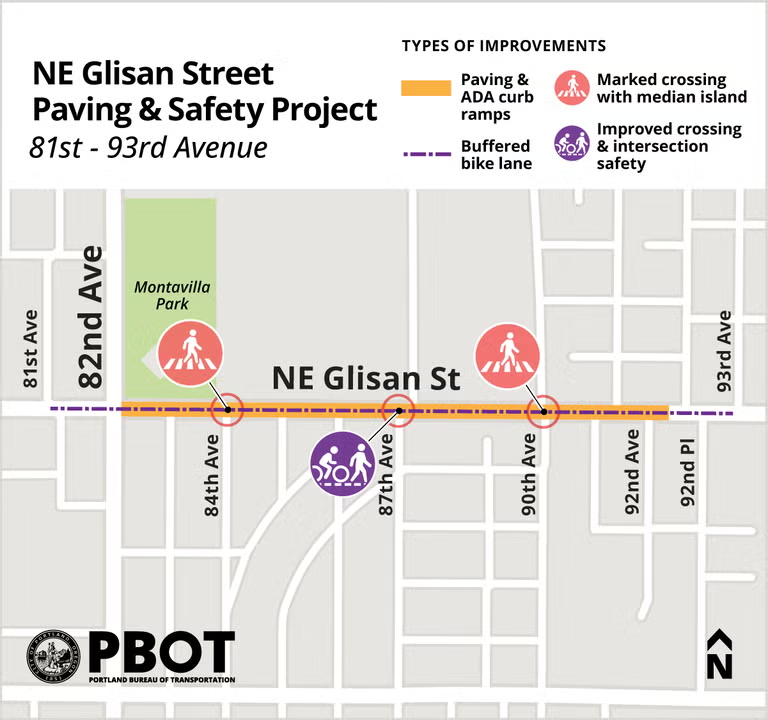
The new NE Glisan bike lanes will connect NE 81st Avenue and NE 93rd Avenue. Early concepts for the cycling infrastructure showed the bike lane extending west to NE 80th. However, area business concerns over losing frequently used street parking on that block prompted a design that still helps connect side-street bike routes for people crossing NE 82nd Avenue outside a car, while minimizing impacts to adjacent commercial property users. PBOT planners anticipate further improving the bike infrastructure in 2030 with hardscape concrete dividers and flex posts to protect cyclists riding next to cars. The reconfiguration is happening during this repaving project to save money. Otherwise, contractors would need to grind off existing street markers and repaint as part of the 2030 work.
NE Glisan St existing crossing at NE 87th Ave that crews will upgrade
NE Glisan Street, from Interstate 205 to 82nd Avenue, is a notoriously challenging roadway to cross with vehicles driving quickly between the two points. Without any fully signalized intersections on this stretch and with a large hill blocking visibility, it can take an extended period to find a safe break in traffic to cross. Crews working with PBOT will install two new pedestrian crossings with concrete median islands at NE 84th and 90th avenues, along with enhancements to an existing crossing at NE 87th Avenue. These in-roadway waypoints allow pedestrians to cross in two phases, focusing on one direction of traffic at a time, and help drivers better see a person waiting at the high-visibility infrastructure.
In the coming days, crews will grind down the eastern segment of the roadway and lay a fresh road surface. Cyclists should consider safer routes until NE Glisan is fully re-striped, and all street users should plan extra travel time as people adjust to the new configuration and speed limits on this segment of NE Glisan.
Article and photos by
Jacob Loeb
Promotion: Montavilla News is supported by contributions from businesses like Catalyst Construction & Kitchen Remodeling, a top-rated general contractor specializing in kitchen, bathroom, basement, and garage remodeling, as well as ADU construction and home additions. We thank them for their support.
Road crews will begin repaving NE Glisan Street between NE 82nd and NE 92nd avenues on Wednesday, August 19th. The approximately two-lane-miles of resurfacing work will take an estimated twelve business days to complete as heavy equipment grinds off the damaged top layer of asphalt and lays down a fresh mixture of crushed stone and bitumen. The Portland Bureau of Transportation’s (PBOT) re-striping plans will create a paint-buffered bike lane next to a single travel lane in each direction and recreate the center turn lane. Cement masons will add two new pedestrian crossing islands along the busy High Crash Street, with an existing crossing at NE 87th Avenue updated to prevent some left turns while better protecting pedestrians and cyclists.
Existing RRFB on NE Glisan St at 87th Ave
This Fixing Our Streets-funded project included substantial updates to sidewalk corner curb ramps, bringing crossings in this area up to Americans with Disabilities Act (ADA)- compliant standards. Starting in May, Crews working with Portland’s Bureau of Environmental Services (BES) installed modern stormwater management sump drains under NE Glisan Street at the intersections of NE 91st and 92nd Avenues. In addition to creating a smoother driving surface for vehicles, this new phase of work will reconfigure the street to remove time-shifting outer lanes used for parking or as an auxiliary travel lane. Collisions occurred on this street where motorists parked cars during allotted times, but drivers may have assumed the outer lane was clear. PBOT engineers anticipate that removing that conflict point will yield significant safety improvements with minimal impact on vehicle throughput.
Project map courtesy PBOT
The new NE Glisan bike lanes will add a connection between NE 81st Avenue and NE 93rd Avenue. Early concepts for the cycling infrastructure showed the bike lane extending west to NE 80th. However, area business concerns over losing frequently used street parking on that block prompted a design that still helps people riding outside a car cross NE 82nd Avenue to meet up with side-street bike routes while minimizing impacts to adjacent commercial property users. PBOT planners anticipate further improving the bike infrastructure in 2030 with hardscape concrete dividers and flex posts to protect cyclists riding next to cars. The reconfiguration is happening during this repaving project to save money. Otherwise, contractors would need to grind off existing street markers and repaint as part of the 2030 work.
NE Glisan Paving and Safety Project 30% Design Concept illustration of NE 84th Ave. Courtesy PBOT
NE Glisan Street, from Interstate 205 to 82nd Avenue, is a notoriously challenging roadway to cross with vehicles driving quickly between the two points. Without any fully signalized intersections on this stretch and with a large hill blocking visibility, it can take an extended period to find a safe break in traffic to cross. In 2021, PBOT lowered the speed limit to 30 mph, but that still did not significantly improve crossing safety for people inside or outside a vehicle. The two new pedestrian crossings with concrete median islands at NE 84th and 90th avenues should help pedestrians cross in two phases, where they can focus on one direction of traffic at a time, and drivers can better see a person waiting at the high-visibility infrastructure.
NE Glisan Paving and Safety Project 30% Design Concept illustration of NE 90th Ave. Courtesy PBOT
The NE 87th Avenue crossing already features street-adjacent buttons that activate Rectangular Rapid Flashing Beacons (RRFB) to signal to drivers that bikes or pedestrians will cross soon. The updates will extend an existing concrete median island east with cutouts for cyclists crossing. This extended mid-street infrastructure will prevent northbound and westbound drivers from turning left at this intersection.
Updated median at NE 87th Ave with left turns prohibited for north and west automotive travel. Courtesy PBOT
PBOT notes that paving and painting work is weather-dependent, so that project work dates may change. Drivers can expect rougher roads during the grinding and resurfacing process and should anticipate traffic delays with detours from 6 a.m. to 5 p.m. weekdays, with some weekend work. Parking on NE Glisan in the project area will end a few days before work begins, but pedestrian access will remain open. Anyone traveling through the worksite should follow all traffic control signs and flaggers and use heightened caution.
Article and photos by
Jacob Loeb
Promotion: Montavilla News is supported by contributions from businesses like Otter Wax, a neighborhood producer of small-batch specialty goods handcrafted in Portland. Using only natural ingredients, they make modern care products that are steeped in tradition. We thank them for their support.
Doing laundry using a machine washer. Source: Delineator magazine, July, 1927
In the early 20th century, Monday was typically washday for American housewives. It was an all-day affair, even if you were one of the few who owned a powered washing machine. Home laundry required multiple steps: rubbing each item with soap, soaking it in hot water, wringing it out, and finally hanging it to dry. Even if you had one of the new-fangled powered washing machines—like the one shown above—this still required multiple steps, eleven according to an article in the Delineator Magazine of July 1927. No wonder washday was often called blue Monday.
For those who could afford it, a local laundry service would do the work for you. Some even had pick-up and delivery service.
Commercial laundry with delivery Source: Ad for Soapalite in the National Laundry Journal, December, 1920
By 1906, housewives had the option of doing laundry at home. At that time, Stevens’ Fancy Grocery on Base Line Road (now Stark Street) was a pickup point for City Laundry located in downtown Portland.
Stevens’ Fancy Grocery ad in the Beaver State Herald of November 30, 1906 Source: Historic Oregon Newspapers.
A few years later, the Acme laundry on Burnside—a little west of Montavilla—offered delivery service for Montavilla customers on Mondays, Tuesdays, and Wednesdays. This was a wet-wash laundry, that is, a commercial laundry that washed your clothes and sent them back damp for you to dry and iron at home.
Ad for the Acme Washery in The Montavilla Sun of June 4, 1915
A purpose-built laundry in Montavilla proper may have appeared in 1910. According to the Oregonian of October 16, 1910, a group of men had purchased a site on East 80th and had already ordered machinery for a future plant. Unfortunately, I could not find information about whether this laundry was actually built or, if so, how long it was in business.
Whether or not a laundry on 80th Avenue materialized in 1910, we know for sure one was built in Montavillain 1925 for John Charles Fremont Brown (1856-1938). It was located on Glisan at 72nd Avenue. The building still exists, most recently housing O’Neill’s Tools.
John C. F. Brown was not new to the laundry trade. He had worked in the laundry business as a deliveryman from at least 1898 until 1920. He worked for two established downtown Portland laundries: Model Laundry and Palace Laundry. He owned his own delivery vehicle, exchanging his horse-drawn wagon for a motorized truck in 1912.
John C. F. Brown in front of his motorized vehicle around 1912
In 1920, Brown opened his own laundry business at 305 Russell Street between Williams and Rodney Avenues. Three of his sons—Floyd P. Brown (1886-1952), Frank Clair Brown (1895-1945), and Oscar L. Brown (1890-1973)—also worked in this business.
John Brown typically went by John C. F. Brown or J. C. F. Brown, perhaps to avoid confusion with C. F. Brown, who owned the Yale Laundry in downtown Portland.
This 1924 Sanborn map shows the location of Brown’s laundry at 305 Russell Street. The building no longer exists.
The Sanborn map describes Brown’s business as a wet-wash laundry. But Portland city directories list both Brown’s Wet Wash Laundry and Brown’s Towel Supply at this address.
As indicated earlier, a wet-wash laundry offered only washing services. A towel laundry, on the other hand, provided clean “linens” for businesses such as hotels, hospitals, restaurants, and gyms. A towel laundry delivered clean items and picked up the soiled ones for washing and pressing. To make sure soiled items returned matched the number previously delivered, the deliveryman had to keep an accurate count. In 1923, John’s son Frank noticed a shortage in the number of dirty items he was picking up from a surgeon’s office. When Frank mentioned this, the client punched him in the eye. Frank took him to court, where the surgeon was found guilty and fined $50.
In 1925, Brown’s towel service remained on Russell Street, but he moved his wet-wash business into a new building in Montavilla. It was located on the north side of Glisan at NE 72nd. With this new location, the corporate name for the business changed from Brown’s Damp Wash Laundry to The General Laundry Company. It was ready for occupancy sometime after the final plumbing inspection on June 16, 1925.
Photo of a damp-wash laundry–not Brown’s—showing the use of powered washing machines. Source: January 19, 1920 edition of the National Laundry and Cleaning Journal
The new laundry was built of brick—a wise choice, since the boilers posed a fire risk. Brown and his sons were probably aware of the fire that almost destroyed the Consolidated Wet Wash Laundry on Halsey Street, caused by an overheated boiler. The wood-frame building was almost completely destroyed.
Like most general laundries, Brown’s probably employed mostly women. The work was hard, and wages were typically low. At a wet-wash laundry, items were marked, sorted, washed, and wrung out. By 1917, a woman’s workday was limited to eight hours, but it still meant a lot of standing on concrete floors in a very hot, humid environment. Housewives may have been relieved of the washday blues, but laundry workers experienced them every day.
In October 1919, Portland laundresses went on strike, demanding better pay. Sometimes they were the sole support for their families, according to Portland’s Labor Press. Several sworn testimonials by the striking women describing their circumstances were published in that newspaper’s October 18, 1919, edition. Here is one example:
Testimonial by Lettie Stinson published in the Labor Press of October 18, 1919
Whether labor conditions at Brown’s laundry were better or worse is unknown. But he undoubtedly expected his business to succeed. He could afford a new building in Montavilla, so presumably the Russell Street laundry was doing well. The American laundry industry was growing rapidly in the 1920s, reflecting a growing demand and increased receipts.
Detail of a chart showing growth of the American power laundry industry in dollars between 1909 and 1929. Source: Joan S. Wang, “Race, Gender, and Laundry Work: The Roles of Chinese Laundrymen and American Women in the United States, 1850-1950,” Journal of American Ethnic History, 2004
Despite hopeful prospects, Brown’s Glisan-Street business failed. In December 1927, the General Laundry Company declared bankruptcy. Why this business failed is unknown. It was almost two years before the stock market crash of October 28, 1929. Whatever the cause, the plant equipment, supplies, and real property were auctioned on January 17, 1928.
Bankruptcy auction for the General Laundry Company. Oregonian, January 17, 1928
Although the Glisan-Street business did not succeed, Brown’s Towel Service survived for many years. It was still in business in 1943, operating at a new location on East Flanders Street.
Ad in the Northwest Journal of Dentistry, December, 1931
While the Brown family’s towel service lasted into the 1940s, many commercial laundry services declined during the Depression. Fewer families could afford this service. After World War II, home washers and dryers became more affordable, reducing the need for laundry services. If you could not afford your own equipment, you could find washers and dryers for personal use in laundromats, which became increasingly popular in the 1950s.
O’Neill’s Tool and Equipment company in the 1925 building
What happened to Brown’s building in Montavilla? After the laundry closed in 1927, Leonard Betz (1897-1957) purchased the building and opened his Fancy Dry Cleaners in June, 1932. The most recent occupant of Brown’s brick building was O’Neill’s Tools & Equipment store. In 2024, the building was sold for $1,010,000 to Tool Building, LLC.
Rendering of a remodeled version of the original Brown laundry building. Courtesy of Bill Neburka EAO
Soon, the historic building will have a new look, a new purpose, and a new life. The BAM collective is currently transforming it into a modern space to house several local businesses.
By
Patricia Sanders
This is part of Montavilla History Questions Answered, a series of history related articles. If you have questions about Montavilla’s past that you’d like answered, local historian Patricia Sanders will investigate your question. Please email your questions to history@montavilla.net and we may feature it alongside Patricia Sanders’ research in a future.
Victress Entertainment recently relocated from 6824 NE Glisan Street, less than a year after moving into that shop from its previous storefront at 7303 SE 82nd Avenue. The adult entertainers working at that business will continue to offer a range of private shows at its new location on SE 122nd Avenue. The now vacant NE Glisan storefront has seen significant turnover, having previously hosted Tusi’s Deli Creations, PDX Nutrition, and DB Dessert Company.
DB Dessert Company’s owner moved out in 2022, investing their efforts in the company’s Alberta District location at 2624 NE Alberta Street. The two businesses that followed DB Dessert Company did not succeed, and the owners moved on to other ventures, ceasing operation. The most recent tenant was the only non-food-related business in the space for the last decade. Not long after Victress Entertainment opened in the space, the city received an “Unpermitted Change of Use” complaint. In January, the business’s owners filed permit application 26-003943 to “Legalize change of use from bakery to modeling studio, with tenant improvement with new interior walls for interview room, break room, and laundry room.” That permit is still under review, but may no longer be active, as they have vacated the space and relocated to a former massage business storefront at 3131 SE 122nd Avenue.
Victress Entertainment July 2025 soon after opeing
Although this location has experienced higher turnover than most in the area, that is not necessarily indicative of a problem storefront. In some ways, it can be a sign of a property owner who is willing to take on more risk when leasing to small businesses. Short-term commercial leases typically run for 1 to 3 years, while most property owners prefer 5- or 10-year commitments. Storefront turnover carries substantial cost beyond the lost revenue while it sits empty. Most spaces are not left in rentable condition and need to be cleared out and upgraded to make them suitable for the next venture. Owners may also offer incentives to fill the space, such as rent discounts during construction or landlord-paid upgrades.
NE Glisan Street and Montavilla in general have a sizable number of independently owned storefronts. While not always classified as affordable retail units, the older buildings with smaller, divisible spaces can naturally create cost-effective rents attractive to people looking to start a business. However, new businesses are risky for the people who start them and those who rent to them. Oregon has a higher-than-average first-year failure rate for businesses. This well-known challenge facing new Portland locations leaves some property owners wary of taking on the risk of renting to first-time commercial tenants. Larger organizations have shown an aversion to renting to an unknown first-time business operator. It takes independent building owners willing to accept uncertainty when making room for creative ideas to flourish or fail in their properties.
6824 NE Glisan clean and ready for new tenant May 2026
Shopfronts like 6824 NE Glisan Street can allow entrepreneurs to take risks. However, if people do not look to start a business in the first place, or those businesses do not receive support during a vulnerable time in operation, storefronts can attract more transient businesses that fill a void before relocating. People can watch this space and others like it opening up along NE Glisan to potentially find the next new venture.
Crews working with Portland’s Bureau of Environmental Services (BES) will install modern stormwater management sump drains under NE Glisan Street at the intersections of NE 91st and 92nd Avenues. This work is happening at the same time crews working with the Portland Bureau of Transportation (PBOT) are updating sidewalk corners and curb ramps in the area to meet modern Americans with Disabilities Act (ADA) standards. These improvement projects are taking place ahead of a planned street repaving and painting project on NE Glisan Street from NE 82nd to 92nd Avenues. Additional work on SE 94th Avenue will add a new sediment structure and sumps near SE Stark Street.
Project map courtesy BES
Sump Graphic courtesy BES
This work requires in-street excavation to make room for the sump maintenance hole created by a large concrete cylinder installed under the street. This structure temporarily stores stormwater, allowing the ground to slowly absorb the rain runoff. During rainfall, water flows into curbside storm drains along the road, which connect to underground separation tanks called sedimentation maintenance holes. This filters out garbage and pollutants from the rainwater before it flows into the sump. At the surface, people only see the round metal maintenance hole covers and the storm drain grates, but the subsurface structures play a critical role in handling runoff from the impervious roadway.
NE Glisan St northwest sidewalk corner reconstructed at 91st Ave
Crews working with BES completed similar work on NE Glisan Street and 91st Avenue in March 2025. Cement masons reconstructed the northeast corner of the intersection during that project.
NE Glisan St mid-block curb ramp at NE 92nd Ave with stormwater inlet
Drivers should anticipate further lane closures starting early May, and pedestrians should be prepared to use detours to cross the street or avoid active job sites. People traveling in the area should follow all crew instructions during working hours and maintain a safe distance from heavy equipment operating in the public right-of-way. Motorists can anticipate further delays on NE Glisan Street during peak travel times.
Promotion: Check out East Portland News as it continues to advocate for and report on outer East Portland. You will find frequently updated articles and an archive of more than 5,000 stories written over the past 20+ years alongside a robust Community Calendar of events.
On April 22nd, crews with the Portland Bureau of Transportation (PBOT) begin grinding down the old asphalt pavement along NE 87th Avenue from the dead-end section near Interstate 84’s sound wall north of NE Hassalo Street and progressing south towards NE Glisan Street. This follows work started last summer to update sidewalk corner curb ramps to meet Americans with Disabilities Act (ADA) standards. That sidewalk infrastructure upgrade and this repaving work underway will create a mostly accessible path through a section of Montavilla with inconsistent pedestrian infrastructure. The northeast section of the neighborhood’s connectivity is constrained by two freeways bordering it to the east and north, along with heavy traffic on NE 82nd Avenue and NE Glisan Street along the other edges of these blocks, inhibiting travel. NE 87th Avenue is part of the city’s low-traffic Neighborhood Greenway for walkers and people rolling to their destination.
Image from Portland Maps showing paving of NE 87th Ave in purple
In August 2025, cement masons reconstructed eight sidewalk corners along NE 87th Avenue and added a mid-block curb ramp on the south side of NE Glisan Street across from the northeast corner of 87th Avenue at the NE Glisan intersection. This project creates an opportunity for a near-continuously paved north-south pedestrian path between NE Hassalo Street and NE Glisan Street. However, missing paved sidewalks on the northern edges of 8631 and 8636 NE Holladay Street will require pedestrians to walk across the lawns of these homes to reach the new ADA curb ramps and the existing paved sidewalks. Future redevelopment of those properties could require installing new sidewalks to complete the pedestrian connection.
PBOT pavement grinding equipment parked along 8631 NE Holladay Street’s frontage without a sidewalk
PBOT will continue grinding down the road surface and then transition to repaving NE 87th Avenue from NE Glisan Street to just north of NE Hassalo Street. The maintenance paving crews will work on one travel lane at a time from 6 a.m. to 5 p.m., Mondays through Thursdays. Drivers should expect delays and obey all crew instructions. The sidewalks will remain open. PBOT intends to complete work by Thursday, April 30th. Funding for this project comes from the voter-approved Fixing Our Streets tax, paid by heavy vehicle users and a 10-cent-per-gallon gas tax.
Dead-end section NE 87th Avenue north of NE Hassalo St
This work, along with the curb ramp improvements and repaving happening on NE Glisan from NE 82nd to 92nd avenues, will strengthen pedestrian and bike infrastructure for the Neighborhood Greenway network. The NE Glisan Street repaving and repainting project will provide space for bike lanes, and its intersection with NE 87th Avenue has a Rectangular Rapid Flashing Beacons (RRFB) to help people cross the busy NE Glisan roadway. People traveling outside a car should soon feel more comfortable navigating the neighborhood on NE 87th Avenue, thanks to these transportation bureau investments. Drivers should also enjoy a smoother street with brighter painted markings.
NE 87th Avenue looking north from NE Glisan St
Update May 1, 2026: Crews completed principle repaving work on April 30th. Replacement speed bumps and on street markings should return within the follow weeks as weather and scheduling allows.
Post-repaving on NE 87th Ave looking south past NE Hassalo StPost-repaving on NE 87th Ave looking north from NE Hassalo St towards the I-84 soundwall
Promotion: Check out East Portland News as it continues to advocate for and report on outer East Portland. You will find frequently updated articles and an archive of more than 5,000 stories written over the past 20+ years alongside a robust Community Calendar of events.
The owners of the single-story Tool Building at 7131 NE Glisan Street are working behind the decoratively painted window coverings to create seven to eight divided spaces for future tenants. With the help of listing agent JJ Hewitt, they are seeking creative businesses for the space that will complement one another while serving the community with active frontage along a historic streetcar commercial district.
Rendering of the Tool Building at 7131 NE Glisan St courtesy Bill Neburka EAO
Architect and one of the project owners, Bill Neburka, explained that he wants to pay tribute to the 1926-era building’s commercial laundry origins by supporting businesses that produce their products on-site. “I think that’s the only model for retail anymore, where the value add actually happens in the space,” said Neburka. He notes that stores that resell items made by others and sold to customers at a slight markup are often put out of business by their online competitors. He feels that this is contributing to the empty retail space across the city. “It’s a little bit of a hard nut to crack within that model, what is the ground floor habitation in a city anymore, because you walk anywhere and we’ve just got acres of empty storefront.” Instead, he thinks successful shops will have a modest showroom for customers but dedicate significant floor space to creating those products in the back.
Steel-casement windows
The Tool Building team has some experience with supporting tenants on this street. Since 2022, they have owned the commercial building two blocks east at 7323 NE Glisan Street, which extends the full width of the city block and has frontages on NE 73rd and 74th Avenues. Neburka says that space hosts a community of fabricators who often support one another and benefit from being in the same space. They hope to similarly find complementary tenants for the Tool Building and are taking a thoughtful approach to signing leases. “We want to find—not in a snobby way—the right group of people that elevate each other,” explained Neburka. “That’s one of the things we found up the street, having a bunch of fabricators [in one building]. It’s nice to have that community. It’s not borrowing a cup of sugar but borrowing a saw blade, bringing value out of those human connections.”
Rendering of the Tool Building unit courtesy Bill Neburka EAO
Despite the leasing success at their other locations, the Tool Building owners see value in having a more customer-facing activity at this site with a wider definition of “makers.” Tool Building co-owner Michael Quinn is also the primary owner of Sparrow Salon’s building at 7243 NE Glisan Street. That location hosts a longtime local business, which adds value on-site and brings the community into the space. The Tool Building team suspects that the same community-serving, gathering-space model could do well down the street. “We’re focusing on creating a nucleus for the neighborhood, I think that’s really where things are at now,” said Neburka. “I think that these buildings begin to become more than just themselves, more than just one space, a place where people can come and interact with people who are making their stuff or food, and it becomes a real collecting spot for our neighborhood.”
Pre-restoration Steel-casement windows and door seen in rendering above
Inside the building, the space is still raw, with just a few stud-framed walls built to show divided space for prospective tenants. The design team wants to preserve much of the century-old building’s character. They will clean and repair the commercial steel-casement windows along the NE 72nd Avenue frontage that give the building its industrial character. They will then create new wood-framed storefront glazing in the existing openings facing NE Glisan Street, with a centrally located atrium containing an American with Disabilities Act (ADA)- compliant entry ramp. That covered opening will have direct access to two storefronts and a central hallway that leads to additional units and shared three-stall restroom facilities. The 7,139-square-foot building features several skylights, making internal spaces naturally bright during the day.
Floor plan courtesy Evident Architecture Office (EAO)
The southwest corner was the historic laundry’s old mechanical room, and still features the ceiling-mounted line shaft power-driven rotating pulleys that provided mechanical power transmission to the commercial washers. The building owners think this space would be an ideal location for a food or bar service establishment. It has two skylights and a large roll-up door at the back that could open to a secluded outdoor seating area.
Rendering of the Tool Building food or bar unit courtesy Bill Neburka EAO
The team has developed a tenancy vision for the space, but must carefully consider the impacts of Change of Use or Change of Occupancy. Those adjustments can trigger substantial Systems Development Charges (SDCs) to the property owner. Portland collects these fees to offset the impact a project may have on the City’s streets, water, storm runoff management, and sanitary sewer systems. They can also add funds for parks and recreation facilities. In 2025, the Portland City Council temporarily exempted newly created housing units from paying SDCs to encourage more construction in that market. However, that does not apply to commercial projects like the Tool Building, and any potential tenant who wants to use the space in a way that triggers SDC fees would need to pay rent at a rate sufficient to cover those charges.
Pre-restoration Tool Building food or bar unit seen in rendering above
Commercial property owners can not simply rent space to any tenant. They often need to consider the long-term viability of the business to fulfill its lease and whether it will significantly change the building’s use in a way that requires them to pay the city’s SDCs. Neburka said they recently had to reverse course due to such a fee. “We got hit when we changed the front space in the building up the street. We changed that to retail, and the development charges from PBOT (Portland Bureau of Transportation) were huge. It’s onerous, to the point we’re changing it back,” explained Neburka. “At the City… there is a thirst for money, and nobody’s getting the message that it doesn’t work. It literally doesn’t work.” In this case, SDC charges can create a situation where a prospective tenant’s business could drive up property expenses to the point that the leased rate is no longer affordable to the operator or the building owner has to forgo revenue. “The charge is enough that it would be our entire profit off a three-year lease, so at what point does it make any sense for us to do it?” Neburka said.
Historic laundry ceiling-mounted line shaft power-driven rotating pulley
With that recent change in occupancy experience, the Tool Building team will favor certain business types but remains flexible and open to hearing from a variety of groups. “I think we’re interested in talking to anybody right now, especially fabrication, especially art-focused. I mean, it’s close to our heart, it’s what we see the building being part of, but we’d love to hear from anybody who wants a space to do something,” Neburka explained. “I think that the design is going to be a blue-collar building. We’re just trying to be smart about it, and we’re hoping that the way we approach it will be attractive to the community.”
The team is working on building permits and bank financing for the project. Interested prospective tenants can contact JJ Hewitt with Cloud City Realty via email at jj@cloudcityrealty.com or by phone at 971-339-1456.
Rendering of the Tool Building entry courtesy Bill Neburka EAO
On Thursday evening, March 12th, supporters and guests of Volunteers of America Oregon gathered near the Convention Center to celebrate the family safety, substance use treatment, behavioral health, and post-criminal justice system support organization’s 130 years in the state. After hearing from VOA Oregon’s current President and CEO, Maree Wacker, and Oregon Secretary of State Tobias Read about the benefits of a planned 5.67-acre campus at 8815 NE Glisan Street, attendees were asked to donate towards the facility’s construction and support the group’s other active programs.
VOA Oregons’s Community Changemakers: From Past to Possibility event on March 12, 2026
Volunteers of America Oregon purchased the Montavilla-based property in 2021, which had previously served as a church. The organization’s President and CEO at the time, Kay Toran, was instrumental in selecting the NE Glisan and 90th Avenue property as a new campus and treatment center. Her quarter-century of leadership concluded when she retired in early 2025, with few updates on campus development plans during the nonprofit’s leadership transition. The new location should allow the organization to co-locate some of its programs in an East Portland site, creating new community resources and one-stop service delivery alongside centralized administrative functions.
Looking Northwest at future NE Glisan site. Rendering by Opsis Architecture provided courtesy VOA Oregon
In February 2024,area residents reviewed renderings of the proposed facility and learned about the phased buildout plans. Designers with Opsis Architecture arranged the proposed campus with external functions in buildings adjacent to NE Glisan Street and internal services in the site’s northwest half. The proposed VOA Oregon buildings will stand two stories tall along the site’s southern edge, rising to three levels as the land slopes downhill, maintaining a consistent scale along the frontage. Crews will reconstruct the existing parking lot, adding more trees and landscaping between the 92 stalls. Another cluster of lots along the property’s northern edge will provide an additional 54 on-site parking spaces. The early redevelopment will raze the 1950s-era church building and add frontage improvements along NE Glisan Street with significant work on NE 90th Avenue. Road Crews will reconstruct sections of NE 90th, adding sidewalks, street trees, and curbside parking spaces to the street’s western edge.
During the 2024 community outreach, Toran noted that the construction schedule is dependent on fundraising efforts. Since that time, VOA Oregon began using two buildings at Jessup University’s Multnomah Campus for its residential treatment for women with children. This partnership leverages surplus dormitory space at the faith-based higher education campus located at 8435 NE Glisan Street, just west of the future VOA Oregon site. Jessup University placed its 20-acre Multnomah campus on the market in 2025 and is still seeking a buyer for the entire property. Depending on which group purchases the university site and its redevelopment timeline, VOA Oregon staff may have a limited timeframe to relocate to the new property. Making this fundraising effort essential to maintaining long-term operations in the area.
VOA Oregons’s President and CEO Maree Wacker speaking at the Community Changemakers: From Past to Possibility event on March 12, 2026
A successful fundraising effort should advance the timeline for work at the VOA Oregon’s NE Glisan Street Health and Family Services Campus. Maree Wacker explained to the Thursday night audience what they intended to create at their site and why people should support their efforts. “Located in Northeast Portland, our campus will become a regional hub for healing, recovery, health, and hope. It will include 100 residential treatment beds for individuals facing severe substance use disorder, co-occurring mental health conditions, and pregnant women with children. Integrated intensive outpatient services that help individuals coming from residential care and back into the community, serving over 15,000 people each year.” She went on to explain that their trained staff will offer recovery housing with outpatient services, including peer support from people who have lived experience redirecting their lives from addiction. The campus will include space for essential health care, along with support, to create mental and physical stability so program participants can succeed in finding housing, employment, and long-term success. The organization provides specific support for families, and the planned campus includes facilities for childcare, helping people stay connected to their parental role as they seek behavioral health services.
Oregon Secretary of State Tobias Read speaking at the Community Changemakers: From Past to Possibility event on March 12, 2026
Oregon Secretary of State Tobias Read followed up with a declaration that the proposed campus was “the kind of solution Oregon deserves. It’s a model that is integrated. It’s evidence-based. It’s place-based. And that vision becomes even more transformative when we recognize the power of placing services designed to care for people and families through some of the most difficult moments in their lives, all in one place.” Read continued to highlight the nonprofit’s campus design’s efficiency and effectiveness. “It’s not about convenience, it’s about connections, reducing duplication, simplifying access, and strengthening accountability. Above all, it is centering dignity and equity, ensuring that the people we’re serving are meeting a system that is designed around them.”
In both speakers’ descriptions of the planned site development, they highlighted the value of having a single location that serves the range of needs of people interested in improving their lives. “Imagine those 100 new residential treatment beds alongside outpatient services, alongside recovery housing, alongside family support. It’s not a collection of disconnected programs, but a true continuum of care, one that welcomes people at the turnstiles of crisis and walks with them through stabilization and healing and through long-term recovery,” exclaimed Read. “This campus is not merely a collection of buildings. In this case, it is a coordinated system. It’s not coordinating programs, but coordinating people, organized and designed around people.”
“We are building a future where services are integrated, where isolation is replaced with connection, and where people now needing recovery encounter support instead of obstacles,” said Wacker. “This campus is more than buildings. It declares loudly and clearly, you belong here. No matter your past, hope lives here. A place that restores your dignity and gives you a chance to leave behind who you’ve been and finally become that person you always knew you could be.”
The VOA Oregon’s Health and Family Services Campus at 8815 NE Glisan Street is likely years away from opening. The nonprofit will continue seeking financial support for the multi-phase buildout. As of yet, there are no active demolition or construction permit applications listed for the property. However, remarks at this week’s fundraising event show the group is intent on continuing the work started under Kay Toran’s leadership and setting up roots in the Montavilla Neighborhood.
In early March, crews with the Portland Bureau of Transportation (PBOT) started preparing underground infrastructure ahead of updating sidewalk corners along NE Glisan Street as part of the planned NE Glisan Pave and Paint Project. The updates will use the pavement maintenance budget to restripe and reconfigure the roadway from NE 82nd to 92nd avenues. Ahead of the planned summer work, contractors will begin rebuilding crossing points to Americans with Disabilities Act (ADA) compliant standards for curb ramps and updating stormwater catch basin placement to match the new ramps and better handle rainwater runoff.
The first wave of work closed the outer travel lane on eastbound NE Glisan Street from the 82nd Avenue Burgerville parking lot’s entrance up to 85th Avenue. In street excavation barricades and heavy equipment block NE 84th Avenue at NE Glisan, requiring vehicles and pedestrians to take a detour in the area. A new maintenance hole cone sits on the side street, awaiting installation just below the road’s surface.
Excavation barricades, new maintenance hole cone, and heavy equipment block NE 84th Avenue at NE Glisan
Pavement markings added to NE Glisan Street along the project path in January indicate the placement of new curb ramps and stormwater inlets. Nearly every corner that hasn’t already been updated needs improvements to assist people trying to cross this stretch of roadway, which has few marked crossings. Up to now, anyone crossing the busy east-west street has had limited curb ramp options. PBOT will need to complete sidewalk and in-road updates before major roadwork takes place, as the repaving project will repair the asphalt cuts made by crews, creating new sidewalk corners and stormwater management at the street’s edge. People can expect that work to take place this Spring.
PBOT planners anticipate that much of the in-traffic lane work will take place in the Summer of 2026, when crews use heavy equipment to grind down old asphalt and spread a new layer of aggregate bound with bitumen to create a smoother driving surface. Contractors will repaint the lane markings in a new configuration to support painted buffered-bike lanes along the curb for much of the project length. This section of NE Glisan Street implemented alternating outer lanes used for parking or an auxiliary travel lane, depending on the time of day. Collisions occurred on this street where cars were parked, but drivers may have assumed the outer lane was clear. PBOT engineers anticipate that removing that conflict point will yield significant safety improvements with minimal impact on vehicle throughput. This work will also increase safer bike and pedestrian infrastructure in the area this year, while later project work can build on the new configuration with hardened street elements for greater safety.
Illustration of the existing four travel and one turn lane over proposed configuration from PBOT’s NE Glisan St – 82nd Avenue Multimodal Safety and Access 2028-2030 RFFA Project Factsheet. Courtesy Oregon Metro
This stretch of NE Glisan received an Oregon Metro Regional Flexible Funds Allocation grant to add physically protected bike infrastructure sometime in 2030. The work included in the Northeast Glisan St: 82nd Avenue Multimodal Safety and Access project would require lane reconfiguration and repainting. PBOT Planners feel that this 2026 road surface maintenance presents an opportunity to save public funds by reconfiguring the street during the post-asphalt-work painting process, years before the larger safety improvement project. By doing road marking work now in the new configuration, PBOT can save taxpayer funds by lessening the reconfiguration costs four years later.
Travelers should anticipate construction on sidewalks and in the roadway along NE Glisan Street from NE 82nd to 92nd avenues as crews rebuild pedestrian and stormwater infrastructure. People walking in the area should anticipate detours when demolition and construction work ramp up. Drivers in the area should expect temporary outer lane closures on NE Glisan during construction, followed by permanent outer lane closures after crews paint new lane markings. Crews will work to maintain access to business and residential driveways. Details are available on the project website.
Correction: NE 84th Avenue was incorrectly identified as SE 84th Avenue.
Promotion: Montavilla News is supported by contributions from businesses like Otter Wax, a neighborhood producer of small-batch specialty goods handcrafted in Portland. Using only natural ingredients, they make modern care products that are steeped in tradition. We thank them for their support.
Crews working with the Portland Bureau of Transportation (PBOT) will update sidewalk corners along NE Glisan Street as part of the planned NE Glisan Pave and Paint Project, which will use pavement maintenance to restripe and reconfigure the roadway from NE 82nd to 92nd avenues. Ahead of the planned summer work, contractors will begin rebuilding crossing points to Americans with Disabilities Act (ADA) compliant standards for curb ramps and updating stormwater catch basin placement to match the new ramps and better handle rainwater runoff.
Future site of mid-block curb ramp at NE 83rd Ave leading to Montavilla Park playground
Recently added pavement markings at the “T” intersection of NE Glisan Street and 83rd Avenue indicate the placement of new curb ramps at the south corners and two mid-block ramps on the north alignment for the unmarked crosswalk. Montavilla Park and the Multnomah University campus create a long, uninterrupted block on the northern edge of NE Glisan. Up to now, anyone crossing the busy east-west roadway had limited curb ramp options. PBOT will need to enhance most crossing points along the work site that are not already updated to modern standards before major roadwork takes place, as the repaving project repairs the cuts made by the sidewalk corner and stormwater system installation at the street’s edge. People can expect that work to take place this Spring.
PBOT planners anticipate that much of the in-traffic lane work will take place in the Summer of 2026, when crews use heavy equipment to grind down old asphalt and spread a new layer of aggregate bound with bitumen to create a smoother driving surface. Contractors will repaint the lane markings in a new configuration to support painted buffered-bike lanes along the curb for much of the project length. This section of NE Glisan Street implemented alternating outer lanes used for parking or an auxiliary travel lane, depending on the time of day. Collisions occurred on this street where cars were parked, but drivers may have assumed the outer lane was clear. PBOT engineers anticipate that removing that conflict point will yield significant safety improvements with minimal impact on vehicle throughput. This work will also increase safer bike and pedestrian infrastructure in the area this year, while later project work can build on the new configuration with hardened street elements for greater safety.
Illustration of the existing four travel and one turn lane over proposed configuration from PBOT’s NE Glisan St – 82nd Avenue Multimodal Safety and Access 2028-2030 RFFA Project Factsheet. Courtesy Oregon Metro
This stretch of NE Glisan received an Oregon Metro Regional Flexible Funds Allocation grant to add physically protected bike infrastructure sometime in 2030. The work included in the Northeast Glisan St: 82nd Avenue Multimodal Safety and Access project would require lane reconfiguration and repainting. PBOT Planners feel that this 2026 road surface maintenance presents an opportunity to save public funds by reconfiguring the street during the post-asphalt-work painting process ahead of the larger safety improvement project. By doing road marking work now in the new configuration, post-repaving, PBOT can save taxpayer funds by lessening the reconfiguration costs four years later.
NE 83rd Ave looking south from NE Glisan
Travelers should anticipate seeing more pavement markings on the sidewalk along NE Glisan Street from NE 82nd to 92nd avenues as planners ready the area for the rebuilt pedestrian and stormwater infrastructure. People walking in the area should anticipate detours when demolition and construction work start in the spring. Drivers in the area should expect temporary outer lane closures on NE Glisan during construction, followed by permanent outer lane closures after crews paint new lane markings. Details are available on the project website.
Promotion: Check out East Portland News as it continues to advocate for and report on outer East Portland. You will find frequently updated articles and an archive of more than 5,000 stories written over the past 20+ years alongside a robust Community Calendar of events.
Neighborhood news site focused on buildings and changing businesses