This week, crews with the Portland Bureau of Transportation (PBOT) will continue road work that began on August 19 along NE Glisan Street between NE 82nd and NE 92nd avenues. Drivers in the area are encountering new traffic patterns and slower speeds as re-striping teams add painted bike lanes on completed segments of the project site and new signage arrives from NE 81st to NE 92nd Avenues. Workers have not restored all lane markings to the repaved half of the project site closest to NE 82nd Street. Road users should use extra caution until work is completed and anticipate delays during the 7 a.m. to 6 p.m., Monday through Thursday work schedule.
New eastbound bike lane segment started on NE Glisan St near NE 83rd Ave (Jacob Loeb)
This Fixing Our Streets-funded project included substantial updates to sidewalk corner curb ramps, bringing crossings in this area up to Americans with Disabilities Act (ADA)- compliant standards. In addition to creating a smoother driving surface for vehicles, this new phase of work will reconfigure the street to remove time-shifting outer lanes used for parking or as an auxiliary travel lane. Collisions occurred on this street where motorists parked cars during allotted times, but drivers may have assumed the outer lane was clear. PBOT engineers anticipate that removing that conflict point will yield significant safety improvements with minimal impact on vehicle throughput.
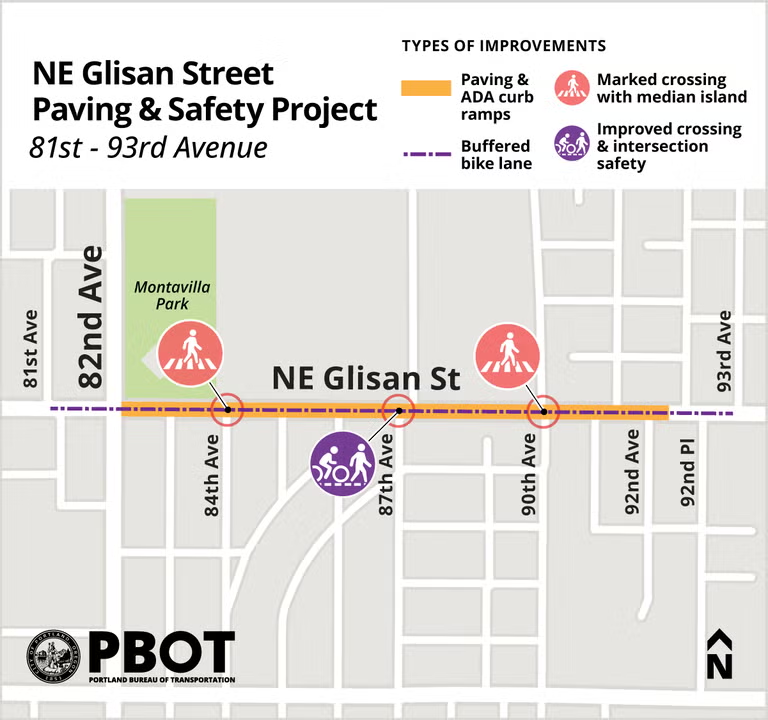
The new NE Glisan bike lanes will connect NE 81st Avenue and NE 93rd Avenue. Early concepts for the cycling infrastructure showed the bike lane extending west to NE 80th. However, area business concerns over losing frequently used street parking on that block prompted a design that still helps connect side-street bike routes for people crossing NE 82nd Avenue outside a car, while minimizing impacts to adjacent commercial property users. PBOT planners anticipate further improving the bike infrastructure in 2030 with hardscape concrete dividers and flex posts to protect cyclists riding next to cars. The reconfiguration is happening during this repaving project to save money. Otherwise, contractors would need to grind off existing street markers and repaint as part of the 2030 work.
NE Glisan St existing crossing at NE 87th Ave that crews will upgrade
NE Glisan Street, from Interstate 205 to 82nd Avenue, is a notoriously challenging roadway to cross with vehicles driving quickly between the two points. Without any fully signalized intersections on this stretch and with a large hill blocking visibility, it can take an extended period to find a safe break in traffic to cross. Crews working with PBOT will install two new pedestrian crossings with concrete median islands at NE 84th and 90th avenues, along with enhancements to an existing crossing at NE 87th Avenue. These in-roadway waypoints allow pedestrians to cross in two phases, focusing on one direction of traffic at a time, and help drivers better see a person waiting at the high-visibility infrastructure.
In the coming days, crews will grind down the eastern segment of the roadway and lay a fresh road surface. Cyclists should consider safer routes until NE Glisan is fully re-striped, and all street users should plan extra travel time as people adjust to the new configuration and speed limits on this segment of NE Glisan.
Article and photos by
Jacob Loeb
Promotion: Montavilla News is supported by contributions from businesses like Catalyst Construction & Kitchen Remodeling, a top-rated general contractor specializing in kitchen, bathroom, basement, and garage remodeling, as well as ADU construction and home additions. We thank them for their support.
Road crews will begin repaving NE Glisan Street between NE 82nd and NE 92nd avenues on Wednesday, August 19th. The approximately two-lane-miles of resurfacing work will take an estimated twelve business days to complete as heavy equipment grinds off the damaged top layer of asphalt and lays down a fresh mixture of crushed stone and bitumen. The Portland Bureau of Transportation’s (PBOT) re-striping plans will create a paint-buffered bike lane next to a single travel lane in each direction and recreate the center turn lane. Cement masons will add two new pedestrian crossing islands along the busy High Crash Street, with an existing crossing at NE 87th Avenue updated to prevent some left turns while better protecting pedestrians and cyclists.
Existing RRFB on NE Glisan St at 87th Ave
This Fixing Our Streets-funded project included substantial updates to sidewalk corner curb ramps, bringing crossings in this area up to Americans with Disabilities Act (ADA)- compliant standards. Starting in May, Crews working with Portland’s Bureau of Environmental Services (BES) installed modern stormwater management sump drains under NE Glisan Street at the intersections of NE 91st and 92nd Avenues. In addition to creating a smoother driving surface for vehicles, this new phase of work will reconfigure the street to remove time-shifting outer lanes used for parking or as an auxiliary travel lane. Collisions occurred on this street where motorists parked cars during allotted times, but drivers may have assumed the outer lane was clear. PBOT engineers anticipate that removing that conflict point will yield significant safety improvements with minimal impact on vehicle throughput.
Project map courtesy PBOT
The new NE Glisan bike lanes will add a connection between NE 81st Avenue and NE 93rd Avenue. Early concepts for the cycling infrastructure showed the bike lane extending west to NE 80th. However, area business concerns over losing frequently used street parking on that block prompted a design that still helps people riding outside a car cross NE 82nd Avenue to meet up with side-street bike routes while minimizing impacts to adjacent commercial property users. PBOT planners anticipate further improving the bike infrastructure in 2030 with hardscape concrete dividers and flex posts to protect cyclists riding next to cars. The reconfiguration is happening during this repaving project to save money. Otherwise, contractors would need to grind off existing street markers and repaint as part of the 2030 work.
NE Glisan Paving and Safety Project 30% Design Concept illustration of NE 84th Ave. Courtesy PBOT
NE Glisan Street, from Interstate 205 to 82nd Avenue, is a notoriously challenging roadway to cross with vehicles driving quickly between the two points. Without any fully signalized intersections on this stretch and with a large hill blocking visibility, it can take an extended period to find a safe break in traffic to cross. In 2021, PBOT lowered the speed limit to 30 mph, but that still did not significantly improve crossing safety for people inside or outside a vehicle. The two new pedestrian crossings with concrete median islands at NE 84th and 90th avenues should help pedestrians cross in two phases, where they can focus on one direction of traffic at a time, and drivers can better see a person waiting at the high-visibility infrastructure.
NE Glisan Paving and Safety Project 30% Design Concept illustration of NE 90th Ave. Courtesy PBOT
The NE 87th Avenue crossing already features street-adjacent buttons that activate Rectangular Rapid Flashing Beacons (RRFB) to signal to drivers that bikes or pedestrians will cross soon. The updates will extend an existing concrete median island east with cutouts for cyclists crossing. This extended mid-street infrastructure will prevent northbound and westbound drivers from turning left at this intersection.
Updated median at NE 87th Ave with left turns prohibited for north and west automotive travel. Courtesy PBOT
PBOT notes that paving and painting work is weather-dependent, so that project work dates may change. Drivers can expect rougher roads during the grinding and resurfacing process and should anticipate traffic delays with detours from 6 a.m. to 5 p.m. weekdays, with some weekend work. Parking on NE Glisan in the project area will end a few days before work begins, but pedestrian access will remain open. Anyone traveling through the worksite should follow all traffic control signs and flaggers and use heightened caution.
Article and photos by
Jacob Loeb
Promotion: Montavilla News is supported by contributions from businesses like Otter Wax, a neighborhood producer of small-batch specialty goods handcrafted in Portland. Using only natural ingredients, they make modern care products that are steeped in tradition. We thank them for their support.
Nick Zarate, working under the barber’s moniker Zarateblendz, recently opened his first shop in a converted shipping container south of 817 SE 82nd Avenue. FadeBox PDX has room to support four haircutting stations within a long, brightly lit space that, when combined with the many ring lights, entices customers to feel like they are on-set, readying for the camera. Two barbers currently work from the space, but Zarate is actively seeking people who want to rent a chair at the unique 82nd Avenue location.
Zarate opened the space on July 3rd, after refreshing an interior that once housed HT Xpress. He painted the space, which already had double glass doors at the front and three side windows. Adding the hexagon lights visually transformed the black-box interior with near daylight illumination. “I feel like lighting is the most important thing for a barber shop, just so you can see your fade and then the before and after pics turn out really good,” said Zarate.
Zarate has cut hair professionally for eight years, working in area shops like Black Diamond Barber Shop when it was on NE Glisan Street. However, some of his most formative works began during a time when he was forced to work alone. “I was in barber school, and then COVID hit a couple of months later,” explained Zarate. “It was hard to get clientele, but then again, it was easier because there were no barber shops open with everything closed down, so I worked from home most of the time.” He built his client book and alternated between working in shops and from home.
Nick Zarate “Zarateblendz” at FadeBox PDX
This year, Zarate heard from a friend about an opportunity to work in this space on 82nd Avenue and jumped at it. “There’s a lot of people that come by and say, ‘we’ve been waiting for a barber shop to be right here on the block because there’s really none,'” recalled Zarate. The barber shop is clustered near Henry’s Market and Covert Cafe just south of the historic Montavilla Downtown on SE Stark Street. He says they are enjoying the business group nearby, with informal cross-promotion efforts occurring between the barber shop and cafe.
Zarate explained that they work with all hair types and are open to all people looking for a haircut. However, they specialize in the fade, a seamless transition in hair length from short to shorter, often tapering down to the skin on the sides and back of the head. “The most popular one is the bald fade, which is a skin fade basically. Anyone who doesn’t really know about that and comes in here, I tell them the best option is getting a skin fade because it grows out to three different haircuts,” said Zarate. They offer other beard and eyebrow trimming services for a small additional fee. He said they target midrange prices starting at $45 for adults and $35 for kids.
The shop opens daily from 9 a.m. to 6 p.m. They accept walk-ins, but the quickest way to get in is to book at fadeboxpdx.booksy.com. The big steel shipping container doors seal up over the storefront when FadeBox PDX is closed, making it easy to see if anyone is available. Zarate likes the converted shipping container barber shop setup and feels that it could become a successful model across the region. “I would like to expand in the Clackamas area, Gresham area. FadeBox Clackamas, FadeBox Gresham, maybe even try to franchise it one day if it really gets popular.” People interested in learning more about the business should visit its Instagram page, instagram.com/fadeboxpdx, to see examples of past work and message Zarate with any questions.
By
Jacob Loeb
Promotion: Montavilla News is supported by contributions from businesses like Otter Wax, a neighborhood producer of small-batch specialty goods handcrafted in Portland. Using only natural ingredients, they make modern care products that are steeped in tradition. We thank them for their support.
The 82nd Avenue Area TIF Community Leadership Committee is midway through a four-month focused exploration of affordable housing priorities to include in the new East Portland Tax Increment Financing (TIF) Action Plan. Portland requires 45 percent of TIF funds to support affordable housing through a variety of established and emerging programs administered by the Portland Housing Bureau. The previous TIF community exploration work that led to the district’s formation in October 2024 created baseline guidance. As part of the continued public engagement, Prosper Portland created an 82nd Avenue TIF District Plan Survey for people living, working, or using resources in the district.
TIF is a funding tool for physical improvements to a specific geographic area. Although funding comes from people’s property tax payments in that District, it does not raise tax rates on its own. Instead, it freezes the portion of the taxes sent to the County and City general funds at its current level and then diverts increases to a special fund that TIF districts can use for projects in the area where those funds were collected. Because of Ballot Measure 50, passed by voters in 1996, property tax increases are mostly capped at three percent annually unless the county reassesses a property due to construction or other upgrades. After the first five years, the City can issue bonds based on the expected three percent TIF district income, providing capital for projects years ahead of collection. TIF allows the City to reserve a segment of tax dollars for use in the community where they’re collected, rather than spreading tax funds across all areas of the City. As of July 2015, Portland mandates that 45 percent of TIF funds be directed to affordable housing, a policy that has led to 47 percent of Portland’s affordable housing units residing in former TIF districts.
TIF district spending is guided by the five-year Action Plan approved by Prosper Portland’s Board of Commissioners and the Portland City Council. In a co-creation process, the district Community Leadership Committee — consisting of local 82nd Avenue Area residents, business owners, and community members — works with city staff to create a spending plan that reflects community needs. The committee does not select specific projects but instead sets a desired percentage of funds that Prosper Portland and the Portland Housing Bureau spend on distinct types of development or programs. The 82nd Avenue Area TIF will have approximately $20-25 million over the next five years to invest in the district.
The Action Plan will focus on permanent, physical development for the corridor. The survey seeks to expand the Community Leadership Committee’s understanding of the 82nd Avenue corridor as experienced by its occupants. Participants will share perceived strengths, weaknesses, opportunities, threats, and aspirations. It also includes questions around housing priorities. The survey will remain open for an indefinite period of time. However, early participation helps the thirteen-member committee incorporate public needs into early drafts. Work on the Action Plan has no hard deadline for adoption, but current projections place the final draft work in 2027. People will have time to comment on draft plans when they are created. Spending of TIF funds can occur only after city leaders approve the Action Plan. After participating in the Survey, people can further contribute by attending a monthly evening meeting in person or online, where public comment is accepted. Details are at the 82nd Avenue Area TIF website.
Disclosure: The author of this article served on the 82nd Avenue TIF Working group and is currently the co-chair of the 82nd Avenue Area TIF Community Leadership Committee. Information presented in this article is based on available public resources, and the author does not speak on behalf of the Committee or any City of Portland bureau.
Promotion: Montavilla News is supported by contributions from businesses like Catalyst Construction & Kitchen Remodeling, a top-rated general contractor specializing in kitchen, bathroom, basement, and garage remodeling, as well as ADU construction and home additions. We thank them for their support.
Crews and subcontractors with Raimore Construction will begin repaving SE 82nd Avenue south of SE Division Street starting May 18th. This continues repaving work from summer 2025 as part of the Portland Bureau of Transportation’s (PBOT) 82nd Avenue Major Maintenance Project. Work will focus on SE Clinton to Brooklyn streets and then continue south to SE Powell Boulevard later in the month. Road users should anticipate delays from 7 a.m. to 4 p.m., Monday through Friday, due to active in-street construction.
This work is funded as part of the Building a Better 82nd initiative, created to address deferred maintenance issues identified after the jurisdictional transfer of 82nd Avenue from the Oregon Department of Transportation to PBOT on June 1st, 2022. PBOT classifies 82nd Avenue’s existing pavement as severely deteriorated in the section its contractor will repave this summer, including work from SE Clinton to Bush streets, NE Thomson to Hancock, and SE Schiller Street to SE Foster Road. The road surface in these areas exhibits cracking that allows water infiltration below the surface, leading to repeated potholes and shortening the road’s lifespan. Additionally, 82nd Avenue’s past expansions decades ago created weak points that need more significant repairs.
82nd Avenue’s 2026 Paving Schedule, courtesy PBOT
In its early stages, 82nd Avenue supported only three lanes of traffic, with one lane for vehicles traveling in each direction and a center turn lane. Transportation officials reserved the outer edges of the street for parking in many places, and engineers did not build parking pavement to the same standard as the street’s center. When transportation officials removed parking to add another travel lane in each direction, they did not update the road’s supporting base, leading to premature wear. Consequently, unlike many repaving projects that grind off the top layer of asphalt and replace it with a fresh mixture of aggregate and bitumen, this project requires more significant work in the outer lanes of the former State Highway. Crews working on this project will need to remove the outer lanes to their base layer and reengineer them to support the weight of moving vehicles before repaving the entire surface. The project calls for 13 inches of new asphalt pavement on top of the new road base, which can support freight and buses.
Northbound view of 82nd Ave, a five-lane street with two lanes in each direction and a center turn lane. Graphic courtesy PBOT.
The results will provide a smoother road surface that should last longer before requiring future repairs. It will also endure the new usage requirements proposed by the TriMet 82nd Avenue Transit Project that seeks to transform the 72 bus line into a Bus Rapid Transit (BRT) system under TriMet’s FX (Frequent Express) moniker. This enhanced transit service will use 60-foot articulated hydrogen fuel-cell electric buses that will serve 82nd Avenue. On February 13th, project designers were allowed to moved forward in developing 7 miles of Business Access and Transit (BAT) lanes along most of Portland’s portion of 82nd Avenue. With high-capacity vehicles, modern stations, traffic signal priority, and, now, transit priority on the outer lanes of 82nd Avenue, this updated project scope will shorten travel times for BRT riders and increase capacity, but place higher demands on the outer lanes of the roadway.
Crews grinding down the top layer of asphalt on previous project
PBOT anticipates work continuing through July, with contractors working on the western lanes first before transitioning to the eastern lanes. Crews will start on the outside lane, then move to the inside lanes on each side. One lane in each direction will remain open during the majority of the work. The final phases of repaving will create concrete median islands with space for street trees in select areas. Landscapers will plant those trees later this fall, when rainwater can help establish healthy root growth. Financial support from the Portland Clean Energy Community Benefits Fund (PCEF) is helping the transportation agency plant more than 175 trees along 82nd Avenue as part of the 82nd Avenue Major Maintenance Project. Planners expect the shade from these trees will mitigate the impact of extreme heat events, which particularly raise temperatures in paved spaces.
2025 82nd Ave repaving
Drivers should expect delays in this area and always follow the crew’s instructions, as people entering and exiting adjacent businesses will require assistance to navigate the construction zone. This roadwork is just one of many PBOT projects underway, all aimed at creating a safer and more stable street. Current projects will extend throughout 2026. Funding for some of the ongoing work comes from the American Rescue Plan Act, which has a deadline of December 31st, 2026, to complete the funded work.
Disclosure: The author of this article served on the Building a Better 82nd Community Advisory Group and the 82nd Avenue Transit Project Community Advisory Committee (CAC).
Promotion: Check out East Portland News as it continues to advocate for and report on outer East Portland. You will find frequently updated articles and an archive of more than 5,000 stories written over the past 20+ years alongside a robust Community Calendar of events.
On April 25th, marchers held the 20th annual 82nd Avenue of Roses Parade from Eastport Plaza Shopping Center to SE Clinton Street. Former U.S. Representative for Oregon’s 3rd congressional district, Earl Blumenauer, and Nancy Chapin were the 2026 Grand Marshals. The procession featured community groups, businesses, elected officials, dancing horses, youth performers, and the diverse cultural flavors that fill 82nd Avenue and East Portland.
Grand Marshals Earl Blumenauer and Nancy Chapin
The parade drew significant crowds along its one-mile route, closing the busy roadway for a few hours on Saturday morning. Sunny skies warmed the morning air, but temperatures remained moderate for the marchers and fans lining the street. Organizers say it has never rained on the parade in its two-decade run.
With the 2026 parade completed, the 82 Roses Community Enrichment Coalition members will begin work on next year’s event, which they expect will continue to grow for another 20 years and feature more participants and enhanced production elements.
82nd Avenue is one of the most important city streets. I’m excited for the activity here to reconfigure it, to make it safer, to make it more efficient, and to help revitalize this important street, this is the number one transit street in the entire city. And the work that’s being done here is going to transform 82nd. It used to be kind of the dividing line. I think 82nd Avenue is going to bring the city together. I’m really excited about what’s happening here. This parade is an expression of that. – Earl Blumenauer
The 20th annual 82nd Avenue of Roses Parade returns on April 25th at 9:30, featuring over 70 groups, including many returning and several new participants. The event organizers will use the scaled-back route implemented last year, starting at Eastport Plaza and ending just short of Montavilla at SE Clinton Street. To celebrate its two-decade run, organizers are adding additional days of activities in the district on Friday, the 24th, and Sunday, the 26th.
The volunteer-led organization, 82 Roses Community Enrichment Coalition, produces the parade each year, having taken over the operation from the 82nd Avenue Business Association. For most of its run, the parade started at Eastport Plaza Shopping Center and ended on SE Yamhill Street. This year, the procession will start from SE Cora Street, across the road from Eastport retail complex, and march less than a mile north, ending right before SE Division Street. People can gather along the SE 82nd Avenue parade route to view the marchers and procession vehicles. However, with the parade no longer ending at SE Yamhill Street, Montavilla spectators will need to walk south past Portland Community College’s Southeast campus to watch the various groups walk, dance, or drive down the road.
Ken Turner started work on parade planning in 2006 when he served as the Eastport Plaza Manager and 82nd Avenue Business Association President. In 2007, the first parade participants marched along its route and quickly grew into a significant community event over the following years. It has been 20 years since the first event; however, they have had to skip the tradition four times during its run. Planned protests and safety concerns led organizers to cancel the parade in 2017. Leaders halted the in-person event during the pandemic and took the parade online for 2022. The traditional parade returned in 2023 to a crowd ready to see its revival. Volunteers bringing this East Portland event to fruition believe the parade shows appreciation for the diverse population that defines 82nd Avenue by celebrating the community’s art, music, and dance.
Sponsor logos for the 2026 82nd Avenue of Roses Parade
The Regional Arts & Culture Council and the Office of Arts & Culture provided funding for this year’s parade, along with sponsorship by several area businesses. Funtastic Carnival will set up in the parking lot of Hong Phat Super Center, 4200 SE 82nd Avenue, for all three days as part of the celebration. The Impalas Car Show will start right after the parade at 11 a.m. on Saturday, April 25th. The parade features the Rose Festival Clown Prince, Rosarians, brass bands, premier Chinese dance groups, classic cars, America’s First Corps Band, City & Metro Councilors, costume characters, dance and theatrical groups, plus Middle and High school Marching and Jazz Bands.
Multnomah County Commissioner Julia Brim-Edwards and State Representative Thuy Tran in 2024
People looking for a front-row seat can volunteer as parade traffic monitors. One or two volunteers control every crossing along the 82nd Avenue route, and staff coordinators still need people. Volunteer applicants can complete a form at 82rosescec.com. A little before the parade starts, and to its conclusion, unauthorized vehicles are prohibited on SE 82nd Avenue from SE Holgate Boulevard to Division Street. People driving to destinations in the area during that time should select a different route. APANO and the Parade are also holding a SOLVE Oregon cleanup on Sunday, April 26th, from 9:30 a.m. through noon to clean up after the event. People interested in volunteering can sign up at volunteer.solve.org.
In early March, crews with the Portland Bureau of Transportation (PBOT) started preparing underground infrastructure ahead of updating sidewalk corners along NE Glisan Street as part of the planned NE Glisan Pave and Paint Project. The updates will use the pavement maintenance budget to restripe and reconfigure the roadway from NE 82nd to 92nd avenues. Ahead of the planned summer work, contractors will begin rebuilding crossing points to Americans with Disabilities Act (ADA) compliant standards for curb ramps and updating stormwater catch basin placement to match the new ramps and better handle rainwater runoff.
The first wave of work closed the outer travel lane on eastbound NE Glisan Street from the 82nd Avenue Burgerville parking lot’s entrance up to 85th Avenue. In street excavation barricades and heavy equipment block NE 84th Avenue at NE Glisan, requiring vehicles and pedestrians to take a detour in the area. A new maintenance hole cone sits on the side street, awaiting installation just below the road’s surface.
Excavation barricades, new maintenance hole cone, and heavy equipment block NE 84th Avenue at NE Glisan
Pavement markings added to NE Glisan Street along the project path in January indicate the placement of new curb ramps and stormwater inlets. Nearly every corner that hasn’t already been updated needs improvements to assist people trying to cross this stretch of roadway, which has few marked crossings. Up to now, anyone crossing the busy east-west street has had limited curb ramp options. PBOT will need to complete sidewalk and in-road updates before major roadwork takes place, as the repaving project will repair the asphalt cuts made by crews, creating new sidewalk corners and stormwater management at the street’s edge. People can expect that work to take place this Spring.
PBOT planners anticipate that much of the in-traffic lane work will take place in the Summer of 2026, when crews use heavy equipment to grind down old asphalt and spread a new layer of aggregate bound with bitumen to create a smoother driving surface. Contractors will repaint the lane markings in a new configuration to support painted buffered-bike lanes along the curb for much of the project length. This section of NE Glisan Street implemented alternating outer lanes used for parking or an auxiliary travel lane, depending on the time of day. Collisions occurred on this street where cars were parked, but drivers may have assumed the outer lane was clear. PBOT engineers anticipate that removing that conflict point will yield significant safety improvements with minimal impact on vehicle throughput. This work will also increase safer bike and pedestrian infrastructure in the area this year, while later project work can build on the new configuration with hardened street elements for greater safety.
Illustration of the existing four travel and one turn lane over proposed configuration from PBOT’s NE Glisan St – 82nd Avenue Multimodal Safety and Access 2028-2030 RFFA Project Factsheet. Courtesy Oregon Metro
This stretch of NE Glisan received an Oregon Metro Regional Flexible Funds Allocation grant to add physically protected bike infrastructure sometime in 2030. The work included in the Northeast Glisan St: 82nd Avenue Multimodal Safety and Access project would require lane reconfiguration and repainting. PBOT Planners feel that this 2026 road surface maintenance presents an opportunity to save public funds by reconfiguring the street during the post-asphalt-work painting process, years before the larger safety improvement project. By doing road marking work now in the new configuration, PBOT can save taxpayer funds by lessening the reconfiguration costs four years later.
Travelers should anticipate construction on sidewalks and in the roadway along NE Glisan Street from NE 82nd to 92nd avenues as crews rebuild pedestrian and stormwater infrastructure. People walking in the area should anticipate detours when demolition and construction work ramp up. Drivers in the area should expect temporary outer lane closures on NE Glisan during construction, followed by permanent outer lane closures after crews paint new lane markings. Crews will work to maintain access to business and residential driveways. Details are available on the project website.
Correction: NE 84th Avenue was incorrectly identified as SE 84th Avenue.
Promotion: Montavilla News is supported by contributions from businesses like Otter Wax, a neighborhood producer of small-batch specialty goods handcrafted in Portland. Using only natural ingredients, they make modern care products that are steeped in tradition. We thank them for their support.
Across from Eastport Plaza, the Meals on Wheels People nonprofit is transforming a full block frontage at 4035 SE 82nd Avenue into an East Portland food distribution hub and resiliency center for a community that depends on their system for regular sustenance. The warehouse portion of the building already houses frozen and shelf-stable meals for the nonprofit’s programs on this side of the river. When construction is complete, this site will serve as a backup kitchen for their westside primary facilities, a resource center, a counter-service restaurant for program participants, and an event space.
The organization purchased the property in July 2021 with the intention of quickly expanding its delivery network, which distributes prepared meals to collection locations across the region where people come to eat in groups, or where volunteers collect and transport those meals to homebound elderly recipients. “We originally thought we could do this pretty quickly because the [existing] warehouse was added on in 2014. We could start with a warehouse because we weren’t moving any walls or anything, just installing our freezers and coolers in there. That took forever, so we then said, ‘Well, let’s do the whole deal,'” recalled Suzanne Washington, the Chief Executive Officer at Meals on Wheels People. They began work in phases, using the completed sections as crews renovate existing structures and then begin construction on new structures. “Phase one was that warehouse. Phase two is some offices and then part of the service area, as I call it,” explained Washington. Most of the building is single-story, but the area under construction will have two levels, an event space upstairs and the main floor hosting a kitchen, cafe area, hub for senior deliveries, and additional space they intend to lease to another service provider group that would benefit from being connected to Meals on Wheels People patrons.
Rendering of expanded building on SE 82nd Avenue courtesy Meals on Wheels People
During the nonprofit’s phased buildout, the neighboring Eastport Food Center cart pod closed, with its owner moving out of Oregon. He listed the property at 3905 SE 82nd Avenue for sale, and Meals on Wheels People purchased it in August 2024 to support development logistics and provide future auxiliary vehicle storage space. “We own this lot across the street, which is right now our staging for construction, but it will become parking for the event space and the senior transportation vans,” said Washington. The main Eastside facility has a parking lot, but four stalls support Electric Vehicle (EV) charging for the growing fleet of battery-powered transportation used by Meals on Wheels People. The SE Center Street accessed parking lot dedicates a sizable amount of space to the “U” shaped driveway that will support the speedy loading of delivery vehicles. Having the expanded parking across the street allowed designers to focus on operational uses adjacent to the building. The large lot across the street also allows for the delivery and staging of produce directly to this location. “So fruits, vegetables, and supplementary food will be delivered here directly, so we don’t have to bring them from Multnomah Village. Multnomah Village is now only bringing those frozen meals,” Washington said.
Reducing the amount of food transported is a key component of this expansion project. Although the established network had served the 55-year-old organization, leadership identified vulnerabilities and operational inefficiencies that this East Portland hub could address. A primary labor and cost savings would come from reducing the number of site-to-site transport trucks needed. “We will be able to get rid of a diesel truck and use our electric vehicles to deliver to Gresham, MLK, and all the places on the east side,” explained Washington. “Right now, a big diesel truck, which costs us $8,000 a month, goes to 20 different sites. We can be better for the environment and get rid of it.” The organization received a PGE Drive Change Fund grant for a second EV to replace a diesel medium-duty delivery truck with an electric delivery truck and to install charging infrastructure.
Another key concept in building along 82nd Avenue is based on maintaining operations when a disaster or weather prevents cross-town traffic. “The goal was to get a hub for emergencies on this side of the river. Our central kitchen right now is in Multnomah Village, and that’s where we make every meal fresh daily. We cook, flash-freeze, and then package anywhere from 6,500 to 8,000 meals a day. All the home deliveries are frozen [with volunteers] dropping them off for a whole week.” In the event of road network disruption, demand for food from program participants increases, and the ability to continue operations will be a critical lifeline for elderly people trapped at home. The kitchen at this new site will primarily serve people walking in for meals, but it has the capacity to prepare 2,000 meals a day in times of emergencies. It also has substantial freezer space for storing food. “The warehouse freezer right now has 45,000 frozen meals in it,” said Washington. They circulate the stockpile every day to deliveries in East Portland, but keep a reserve for emergencies. They also keep another 20,000 shelf-stable meals that can further bolster food delivery capabilities in situations where not everyone may have access to power to store and cook deliveries. The building is served by dual-fuel generators to keep the facility operational even if the power grid is down, and contractors will install solar panels on the roof, further ensuring the building remains powered and reduces its daily dependence on utility power.
Rendering of expanded building on SE 82nd Avenue courtesy Meals on Wheels People
Suzanne Washington and others led the drive to buy this property because the organization is relying on leased space east of the river, and making this level of investment in someone else’s property would not have been a good use of resources. Additionally, the current locations are too small for the storage needs provided by the 82nd Avenue building. However, this new space will not immediately replace any existing site as the nonprofit needs those locations to continue serving its primary function. “We’ll keep those sites because people can only go so far. We do two things. For older traditional adults, we do home-delivered meals, and then we do congregate dining, where, if they can, we get them out of their homes to eat with other people. It’s much better for their health,” Washington said. “We still want to provide that service where they can come in and eat.”
Similar to other locations, the SE 82nd Avenue building is designed to bring people in to eat, but with more flexible hours and the ability to order something prepared to the individual’s tastes. “When somebody comes in for a meal here, first of all, they can come in at 8 o’clock and get a breakfast burrito; it doesn’t have to be lunch. They can eat at 3 o’clock in the afternoon, they order at the counter, and then we’ll bring it to them,” remarked Washington. “So we can serve the diversity of folks out here with their ethnic cultural needs and not your traditional lunch where you get one of two choices, and that’s it, because we control this space.” She describes it as similar to a Chipotle restaurant, where a person can customize flavors and mix and match base ingredients, all prepared fresh on site.
Rendering of tech hub courtesy Meals on Wheels People
Guests can stop in at this location on their schedule, but they must become program participants and are limited to one meal per day. “It’s not meant to open to the street, especially right on this street,” said Washington. “We had a place downtown that we closed because most of the older people wouldn’t come because we had so many homeless folks.” Meals on Wheels People’s primary mission is serving older adults 60 and over. Washington explained that about 30 percent of the organization’s funding comes from the federal government through the 1965 Older Americans Act. “That comes with requirements like we have to have certain dietary guidelines and we have to ask for donations [from recipients], but there’s no coercion for that donation.”
Although serving older adults is what most people associate with the Meals on Wheels brand, through other funding systems, they also help alleviate food insecurity among youth and their families. The Meals 4 Kids program serves families with at least one child under 18. “Last year, we served over 275 people within those families. We provided more than 300,000 meals,” said Washington. In this program, families receive frozen meals with supplemental foods like bread, milk, and fruit, or they can get the raw ingredients and cook them themselves. The program is based out of the SE 82nd Avenue facility and primarily serves East Portland residents. “The great thing about that program is that over 70% get the raw food and then they’re home with kids cooking, doing homework, that kind of thing. Not trying to haul somebody around on the bus or trying to figure out how to make a meal out of a school backpack,” remarked Washington. They have other dietary assistance initiatives, including one that delivers medically tailored grocery boxes to pregnant and newly lactating women.
Rendering of dining area courtesy Meals on Wheels People
Food is at this organization’s core, but this new location will help Meals on Wheels People further expand services beyond feeding people by offering a tech hub and community space within an environment where people can eat healthily alongside their peers and stay to discover other opportunities and services to enrich their lives. This project represents a significant milestone for Meals on Wheels People. Suzanne Washington has spent over a decade strengthening the organization. “They didn’t have enough money when I started. They were always in the hole. I focused on three things while I’ve been here. To do the best service possible to those we serve, we’ve got to support our staff the best way possible. To do that, we need resources, money. So by focusing on those three things, [service, staff, and resources], we’ve gotten more efficient, where we can put more money into the quality of our food and the type of food. We support our staff, I think, much more than we did when I got here for benefits, wages, just everyday support,” said Washington. She believes the new property allows the organization to significantly update its operational infrastructure, ultimately saving on recurring costs by lowering transportation expenses and better utilizing people’s time.
Halbert Construction Services will continue working on the project through November. Several delays with permitting and supply-chain disruptions have already pushed back the completion date, but Meals on Wheels People anticipates completion this Fall season.
Correction: Fixed a typo in Eastport Plaza’s name that misidentified it.
Promotion: Check out East Portland News as it continues to advocate for and report on outer East Portland. You will find frequently updated articles and an archive of more than 5,000 stories written over the past 20+ years alongside a robust Community Calendar of events.
On Friday, February 13th, TriMet leadership instructed the 82nd Avenue Transit Project designers to work toward creating 7 miles of Business Access and Transit (BAT) lanes along most of Portland’s portion of 82nd Avenue. The transformative project would convert the 72 bus line into a Bus Rapid Transit (BRT) system under TriMet’s FX (Frequent Express) moniker, with high-capacity vehicles, modern stations, traffic signal priority, and, now, transit priority on the outer lanes of 82nd Avenue. This updated project scope will increase the current project’s proposed $350 million budget by at least $8 million, and the project partners are depending on yet-unawarded $150 million in federal funding.
TriMet General Manager Sam Desue Jr. made the directive to advance the incorporation of significant BAT lane allocation in the design at the project’s Policy & Budget Committee meeting. This follows months of public dispute over restricting a lane of automotive travel in each direction on a busy north/south connector road that was formerly a state highway until transferring to Portland’s ownership in 2022. BAT lanes serve two primary functions in a transportation network. They are focused on providing local access for vehicles on congested streets and on providing transit systems with a less encumbered lane to move more reliably between stops. Advocates for the design note that driving to a business’s parking lot entrance on a busy road requires a visitor to wait in rush-hour congestion even if they turn onto the street a block away. In those conditions, it can also take a significant time for a motorist leaving a driveway to exit and merge into traffic. BAT lanes can help address those situations by requiring all outer-lane travelers in private vehicles to turn right within a block. Supporters also tout the BAT lanes used by emergency vehicles, which can speed through congestion when time matters.
BAT lanes are strongly supported by surveyed residents who favor a faster, more effective BRT system on 82nd Avenue. People who spoke in support at the 82nd Avenue Transit Project Community Advisory Committee (CAC) meetings also appreciated the anticipated reduced speed of BAT lanes on the curb adjacent portion of the road. 82nd Avenue once had parking along its outer edges that later became travel lanes, leaving pedestrians and fast-moving vehicles inches apart. However, many businesses are concerned about the economic impact of a sudden change in vehicle throughput. Although 82nd Avenue is not at capacity at all times of day, it does often become congested, and transportation models indicate that introducing this level of BAT lanes will divert 20 to 25 percent of traffic to other routes during peak times. Local businesses that started their ventures on a state highway years ago worry that this change will force them to relocate or close as their customers take a different route to avoid heightened congestion. People advocating for 82nd Avenue to transform into a more pedestrian-forward design say that new shoppers will come by foot and by bus, but that mode shift can take years, and many of the small businesses that have made up 82nd Avenue’s culture say they cannot survive the transition timeline, which is far from certain.
Feb 13 Business Access and Transit (BAT) lanes graphic courtesy TriMet with MV News directional notation
The TriMet adopted design for BAT lanes closely represents the community-supported design, and the project 82nd Avenue Transit Project CAC endorsed design, referred to as the “More BAT Lanes” option, with one notable exception. The nearly seven miles of transit-priority updates will stop before and resume after SE Powell Boulevard. During the January 28th CAC meeting, presenters explained that because that cross street is still a state highway, the Oregon Department of Transportation would require significant improvements at that intersection and on SE 92nd Avenue to accommodate the agency’s design standards for vehicle throughput. They explained that it would dramatically increase project costs or significantly delay the design process, seeking exemptions.
The project is targeting a 72 FX Line opening in 2029 and still has many milestones to meet before construction can begin. Planners need to find additional funds for the BAT lane portion of the project and secure federal funding in a challenging time for states seeking support from national leaders. TriMet says the Federal Transit Administration (FTA) gave the project a Medium-High rating, a strong indicator that it could receive those funds. Proponents of the BRT investment point to this corridor as an essential focus for efforts. TriMet’s Line 72 bus provides nearly 66,000 rides each week and is the busiest bus line in TriMet’s system. It also represents the highest-ridership bus line in all of Oregon, making it an ideal candidate for upsizing to strengthen the network’s backbone. Many riders use this route along 82nd Avenue to the Clackamas Town Center to connect with other lines. Transit designers say reliable and timely performance is essential to improving the network and reducing future congestion by getting more people out of personal vehicles for daily commutes. People can provide comments and learn more at the project website (trimet.org/82nd/).
Disclosure: The author of this article previously served on the 82nd Avenue Transit Project Community Advisory Committee (CAC).
Promotion: Montavilla News is supported by contributions from businesses like Greg Beddor – SEO Specialist, an Oregon based digital marketing consultancy. The company markets customer’s websites and provide SEO services to grow their business. We thank them for their support.
Neighborhood news site focused on buildings and changing businesses