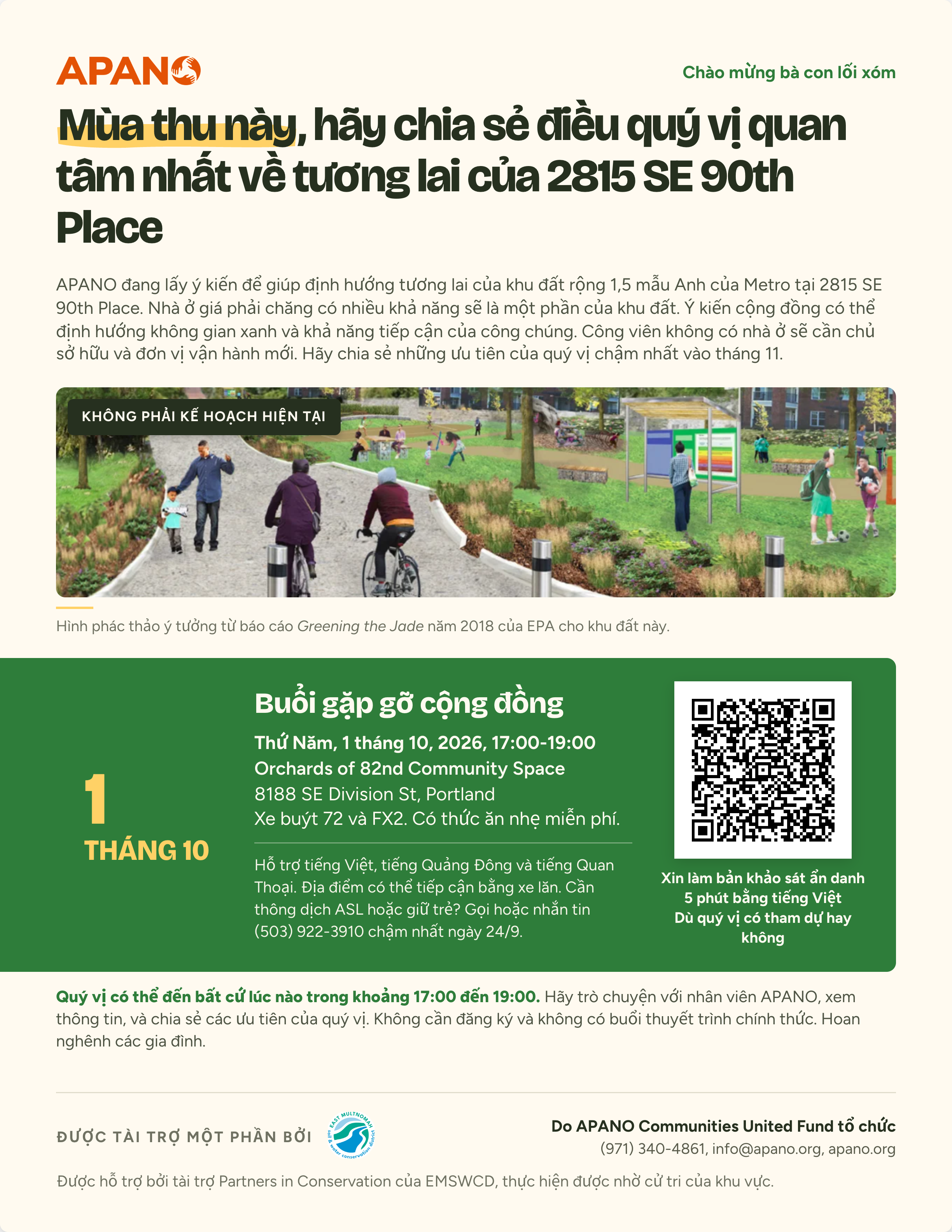
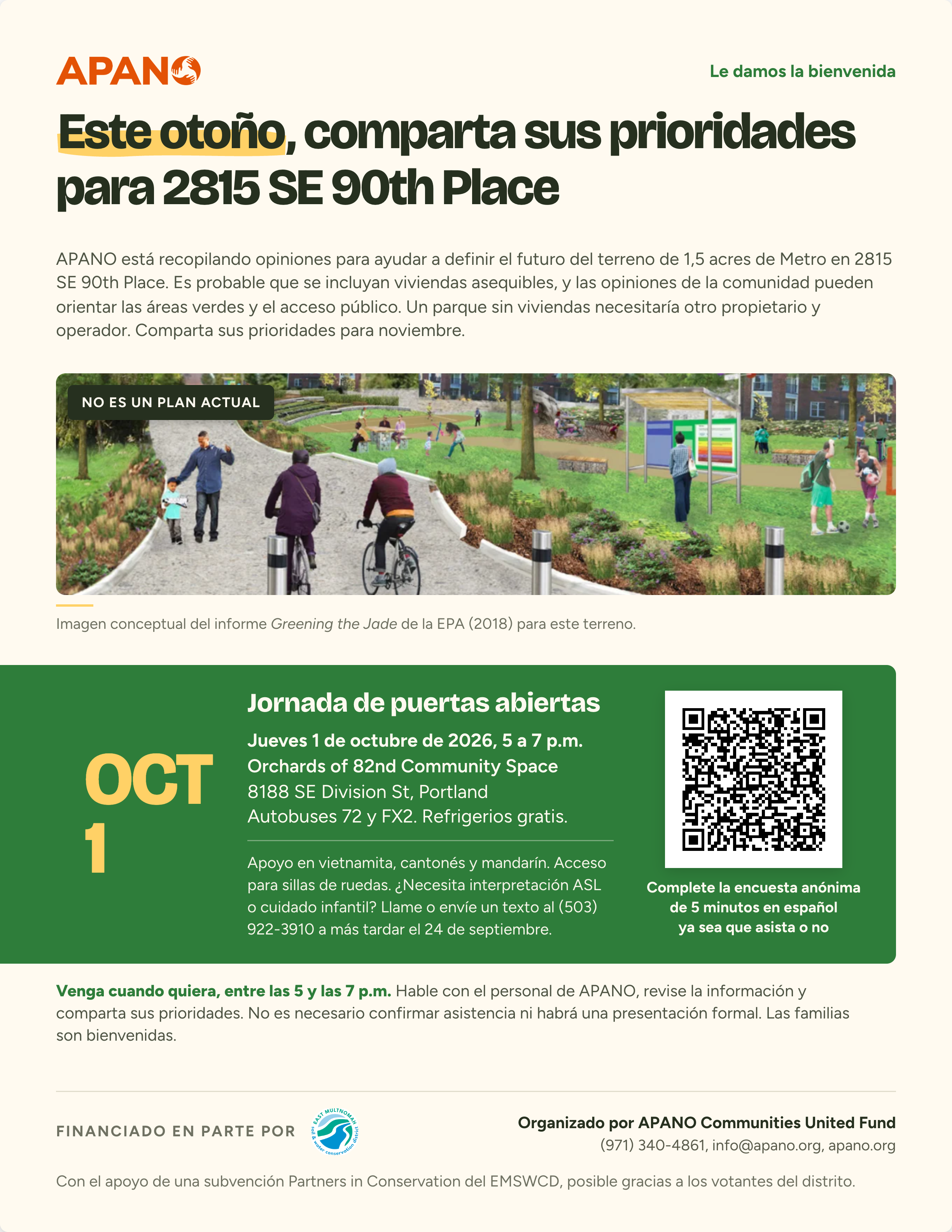
On October 1st, APANO Communities United Fund will host an open house from 5 to 7 p.m. to gather Jade District residents’ perspectives on access to green space. Participants attending the drop-in gathering within the community room at 8118 SE Division Street will join a focused conversation about a roughly 1.5-acre property owned by Metro on the southeast corner of SE 89th Avenue and 90th Place. All area residents, whether or not they attend, can complete an anonymous online survey to share their opinions.
Oregon Metro owns the large parcel at 2815 SE 90th Place after purchasing the property in July 2025 for planned Transit-Oriented Development (TOD). Community advocates have long envisioned the large property as a neighborhood park and recently sought support for that project. Last March, APANO collected 149 community member signatures on a letter calling for meaningful engagement and substantial green space at the site. This support follows the 2014 Jade District community visioning plan and the 2018 EPA Greening the Jade project work. That previous community outreach recorded in those documents showed a desire and expressed need for green space across all groups in the neighborhood.
Since sharing that letter, organizers have focused on developing plans based on current capacity for new parks, indicating the need for a practical shared-use model for the site. A standalone park or community garden without housing would require another organization to purchase the property from Metro and take responsibility for long-term maintenance. A mixed housing and green space approach could include shared outdoor areas for residents or a combination of affordable housing and publicly accessible green space, community gardens, paths, or gathering areas. They expect the open house and survey results will help rank community priorities for affordable housing, outdoor recreation, and public access to green space. APANO will compile the results into a community engagement report for Metro to inform its plan for the site and shape Request for Proposal (RFP) language used to secure future development.
Although creating a full site park is less likely, APANO staff expect an opportunity for public use of part of the 1.5-acre site, and survey and open house input could support that initiative. The open house will have language support in Vietnamese, Cantonese, and Mandarin. People needing childcare or American Sign Language support to participate should call or text (503) 922-3910 by September 24th. The venue is wheelchair accessible and off the 72 and FX 2 TriMet bus lines. No registration is needed to attend this family-friendly event.
Promotion: Montavilla News is supported by contributions from businesses like Otter Wax, a neighborhood producer of small-batch specialty goods handcrafted in Portland. Using only natural ingredients, they make modern care products that are steeped in tradition. We thank them for their support.
Portland is recognized as a bikeable city that invests in infrastructure that makes this transportation and recreation activity more accessible to new or vulnerable riders. On Wednesday, September 30th, the New to Portland 2026 Rides series will gather in the Montavilla Plaza at SE 79th Avenue and SE Stark Street for a 5:30 to 7:30 p.m. moderate-paced 6- to 8-mile bicycle ride. The event is geared towards people who are new to town, new to cycling, or want to explore low-stress bike routes on the east side of Mount Tabor.
This Jade District and Montavilla ride is free and open to everyone, and people without a bike can ride free on a BIKETOWN e-assist bike. People interested in that offer will need to ask the ride leader for a free ride code to cover the cost of the bike ride and download the BIKETOWN app or the Lyft app. Participants can expect to roll past several neighborhood parks along current and future bikeways while discovering lesser-known features of the area.
This is a slower-paced ride, and participants can expect to travel in the group at 8 to 10 mph. Event organizers want to direct people to one of Portland’s bike shops to rent or buy a bike if they are interested in this event or in adopting cycling as one of the many ways to navigate the city. This Portland Bureau of Transportation-hosted event is made possible with support from Oregon Metro and the Federal Transit Administration. People are encouraged to check the BIKETOWN map for station locations near the event if they plan to use the program. The City also offers a checklist to help you get started on a bike and prepare for a ride on city streets.
Promotion: Check out East Portland News as it continues to advocate for and report on outer East Portland. You will find frequently updated articles and an archive of more than 5,000 stories written over the past 20+ years alongside a robust Community Calendar of events.
On September 10th, the public and private organizations responsible for creating the Legin Commons apartment building at 7755 SE Division Street celebrated its opening with a ribbon-cutting ceremony. Soon, new residents will begin moving into 124 new regulated affordable homes on Portland Community College’s (PCC) Southeast campus, prioritizing families with children and low-income households.
The new four-story building sits on the site of a former Kaiser Permanente one-story medical clinic built in 1964. PCC acquired the land several years before Kaiser’s closure and demolished the building in 2015, using the land as an auxiliary parking lot with a large grassy spot where the building once stood. PCC had always planned to repurpose the space for more effective uses than parking. In 2021, College leadership worked to develop a twenty-year facilities plan for the educational institution’s properties. During that evaluation, PCC determined that portions of the school grounds should support low-income affordable housing. Instead of student-only dormitories, they opted to focus on attainable housing open to the community. From internal student surveys, PCC staff learned that housing insecurity is a significant concern. They also observed that students often spread their education out over many years with inconsistent enrollment. As a result, PCC determined that tying housing programs to school affiliation would not alleviate housing insecurity among the student population, so planners opened this housing to all who qualify.
A previous PCC campus expansion razed the former site of the Legin Restaurant, a beloved Chinese eatery and community hub. Housing developers APANO, Our Just Future, and Edlen & Co. chose to honor the area restaurant by naming the building Legin Commons and incorporating central gathering amenities to match its namesake’s role as a community hub. Located in the Jade District and the Montavilla neighborhood, blocks from SE 82nd Avenue, it offers access to some of Portland’s most active transit lines and walkable destinations. The building also offers secured on-site parking for some residents with dedicated EV charging stalls.
Security gate leading to resident onsite parking with EV charging stalls to the left
The Portland Housing Bureau awarded this development $3.78 million from the Portland Clean Energy Community Benefits Fund (PCEF) to install a solar array and high-efficiency heating and cooling split systems. Other public funding came through a $1.67 million allotment from the voter-approved Metro Affordable Housing Bond and a Metro-awarded $250,000 Transit-Oriented Development grant. Legin Commons residents also enjoy natural cooling from a mature tree canopy on its eastern edge and new greenery planted around the property to help replace the shade once provided by older trees removed during construction.
Rooftop mounted mini-split heat pump condenser units and solar array
PCEF Program Manager Sam Baraso explained during the Thursday event that green investments in this building benefit residents and the environment by reducing off-property energy consumption and lowering costs. “We invested in 294 in-unit mini-split heat pumps and 22 common-area mini-split heat pumps, three high-efficiency whole-building ventilation systems, 33 energy recovery ventilators, which means we can bring in fresh air into the building constantly, make sure folks are breathing clean, fresh air and do so in a way that actually uses the outgoing air to cool or warm [incoming air].” On the roof is a 180-kilowatt solar array that further reduces the energy demands of these residences on the grid. Claire Parisa with the nonprofit Enterprise Housing Credit Investments, which provided funding support for this project, highlighted the unique support for environmental construction in Portland. “There’s always a goal to make buildings green, but not necessarily the funding to go with it. And we’re so lucky to have PCEF in the city to make those dreams a reality.”
Outdoor play area and resident courtyard
Lower energy bills and cleaner indoor air are just a few of the key features of this complex. Designers used the natural amenities to create significant outdoor space for residents, including an outdoor play area off a large community room. On-site laundry and bike storage are available on multiple floors. Private meeting rooms throughout the building provide secluded workspace or an area for private conversations away from home. Elevators offer seating in an adjacent lobby on each floor so people with mobility considerations can navigate the property with less impact on their comfort. A ground-floor classroom can also host community meetings or events, as long as it remains open to all residents in the building. APANO will provide resident services, leveraging its headquarters’ proximity to the site to be an integrated partner in the building’s supportive services.
Ground-floor classroom
For over a decade, APANO has looked for opportunities to increase housing in the district, making good on a community-driven concept for the area. “Our vision for Jade is for it to be Portland’s most transit-rich, most affordable, and most climate-resilient part of town. We have Legion Commons opening today, we have Jade Apartments opening next month, and we’re in pre-development at Canton Grill,” explained Metro Councilor Duncan Hwang, who also works for APANO. “Part of the housing piece is our work around anti-displacement. We have some time right now to really build up these community assets to make sure we can stay in place.”
Quisha Light, interim director of the Portland Housing Bureau
Quisha Light, interim director of the Portland Housing Bureau, celebrated the addition of these new housing units but noted it is just an early step in a larger effort to meet the community’s needs. “According to the city’s housing needs analysis, Portland must add about 28,000 homes that are affordable to families in that 0 to 60% of AMI (Area Median Income) range by 2045. So we still have a lot of work to do. It’s a big lift, but I have lived here for 20 years now, and I’ve seen Portlanders step up and really accept the big challenges. So I know all of us standing here today can make that happen. Legin Commons makes stability real. With 124 new affordable homes, including 20 deeply affordable homes at 30% AMI, and more than half of all units sized for families, this development reflects the community it serves,” said Light.
Katy Ho Interim President PCC and Councilor Tiffany Koyama Lane
Speakers at the ceremony noted the importance of creating high-quality affordable housing in an area that has historically supported generations of the city’s minority populations. “This stretch in the Jade District and the 82nd Avenue corridor in particular has long been home to one of our most diverse communities in the city. Immigrant families, refugees, students, working people who bring so much to Portland,” said Portland Councilor for District 3, Tiffany Koyama Lane. “This is a place where we can hear more than 140 languages spoken, where we can find our culturally specific food and markets that reflect our beautiful diversity. This neighborhood was built by people. The character comes from families who have been here for generations, and also from folks who crossed oceans and borders to get here.”
Metro Councilor Duncan Hwang, Lynn Fuchigami Parks, and Councilor Tiffany Koyama Lane
Koyama Lane explained how preserving communities through anti-displacement and naming is a significant step for a city whose past leaders excluded many non-white voices. In 2024, Sameer Kanalwe and Koyama Lane became the first two Asian Americans ever elected to Portland City Council. Beyond naming the building after a community gathering space, residents will use the Minoru Yasui community room. “Legin Restaurant was more than just a great restaurant. It was a center of community life, and today, Legin Commons carries that spirit forward as a place where people can gather, connect, celebrate, and build community. This is especially meaningful that the community room bears the name of Minoru Yasui,” said Lynn Fuchigami Parks, Executive Director Emeritus of the Japanese American Museum of Oregon. “The night of March 28th in 1942, Minoru, who was only a 26-year-old attorney at the time, walked the streets of downtown Portland to deliberately violate the military curfew imposed on people of Japanese ancestry. He did so to challenge the constitutionality of that order. That’s the order that led to the unjust incarceration of over 120,000 men, women, and children, the majority of whom were American citizens.” The plaque that will be in the community room touches on Yasui’s story and adds to the sense of place created in the building.
PCEF Program Manager Sam Baraso
Residents will start moving into Legin Commons soon, with the 30% AMI units mostly committed to people. Many 60% AMI-priced units are still available for qualifying renters. Those homes are restricted to households whose annual income does not exceed $53,940 for one person, $61,620 for two, and upward based on the number of residents. Homes restricted to 60% of AMI earners are currently rented at near-market rates. Still, this new building offers far more amenities than other multifamily buildings in the area, and the protected rental rate can help provide housing stability when market rates rise faster than median income. Consequently, the building should fill to capacity slowly, allowing a gradual influx of new neighbors to the residential area around the new apartment building.
Article and Photos by
Jacob Loeb
Promotion: Montavilla News is supported by contributions from businesses like Otter Wax, a neighborhood producer of small-batch specialty goods handcrafted in Portland. Using only natural ingredients, they make modern care products that are steeped in tradition. We thank them for their support.
In July 2025, Oregon Metro purchased a 1.46-acre property at the intersection of SE 90th Place and SE 89th Avenue for planned Transit-Oriented Development (TOD). For over a decade, community advocates have envisioned the large, sloped property as a neighborhood park and are now seeking support for that project ahead of Metro’s RFP (Request for Proposals) this summer. Residents and interested parties can complete an Online Form to endorse a call for the City to purchase the lot from Metro and to direct Portland Parks and Recreation to create public green space for the expanding community in this area.
Park Rendering from the 2018 EPA Greening The Jade project document
Metro’s TOD team plans to introduce new affordable housing at the site with help from partner developers. The early concepts included open neighborhood greenspace, but not at the scale documented in the 2014 Jade District community visioning plan or the 2018 EPA Greening the Jade project. The community outreach recorded in those documents showed a desire and expressed need for green space across all groups in the neighborhood. The Metro-owned property at 2815 SE 90th Place is in the center of a community surrounded by busy city roadways, a State highway, and a freeway. Harrison Park is the closest park to this location, at over half a mile away, and often serves as an extension of the adjoining school’s campus rather than a neighborhood park.
2815 SE 90th Placeproperty with fence
Andrea Pastor, Metro’s Senior Development Project Manager of Housing and TOD, explained in a September 2025 interview that Metro purchased the land along SE 89th Avenue using an allocation provided by the Oregon State legislature for a revolving acquisition fund around 82nd Avenue. “With all of the improvements happening on 82nd, including the planning of the new transit, we wanted to prioritize the area. So we made a specific legislative ask back in 2023 for some funds to buy land near 82nd,” said Pastor. “We have been basically looking and making offers on properties in the area for the last couple of years.” She notes that Metro has often owned land around transit with the intention of developing it. “We are trying to think of ourselves as a regional land bank specifically aimed at building affordable housing near transit.”
The Jade District advocacy organizers seeking support for the park say Metro TOD is willing to sell the parcel, but City of Portland support must be secured before Metro releases an RFP to potential developers in August or September 2026. The park space is across from The Jade apartments, which are currently under construction and will offer 15 units with family-sized accommodations, including three bedrooms and two bathrooms. The workforce housing development will also create 14 one-bedroom and 11 two-bedroom flats. The expanded pool of families on this street would benefit from a new city park with a safe crossing to a play area. The site can also amplify existing green space that is not publicly accessible but protected by Portland’s Bureau of Environmental Services, which owns the lot to the south of this property. It serves as a natural stormwater detention area where plants and soil help absorb the area’s rainwater. It also contains a sewer pump facility that requires 24-hour security for community safety and asset protection. Depending on the City’s flexibility, designers could extend park space into some of the stormwater detention area land without compromising security.
Image from the 2018 EPA Greening The Jade project document
Park designs and amenities presented in the visioning materials are illustrative only and do not constitute final design options. If the idea receives community support through the Online Form and city officials adopt the property for a new park, future community outreach from park planners will drive the development of the green space. Whether the land serves as a public park or affordable housing, this large, underdeveloped property will become a needed community resource as housing density brings more people into the Jade District.
As part of the 82nd Avenue Transit Project currently under development, Oregon Metro and TriMet have launched a survey to gauge the impact of station construction on recreational and historic areas along the planned Bus Rapid Transit route. Provided details and several questions focus on work to convert the existing bus stop in front of the Montavilla Community Center, at 8219 NE Glisan Street, into an FX–Frequent Express station. Additional improvements impacting the recreational center include widening the connecting sidewalk along Montavilla Park’s NE 82nd Avenue frontage.
Transit line improvements will provide faster bus service along 82nd Avenue from the Cully neighborhood to Clackamas Town Center through a partnership between TriMet, the Portland Bureau of Transportation, the Oregon Department of Transportation, and Metro. The project offers several components that will impact 72 bus riders and street users along the route. Draft plans will transform some sections of the pedestrian zone near stations by improving sidewalks where they connect to new boarding platforms, offering covered seating, lighting, trash cans, and digital signage similar to some FX2 stops on SE Division Street.
Expanding the sidewalk width along Montavilla Park’s western edge and creating the FX station would push the property line eastward towards a row of mature trees, making 1,300 square feet of parkland public right-of-way. Construction crews would stage materiel along the worksite using 1.37% of the adjacent park property for temporary access. TriMet expects construction work to begin in 2027 and last around two months. Visitors will retain access to the park and community center throughout the project.
Montavilla Park site diagram courtesy TriMet and Metro
Transit planners have asked community members to complete several surveys meant to guide the 82nd Avenue Transit Project. However, this outreach is designed to share specific information about park, recreational, and historic resources in the project corridor that pertain to federal regulations governing the transit planning process. Section 4(f) of the U.S. Department of Transportation Act prevents harm to publicly owned parks, recreation areas, and historic sites that are along this transportation project’s path. The survey documents explain that “transportation agencies must show there is no feasible and prudent alternative and that all possible measures are taken to minimize harm.”
The other federal regulation under consideration is Section 106, which requires federal agencies to consider a project’s impact on historic properties. The Milepost 5 Apartments—originally the German Baptist Old People’s Home—at 823 NE 82nd Avenue is on the National Register of Historic Places (NHRP), and designs will need to minimize impact to that site. TriMet plans to remove the bus stop and shelter in front of that property and build a new FX station 300 feet north on the same block. Historians and archaeologists will evaluate the history, setting, and characteristics of older buildings and sites to determine whether any other resources in the project area are eligible for listing on the NHRP.
National Register of Historic Places registered German Baptist Old People’s Home at 823 NE 82nd Avenue (now Milepost 5 Apartments)
Survey questions allow community guidance on preservation considerations and gather comments on plans that could impact recreational spaces along 82nd Avenue, which may be affected by the transit development. The survey is available until January 18th, 2026.
Disclosure: The author of this article previously served on the 82nd Avenue Transit Project Community Advisory Committee (CAC).
Promotion: Montavilla News is supported by contributions from businesses like Greg Beddor – SEO Specialist, an Oregon based digital marketing consultancy. The company markets customer’s websites and provide SEO services to grow their business. We thank them for their support.
In late July, Oregon Metro purchased a 1.46-acre property at the intersection of SE 90th Place and SE 89th Avenue. Crews recently installed a chainlink fence around the sloped lot and cut back the overgrown greenery that dominated this parcel. Over the next two years, Metro’s Transit-Oriented Development (TOD) team will collaborate with partner developers to introduce new affordable housing at the site, which will incorporate open neighborhood greenspace. In the coming months, deconstruction specialists will raze the dilapidated 1928-era home at 2815 SE 90th Place and demolish the metal-clad barn on the property. The next phase of pre-construction work will build on previous community engagement to guide the development team in meeting area residents’ needs.
Portland Maps graphic with 2815 SE 90th Place outlined in blue
The nearly 100-year-old 720-square-foot building faces the curb-less SE 90th Place on the high point of the property. The small single-story home sits atop a daylight basement that opens up to the south of the property. Vehicles access the barn from a gravel road segment of SE 89th Avenue that currently extends along the property’s entire western frontage and 100 feet south. The City of Portland has not accepted this unimproved road into its maintenance network. However, work on The Jade apartments across the street will include paving on its half of the street and sidewalk installation along the new workforce-priced housing’s frontage. Andrea Pastor, Metro’s Senior Development Project Manager of Housing and TOD, explained that Metro is coordinating with Gorman & Company to extend the street paving work across the whole road width when they do their road construction for The Jade apartments. The asphalt surface will terminate at a new curb on the eastern edge of SE 87th Avenue near where the new fence line marks the property’s edge. This enhanced infrastructure will provide a more stable roadway constructed to city standards for people rolling or walking through this area. When completed, the Portland Bureau of Transportation (PBOT) can then take over street maintenance, filling a long-disruptive gap in the street network previously made rough by potholes and wheel ruts.
SE 89th Avenue’s gravel road with potholes
A 2018 U.S. Environmental Protection Agency (EPA) funded study titled “Greening The Jade” identified the unimproved segment of SE 89th Avenue north of SE Brooklyn Street as a prime redevelopment opportunity for sustainable housing and a public park. Pastor said that this put the 2815 SE 90th Place property on Metro’s watch list for a future acquisition. “We saw it come up on the market and we were able to approach the seller pretty quickly, and they were open to it,” recalled Pastor. She explained that Metro fenced its property to keep people safe as they clean up the field from its former uses and to prevent individuals from entering the unsafe structures on the site. Redevelopment will take a few years as the TOD team plans for housing at the site and seeks development partners.
Pastor explained that Metro’s regional housing bond, approved by voters in 2018, successfully spent its $652.8 million budget delivering affordable housing in three counties. However, the region lacks a replacement for that program, and the Local Innovation and Fast Track (LIFT) program funds are allocated through the middle of 2027, possibly delaying the construction for two years without some creativity. “We are left wondering about other resources. If you think about it in established funding routes, looking at a rental project that has to have tax credits and LIFT, we would be looking at maybe mid-2027 for groundbreaking,” said Pastor, noting that speedy housing development is critical to Metro’s goals. “We are definitely exploring options for moving faster than that because we know we’re in a housing emergency, and we need as much housing as quickly as possible. We’re interested in thinking about what are some alternative models we can pursue in terms of financing. Can we move quickly, prioritizing quality of course, but cost efficiency and speed?”
2815 SE 90th Place
Pastor explained that Metro purchased the land along SE 89th Avenue using an allocation provided by the Oregon State legislature for a revolving acquisition fund around 82nd Avenue. “With all of the improvements happening on 82nd, including the planning of the new transit, we wanted to prioritize the area. So we made a specific legislative ask back in 2023 for some funds to buy land near 82nd,” said Pastor. “We have been basically looking and making offers on properties in the area for the last couple of years.” She notes that Metro has often owned land around transit with the intention of developing it. “We are trying to think of ourselves as a regional land bank specifically aimed at building affordable housing near transit. Our program focus has shifted in the last few years, but we’re really not doing anything that different from what Metro has been doing in this space for decades.”
As Metro adjusts its programs, the staff will look at ways to extend the useful life span of public investment. “In the past, we’ve typically just written down the value of the land and conveyed it to the developer if they’re doing affordable [housing]. The program has basically been trying to spur development, but now we are trying to make this idea sustainable. It’s simply not that sustainable for us to continue to give land away for free,” said Pastor. She explained that they are consulting development partners to explore how programs can deliver housing while potentially repaying public investment. Repayment could become part of the project lending structure, or developers could pay back Metro’s investment over a period of time. “It could be 15 years. It could be a ground lease. We’re open to structuring those deals in a number of different ways, but in a way that we can make this a revolving fund of money that is able to continually buy new properties along this corridor. The $5 million that we received is nowhere near enough to really meet the need for how much housing we really need,” Pastor said.
Metro expects to work with a single developer on this new project in the Jade District. Still, it could offer a mix of multifamily or single-family units with affordable home ownership options. The sloped lot and land dedication to PBOT for the modern streets and sidewalks reduces the buildable land to around an acre. So the vast open lot will not support a large housing complex. They also anticipate providing some on-site parking to minimize the impact on neighbors from the increase in housing density. However, incorporating green space into the development is a key consideration. They are communicating with Portland’s Bureau of Environmental Services, which owns the lot to the south of this property. It serves as a natural stormwater detention area where plants and soil help absorb the area’s rainwater. It also contains a sewer pump facility that requires 24-hour security for community safety and asset protection. Depending on the City’s flexibility, designers could incorporate green space on Metro’s land to extend into the City-owned land without compromising security.
Property with new fence
Portlanders in the area can anticipate future Metro conversations about 2815 SE 90th Place as they determine the appropriate development path. They will also consider leasing the land to an organization with suitable insurance and liability coverage to use the site until construction begins. In the short term, neighbors will see the unsafe structures removed and eventually a new paved road on SE 89th Avenue. The construction phase relies on a yet-to-be-determined development partner’s ability to secure funding and deliver a proposal that meets Metro’s goals for affordable transit-oriented housing at this site.
Promotion: Check out East Portland News as it continues to advocate for and report on outer East Portland. You will find frequently updated articles and an archive of more than 5,000 stories written over the past 20+ years alongside a robust Community Calendar of events.
Residents living in single-family homes, duplexes, triplexes, and fourplexes can now schedule curbside pickup of bulky items from their trash service at a predictable price point. People trying to dispose of something that won’t fit in a residential garbage bin have had limited choices, often with a substantial price tag, prompting some to place items on sidewalks with “free” signs to dispose of them. New city-set rates for curbside collection of large items make it easier for many Portlanders to properly unburden themselves from broken furniture, old mattresses, appliances, and other irregular waste.
Eligible households can contact their garbage and recycling company to schedule curbside pickup for large items, often referred to as bulky waste. After being assigned a special pickup day by the hauling service, people will then place the items at the curb by 6 a.m. on the scheduled day, but no more than 24 hours before pickup to avoid excessive rainwater contamination that can make items heavier and more challenging to handle. Collection companies could charge an additional fee if the pickup requires extra time or additional staff.
The City of Portland is currently promoting its bulky waste cost calculator, which allows people to view the expected collection cost for each item, along with a single-trip pickup fee of $18. Although they include many common examples—including a refrigerator collection cost of $51, a Water heater is $6, and a King mattress is $29—the garbage company decides which category each item falls into. If the item isn’t listed, it will estimate the price based on size or type. This tool is not an exact quote, but it offers many residents a reasonable option for budgeting when disposing of larger items.
The garbage service account holder must authorize the added cost of collection; therefore, some renters may need to contact their landlord to request pickup. People in apartments or businesses will need to check with the property manager about disposal options. If people have a transport vehicle, there are free options for disposing of mattresses through Bye Bye Mattress’s listing of drop-off locations or E-Cycle Oregon’s directory for responsibly disposing of unwanted electronics. People can pay less if they take their bulky waste items to a Metro Transfer Station for disposal, paying a fee based on weight and other factors. Additionally, a new Metro program allows people to recycle old mattresses and box springs for free, thanks to a 2022 Oregon Senate Bill.
The city-set rates for curbside collection of large items and bulky waste cost calculator can help people make an informed choice about how to dispose of items that are challenging to handle. The predictable prices and convenience of curbside collection could entice more residents to use the collection service and help reduce abandoned items on Portland Streets. Visit the Portland Bureau of Planning and Sustainability website for more information.
The U.S. Environmental Protection Agency, Oregon Metro, and partner organizations will host a community workshop focused on cooling down 82nd Avenue for the health and safety of its residents. The organizers invite people to pre-register for this free event on July 22nd from 5:30 p.m. to 7:30 p.m. However, organizers are seeking youth participants, renters, and community members who are not often included in planning conversations to participate. The Dharma Rain Zen Center, located at 8500 NE Siskiyou Street, will host this Tuesday evening gathering. Attendees will receive food and beverages, but registration is required, and organizers explained that space is limited.
People familiar with 82nd Avenue understand how hot it is during the summer months, as the corridor exhibits a significant heat island effect, where pavement and other elements increase the temperature higher than surrounding areas. Workshop leaders believe that addressing this Portland urban heat zone requires governments to collaborate with the people who live and work in those areas to develop community-driven ideas for a cooler, healthier, and more interconnected 82nd Avenue.
This workshop will connect attendees with federal, regional, and city government officials working alongside community advocacy groups, including Oregon Walks, the 82nd Avenue Coalition, and APANO. Transit provider TriMet is also a partner organization, as it is working to expand the FX Bus Rapid Transit system along 82nd Avenue with zero-emission buses powered by hydrogen, which emit less exhaust heat.
People interested in participating should register before the slots fill up and consider sharing the information with renters and youth who can contribute their unique perspectives to solutions to the harmful temperatures in the 82nd Avenue community.
Disclosure: The author of this article serves on the 82nd Avenue Transit Project Community Advisory Committee (CAC) and the board of the 82nd Avenue Business Association which is a member organization of the 82nd Avenue Coalition.
On April 11th, project leaders and development participants gathered to celebrate the opening of Glisan Landing at NE 74th Avenue and Glisan Street. The event occurred as residents continued to move into the two buildings offering 137 affordable housing units. Transforming a 1.65-acre underutilized commercial property into housing required many partner organizations, and the 2018 voters approved Metro Housing Bond. The project also faced funding constraints beyond the developer’s expectation after Oregon’s Bureau of Labor and Industries (BOLI) determined the project was not exempt from the higher labor rates of prevailing wage rate laws.
The property once housed a grocery store but later became the transmission facility for the Trinity Broadcasting Network before Oregon Metro bought the site in 2019. In June 2023, demolition crews razed the single-story building. They began constructing the first two buildings focused on housing with storefront space for Stone Soup culinary training center and supportive ground floor resident amenities. A third building under construction on the south end of the site will house the Immigrant and Refugee Community Organization’s (IRCO) free preschool in a single-story structure. In December 2024, residents started moving into the first building, offering 41 units of Permanent Supportive Housing (PSH). Catholic Charities of Oregon runs Beacon at Glisan Landing apartments at 7450 NE Glisan Street. That nonprofit jointly owns the four-story PSH building with Related Northwest as part of the public-private partnership that made this project possible.
Related Northwest partnered with IRCO for the 96-unit C-shaped building Aldea at Glisan Landing. That four-story development recently started moving people in and is nearly 50% leased. It features many family-sized units with secure ground-floor parking containing enough stalls for its higher-capacity residences. However, developers constructed this site with the support of Metro’s Transit-Oriented Development Program (TOD), which stimulates high-density housing development within frequent transit corridors like NE Glisan Street, accommodating residents who live car-free. Aldea reserves its units for people earning at or below 60% Area Median Income (AMI). That threshold is a U.S. Department of Housing and Urban Development (HUD) determined rate by region adjusted by family size. The leasing company will also hold 15 of Aldea’s 96 units for people earning up to 30% AMI. Operators also reserve all of Beacon at Glisan Landing’s 41 PSH units for people making up to 30% AMI.
Although designed for income-restricted residents, this complex features amenities not seen in many market-rate units east of the City center. Residents have access to indoor and outdoor exercise equipment, a youth reading room, a computer lab, a teen lounge, and a fiber studio with sewing machines and work tables. Residents can access onsite laundry rooms on each residential floor, and in-unit washers and dryers are available in the three and four-bedroom apartments. The fenced central courtyard contains play equipment and a garden trail alongside seating. A ground-floor breezeway at the south gap between the two parking garages leads to the preschool and its adjacent community garden space. Designers wanted to connect the residents with the community in the building while allowing neighbors living outside Glisan Landing opportunities to interact with the site through its natural spaces. The building features several exterior murals by Jeremy Nichols (Plastic Birdie), with two visible from NE 75th and 74th Avenues. Muralist Alicia Schultz (Vine & Thistle) produced interior artwork warming the space for residents. Colorful punched metal screens obscure the parking while letting air flow through the courtyard.
Glisan Landing is a loosely integrated complex with shared spaces, but independent lots contain each building with differing ownership and financing. Related Northwest and its partners arranged the development’s structure to treat each building as an autonomous project with separate funding, general contractors, and other considerations. This approach has several operational benefits, but it also has the potential to save on labor by avoiding prevailing wage requirements for public works projects. Contractors hiring labor for government-funded projects over a specific budget are often required to pay a rate based on the average wage paid to similarly employed workers within a particular occupation. The prevailing wage requirement ensures that low-bid rules on government-funded projects do not use the power of public money to suppress labor rates. However, many affordable housing projects with participation from for-profit developers are not always financially sound when paying the prevailing wage. Consequentially, officials exempt completely affordable development from paying the prevailing wage. “Affordable housing will be non-prevailed if it’s 100% affordable, meaning 60% AMI or lower, four stories or less, and no ground floor commercial,” explained Stefanie Kondor, Executive Vice President of Related Northwest.
The development group’s experience with affordable housing led them to think BOLI would not require a prevailing wage workforce for the affordable housing buildings. However, two months before closing on the project, Kondor says BOLI informed the team that the free preschool was considered a commercial use and that the whole Glisan Landing complex would need to pay prevailing wage labor rates. It was challenging for the team that was looking at a ten to twenty percent increase in building costs, but they were able to bridge the gap and break ground. “We prevailed when we were prevailed,” remarked Kondor. Still, she feels Oregon has some work to do with its interpretation of prevailing wage rules. “The question becomes, is a preschool considered ground floor commercial, even if we’re not charging the residents to take care of the kids? Is that a commercial use, or is that a residential use benefiting the residential community?” said Kondor. “I think that is why you’re not seeing a lot of co-located preschools, and it’s a shame.” Studies often identify accessible childcare and early education as essential to improving a family’s success and future prosperity.
The Related Northwest team took on the budget challenge and continued with their plan, offering a high-quality, affordable housing development. “Even though we are for-profit, we are mission-driven. Every person in my office was formerly a nonprofit person,” explained Kondor. The group pursues projects based on their experience in the region and the guidance from nonprofits they partner with. Stefanie Kondor wanted to work on Glisan Landing because of her appreciation of the Montavilla neighborhood, and she is currently working on a project in her hometown of Seaside. “The places where we develop are places that we would want to live ourselves and want to be, that we feel that we can add value, that we can do something special,” said Kondor.
The Northwest division of Related develops housing projects in Washington, Oregon, Idaho, and Montana. The group wants to take on more development in Portland and other areas of Oregon. However, the 2018 Metro Housing Bond has depleted its $652.8 million budget, significantly exceeding the delivery of its planned 3,900 affordable housing units. Taxpayers will continue to pay off the bond for over a decade, inhibiting another bond issuance without impacting the tax rate. If the community wants more affordable housing developments like Glisan Landing, Kondor feels that the region will need to recreate the funding conditions created by the 2018 Metro Housing Bond. “The partnership with Metro and Portland Housing Bureau came together with resources. If it was just one of them, I don’t think you could accomplish this [type of development]. Metro donating the land, they contributed TOD funds, infrastructure funds, and Metro bonds. The Portland Housing Bureau administers the housing bonds, and they do the property tax exemptions and the SDC (System Development Charge) waivers. All of those things really help make the project come to fruition.”
Kondor also attributes Glisan Landing’s success to the work of the stakeholder committee and support from local organizations like Vestal Elementary School, which has already seen enrollment expand due to the families moving into the housing complex. The Montavilla community will see more people living in NE Glisan as this building changes the dynamic of the street to support more human-scale and family-oriented activities.
The City of Portland recently shared information about six projects under consideration by Oregon Metro to receive its Regional Flexible Funds Allocation (RFFA). The regional government will distribute federally sourced funds through a competitive grant process for transportation projects across the greater Portland area. One project under consideration would reorganize travel lanes on NE Glisan Street from NE 82nd Avenue to Interstate 205, promoting better safety and comfort for non-motorized street users by adding protected bike lanes, wider sidewalks, and enhanced crossings.
As the project sponsor, the Portland Bureau of Transportation (PBOT) requested $7,732,932 from Metro’s distribution of Federal funds to cover a majority of the NE Glisan Street improvement costs totaling $8,618,000. The proposed project, Northeast Glisan St: 82nd Avenue Multimodal Safety and Access, plans to construct new separated bicycle lanes from 80th Avenue to 102nd Avenue along NE Glisan Street while building enhanced crossings at NE 84th, 90th, and 92nd Avenues. Funds would also cover Glisan sidewalk widening from 92nd Avenue to the I-205 overpass. The project would upgrade the existing Rectangular Rapid Flashing Beacon (RRFB) protected crossing at NE 87th Avenue and create better configurations around the freeway entrances to protect people walking and rolling past those conflict points. Not only could this work reduce dangerous driving on a High Crash Corridor, but it also intends to improve transit flow when approaching 82nd Avenue.
Designs for these proposed updates to NE Glisan came from work started years ago creating the East Portland Arterial Streets Strategy (EPASS) report, where staff conducted a safety analysis of the major roadways east of 82nd Avenue and examined how changes to street design could positively impact safety for all people using those routes. Work east of I-205 is already underway and near completion as part of the East Glisan Street Update: NE 102nd to 162nd Avenues project. If Metro awards funding, this new work will address many safety deficiencies on NE Glisan Street west of the freeway that PBOT identified in EPASS. It would also better align with the travel lane configuration on this street west of NE 80th Avenue, which reduces to a lane in each direction with a center turn lane. The primary difference is the addition of dedicated bicycle space on the outer edges of the street east of NE 80th Avenue. This space currently has street parking on both sides in specific sections that double as additional travel lanes at certain times of the day. That outer lane’s modal switch from parking to travel often discourages people from parking there, fearing damage caused by an inattentive driver missing the change and colliding with their parked vehicle. Simplifying traffic patterns here could also help people crossing NE Glisan who currently must wait for five vehicle lanes to stop before crossing, often with obscured views from the hilly terrain.
Illustration of the existing four travel and one turn lane over proposed configuration from PBOT’s NE Glisan St – 82nd Avenue Multimodal Safety and Access 2028-2030 RFFA Project Factsheet. Courtesy Oregon Metro
During this cycle of grants, Metro received 24 applications requesting a little over $140 million in total. The PBOT application for NE Glisan Street is among 19 projects requesting federal funds to support construction between 2028 and 2030. However, available funds are limited to around $42 million, so not all project teams will receive the money they requested. To help decide what projects are a priority for residents, Metro is accepting feedback through Wednesday, April 30th. People interested in commenting can go online to the Metro Survey. Respondents can read each project’s factsheet and add comments in the Step 2 Survey (English or Spanish). It is a map-based interface where users can zoom into their area to select applicable projects or use the left-hand navigation to search by county for projects of interest. People add comments to a project by clicking on the chat-bubble icon below the project description or the blue button at the bottom left of the page.
By
Jacob Loeb
Update: This article was updated with additional links and more information about providing comment.
Neighborhood news site focused on buildings and changing businesses