Category: Infrastructure

Months of Roadwork Begins on NE Glisan

In early March, crews with the Portland Bureau of Transportation (PBOT) started preparing underground infrastructure ahead of updating sidewalk corners along NE Glisan Street as part of the planned NE Glisan Pave and Paint Project. The updates will use the pavement maintenance budget to restripe and reconfigure the roadway from NE 82nd to 92nd avenues. Ahead of the planned summer work, contractors will begin rebuilding crossing points to Americans with Disabilities Act (ADA) compliant standards for curb ramps and updating stormwater catch basin placement to match the new ramps and better handle rainwater runoff.

The first wave of work closed the outer travel lane on eastbound NE Glisan Street from the 82nd Avenue Burgerville parking lot’s entrance up to 85th Avenue. In street excavation barricades and heavy equipment block NE 84th Avenue at NE Glisan, requiring vehicles and pedestrians to take a detour in the area. A new maintenance hole cone sits on the side street, awaiting installation just below the road’s surface.

Construction site with a 'Sidewalk Closed' sign and an excavator, surrounded by traffic cones and barricades on a residential street.
Excavation barricades, new maintenance hole cone, and heavy equipment block NE 84th Avenue at NE Glisan

Pavement markings added to NE Glisan Street along the project path in January indicate the placement of new curb ramps and stormwater inlets. Nearly every corner that hasn’t already been updated needs improvements to assist people trying to cross this stretch of roadway, which has few marked crossings. Up to now, anyone crossing the busy east-west street has had limited curb ramp options. PBOT will need to complete sidewalk and in-road updates before major roadwork takes place, as the repaving project will repair the asphalt cuts made by crews, creating new sidewalk corners and stormwater management at the street’s edge. People can expect that work to take place this Spring.

A sidewalk closed sign with arrows indicating where to cross, placed next to a grassy area and a street with traffic cones.

PBOT planners anticipate that much of the in-traffic lane work will take place in the Summer of 2026, when crews use heavy equipment to grind down old asphalt and spread a new layer of aggregate bound with bitumen to create a smoother driving surface. Contractors will repaint the lane markings in a new configuration to support painted buffered-bike lanes along the curb for much of the project length. This section of NE Glisan Street implemented alternating outer lanes used for parking or an auxiliary travel lane, depending on the time of day. Collisions occurred on this street where cars were parked, but drivers may have assumed the outer lane was clear. PBOT engineers anticipate that removing that conflict point will yield significant safety improvements with minimal impact on vehicle throughput. This work will also increase safer bike and pedestrian infrastructure in the area this year, while later project work can build on the new configuration with hardened street elements for greater safety.

Proposed cross-section diagram for 80th Ave to I-205 segment, showing lane widths for vehicles and bike lanes.
Illustration of the existing four travel and one turn lane over proposed configuration from PBOT’s NE Glisan St – 82nd Avenue Multimodal Safety and Access 2028-2030 RFFA Project Factsheet. Courtesy Oregon Metro

This stretch of NE Glisan received an Oregon Metro Regional Flexible Funds Allocation grant to add physically protected bike infrastructure sometime in 2030. The work included in the Northeast Glisan St: 82nd Avenue Multimodal Safety and Access project would require lane reconfiguration and repainting. PBOT Planners feel that this 2026 road surface maintenance presents an opportunity to save public funds by reconfiguring the street during the post-asphalt-work painting process, years before the larger safety improvement project. By doing road marking work now in the new configuration, PBOT can save taxpayer funds by lessening the reconfiguration costs four years later.

Digital traffic sign displaying 'LONG DELAY' with orange traffic cones in the foreground.

Travelers should anticipate construction on sidewalks and in the roadway along NE Glisan Street from NE 82nd to 92nd avenues as crews rebuild pedestrian and stormwater infrastructure. People walking in the area should anticipate detours when demolition and construction work ramp up. Drivers in the area should expect temporary outer lane closures on NE Glisan during construction, followed by permanent outer lane closures after crews paint new lane markings. Crews will work to maintain access to business and residential driveways. Details are available on the project website.

Correction: NE 84th Avenue was incorrectly identified as SE 84th Avenue.


Promotion: Montavilla News is supported by contributions from businesses like Otter Wax, a neighborhood producer of small-batch specialty goods handcrafted in Portland. Using only natural ingredients, they make modern care products that are steeped in tradition. We thank them for their support.

District 3 Transportation Funding Open House

On Wednesday night, February 25th, community members and City representatives gathered in the cafeteria at Atkinson Elementary School for District 3’s local transportation funding open house. This is one in a series of four in-person events led by the Portland Bureau of Transportation (PBOT) to help inform the Portland City Council, which will consider new ways to fund the maintenance and operation of Portland’s streets. Mayor Keith Wilson spoke at the event, summarizing some of the alternative funding options under consideration. People interested in learning more and contributing their perspective can visit the online open house and take a post-open house survey.

Informational poster outlining structural funding challenges, highlighting restricted resources totaling $444 million and various revenue sources for transportation services.

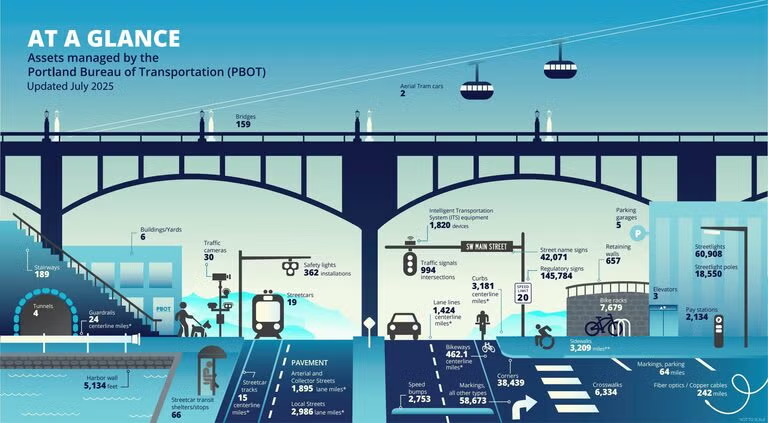
The two-hour event at 5800 SE Division Street saw visitors drop in between 6:30 and 8:30 p.m. as they moved through a self-guided arrangement of poster boards, with City staff available to ask questions and take notes. Portland transportation leaders have spent years warning the community and elected officials that its funding is overburdened by project-based restrictions, preventing 70% of PBOT’s budget from reducing a $6 billion maintenance backlog that impacts road conditions, sidewalks, bridges, signs, lights, and other infrastructure. Much of the funding sourced from Federal and Oregon State sources is for specific projects, such as new crossings or other safety infrastructure, and cannot directly fill potholes or repave roads. Even if a one-time grant were sourced to repair all of Portland’s transportation infrastructure to a “fair” condition, without an updated maintenance revenue source, PBOT assets would decline over the following decades, and a new generation of Portlanders would face the same systemic problem with infrastructure upkeep. In Wilson’s remarks, he painted a troubling picture of Portland’s $85 billion in street assets. “65% of our roads are in a state of not good repair. Most of the nation is above 50%, we are at 35% [for fair condition roads]. So we’re in trouble.”

A man in a blazer is engaging in conversation with a woman in a floral blouse at a social gathering. People can be seen in the background, and the setting appears casual.
Mayor Keith Wilson speaking to attendee at the February 25th transportation funding open house

The primary reason for the funding shortfall is inflation, with the presentation material noting that the costs of transportation, construction labor, and materials have increased rapidly while general funding sources have not kept pace. The mayor also pointed to the inequity and ineffective nature of a fixed gas tax that federal legislators have not increased since 1993. “I think we all know that fossil fuels and liquid fuels are going out of style. I drive an electric vehicle myself, and I don’t pay gas taxes. So when we think about paying our fair share, we have to think about the new generation, the new century, and not look to the last century for a failed taxing policy,” said Wilson. He explained the City is looking at “dozens of different options from around the country and the State” to evaluate for Portland transportation funding.

A workshop setting featuring informational posters about the Street Damage Restoration Fee, with details on damage recovery scenarios and comparisons with other cities. A person sitting at a table with a backpack is partially visible.

In the open house materials, PBOT has surfaced several proposals that may lay the groundwork for future street funding. Visitors read information about a possible “Street Damage Restoration Fee” that would be charged to utility companies, contractors, or other entities that excavate or trench in the public right-of-way, damaging streets and sidewalks. These crews, including other Portland bureaus, must repair the damage. However, that work often fails to adequately restore the full integrity of a street or sidewalk, and those assets can fail prematurely, a decade or decades earlier than expected.

Presentations also asked attendees to consider a “Transportation Utility Fee” as a funding source, as 31 other Oregon cities have implemented. It could be a monthly fee added to existing public utility bills, which residents and businesses pay. That money collected would support basic road maintenance, such as fixing potholes, and requested safety improvements. A “Retail Delivery Fee” concept would require major retailers to pay a fee for packages delivered to customers through the city’s transportation network. This would come from companies like Amazon, Walmart, Home Depot, Target, and eBay. Colorado and Minnesota have programs like this, but Portland could be the first city to enact this if the City Council adopts this idea. This approach could cover prepared-food transportation in addition to, or in place of, packages with a “Third-Party Food Delivery Fee” similarly proposed.

Asset graphic courtesy PBOT

The open house materials also stressed accountability through audits and transparency. Mayor Wilson’s remarks also centered on shifting taxes rather than simply layering new revenue sources on residents. “The one that we’re gonna be talking about is the transportation utility fee that is going to be a replacement for a gas tax… It’s a real fair way that all houses and/or businesses will pay a portion. My promise to you is if council passes this, I will work to phase out your gas tax for fixing our streets because it’s just not fair, and we have to start rethinking how we’re gonna move our city forward.

Informational posters detailing the City of Portland's transportation funding crisis and challenges, including budget timelines and structural funding issues, set up in a community space.

PBOT encourages people to visit portland.gov/pbotfunding for more information and share feedback by noon on Wednesday, March 4th, 2026. After that date, extending into May, Portland City Council members will deliberate on the presented materials and community feedback.

Correction: Updated a percentage in Mayor Wilson’s quote clarifying a statement that most cities in the nation have more than 50% of streets in “fair” or “good” condition and Portland is at 35%.


Promotion: Montavilla News is supported by contributions from businesses like Otter Wax, a neighborhood producer of small-batch specialty goods handcrafted in Portland. Using only natural ingredients, they make modern care products that are steeped in tradition. We thank them for their support.

Two-month Westbound NE Halsey Detour at I-84

Starting Monday, February 16th, westbound motorists on NE Halsey Street need to take a detour to NE 82nd Avenue during the next two months of construction on a new mini-roundabout. Eastbound travelers should not experience any significant disruption, but northbound users of NE 80th and NE 81st Avenues will continue to experience local-access restrictions from NE Clackamas Street to NE Halsey Street.

Crews recently completed half of a new mini-roundabout along NE Halsey Street as contractors working with the Portland Bureau of Transportation install street-level bike and pedestrian safety infrastructure, along with upgraded underground stormwater management pipes that connect with relocated catch basins. This street reconfiguration includes reconstructed sidewalks and curbs on sections of NE Halsey at notoriously challenging intersections with multimodal conflict points.

A map illustrating traffic directions for westbound NE Halsey St, highlighting required use of the I-84 onramp after NE 84th Ave. Features green arrows for bidirectional traffic and orange arrows indicating temporary one-way traffic.
Portland Maps image with MV News illustrations

This work is part of the NE Halsey Street (68th to 92nd Avenues) – Safety and Access to Transit Project. It builds on substantial street safety improvements undertaken in 2024, when roadwork reconfigured NE Halsey Street between 68th and 81st Avenues, removing a lane in each direction while adding painted buffered bike lanes and a center turn lane. In this section of the project, the new mini-roundabout at NE 80th Avenue and Halsey Street will address a confusing intersection, located just before one of the three NE Halsey Street freeway overpasses. Renderings posted show that people will have access to high-visibility pedestrian and bike crossings. Rebuilt and extended corners will also shorten the crossing distance, and new sidewalk segments will guide users to pathways that lead to transit connections. When contractors complete work at NE 81st Avenue, cyclists will have access to a bi-directional buffered bike track on the south side of NE Halsey Street, extending up to NE 92nd Avenue.

Map of a roundabout intersection featuring NE Halsey Street, NE 80th Street, and NE 81st Street, alongside the I-84 Eastbound off-ramp.
PBOT provided illustration showing the NE Halsey, NE 80th, and 81st junction with mini roundabout

PBOT chose this intersection design to reduce crashes while keeping traffic flowing. The roundabout will slow drivers and reduce conflict points, without requiring drivers to come to a complete stop unless a cyclist, pedestrian, or other vehicle has the right of way. The infrastructure should have a lower lifecycle cost because it does not rely on electric traffic signal equipment. Buses and fire trucks can easily drive through the center of the roundabout to make tight turns when needed, improving safety without impacting critical travel routes.

The next phase of work will focus on the northern half of the mini-roundabout, following the recent completion of the southern portion. Crews will continue to work at the site from 7 a.m. to 6 p.m., Monday through Friday. All driveways on these blocks will remain open for people traveling to or from the worksite. However, street users should anticipate additional detours and follow all instructions from crews working in the area.


Promotion: Montavilla News is supported by contributions from businesses like Otter Wax, a neighborhood producer of small-batch specialty goods handcrafted in Portland. Using only natural ingredients, they make modern care products that are steeped in tradition. We thank them for their support.

TriMet Moves Forward with Nearly 7 Miles of Transit-Priority Lanes on 82nd Ave

On Friday, February 13th, TriMet leadership instructed the 82nd Avenue Transit Project designers to work toward creating 7 miles of Business Access and Transit (BAT) lanes along most of Portland’s portion of 82nd Avenue. The transformative project would convert the 72 bus line into a Bus Rapid Transit (BRT) system under TriMet’s FX (Frequent Express) moniker, with high-capacity vehicles, modern stations, traffic signal priority, and, now, transit priority on the outer lanes of 82nd Avenue. This updated project scope will increase the current project’s proposed $350 million budget by at least $8 million, and the project partners are depending on yet-unawarded $150 million in federal funding.

TriMet General Manager Sam Desue Jr. made the directive to advance the incorporation of significant BAT lane allocation in the design at the project’s Policy & Budget Committee meeting. This follows months of public dispute over restricting a lane of automotive travel in each direction on a busy north/south connector road that was formerly a state highway until transferring to Portland’s ownership in 2022. BAT lanes serve two primary functions in a transportation network. They are focused on providing local access for vehicles on congested streets and on providing transit systems with a less encumbered lane to move more reliably between stops. Advocates for the design note that driving to a business’s parking lot entrance on a busy road requires a visitor to wait in rush-hour congestion even if they turn onto the street a block away. In those conditions, it can also take a significant time for a motorist leaving a driveway to exit and merge into traffic. BAT lanes can help address those situations by requiring all outer-lane travelers in private vehicles to turn right within a block. Supporters also tout the BAT lanes used by emergency vehicles, which can speed through congestion when time matters.

A green public transit bus stopped at a modern bus station with a clear shelter and seating area, surrounded by bike lanes and pedestrian pathways.

BAT lanes are strongly supported by surveyed residents who favor a faster, more effective BRT system on 82nd Avenue. People who spoke in support at the 82nd Avenue Transit Project Community Advisory Committee (CAC) meetings also appreciated the anticipated reduced speed of BAT lanes on the curb adjacent portion of the road. 82nd Avenue once had parking along its outer edges that later became travel lanes, leaving pedestrians and fast-moving vehicles inches apart. However, many businesses are concerned about the economic impact of a sudden change in vehicle throughput. Although 82nd Avenue is not at capacity at all times of day, it does often become congested, and transportation models indicate that introducing this level of BAT lanes will divert 20 to 25 percent of traffic to other routes during peak times. Local businesses that started their ventures on a state highway years ago worry that this change will force them to relocate or close as their customers take a different route to avoid heightened congestion. People advocating for 82nd Avenue to transform into a more pedestrian-forward design say that new shoppers will come by foot and by bus, but that mode shift can take years, and many of the small businesses that have made up 82nd Avenue’s culture say they cannot survive the transition timeline, which is far from certain.

Map showing city/county limits with SE Clatsop St and NE Lombard St, intersecting streets including SE Powell Blvd and SE Foster Rd, and I-84 orientation.
Feb 13 Business Access and Transit (BAT) lanes graphic courtesy TriMet with MV News directional notation

The TriMet adopted design for BAT lanes closely represents the community-supported design, and the project 82nd Avenue Transit Project CAC endorsed design, referred to as the “More BAT Lanes” option, with one notable exception. The nearly seven miles of transit-priority updates will stop before and resume after SE Powell Boulevard. During the January 28th CAC meeting, presenters explained that because that cross street is still a state highway, the Oregon Department of Transportation would require significant improvements at that intersection and on SE 92nd Avenue to accommodate the agency’s design standards for vehicle throughput. They explained that it would dramatically increase project costs or significantly delay the design process, seeking exemptions.

The project is targeting a 72 FX Line opening in 2029 and still has many milestones to meet before construction can begin. Planners need to find additional funds for the BAT lane portion of the project and secure federal funding in a challenging time for states seeking support from national leaders. TriMet says the Federal Transit Administration (FTA) gave the project a Medium-High rating, a strong indicator that it could receive those funds. Proponents of the BRT investment point to this corridor as an essential focus for efforts. TriMet’s Line 72 bus provides nearly 66,000 rides each week and is the busiest bus line in TriMet’s system. It also represents the highest-ridership bus line in all of Oregon, making it an ideal candidate for upsizing to strengthen the network’s backbone. Many riders use this route along 82nd Avenue to the Clackamas Town Center to connect with other lines. Transit designers say reliable and timely performance is essential to improving the network and reducing future congestion by getting more people out of personal vehicles for daily commutes. People can provide comments and learn more at the project website (trimet.org/82nd/).

Disclosure: The author of this article previously served on the 82nd Avenue Transit Project Community Advisory Committee (CAC).


Promotion: Montavilla News is supported by contributions from businesses like Greg Beddor – SEO Specialist, an Oregon based digital marketing consultancy. The company markets customer’s websites and provide SEO services to grow their business. We thank them for their support.

Parking Protected Bike Lanes on SE Washington

At the end of January, crews working with the Portland Bureau of Transportation (PBOT) completed the installation of slightly raised concrete separators for the newly created parking-buffered bike lane on the south side of SE Washington Street. This new physical infrastructure helps keep parking vehicles from encroaching on the curbside non-automotive path. However, the installation of the bicycle safety infrastructure on the one-way street is not universally appreciated by street users.

A street scene showing a utility work sign, traffic cones, and a bike lane marking, indicating ongoing construction. Wooden planks are laid across the road.
Concrete forms for lane separators on SE Washingtons St looking east from SE 76th Ave Jan 27th, 2026 (Crossett Freilinger)

In August, 2025, crews with Specialized Pavement Marking (SPM) removed lane markings on SE Thorburn, Stark, and Washington Streets as part of PBOT’s reconfiguration of the roads to improve safety for bike and pedestrian use. Road marking contractors repainted the streets, changing the traffic pattern for drivers on SE Thorburn and Washington Streets who lost a lane of travel in each direction. Bike lane users gained a protected route from SE Gilham Avenue to SE 92nd Avenue. PBOT retained much of the existing street parking on both sides of SE Washington Street for a critical two-block segment near the historic Montavilla downtown area. The road striping plan removed south curbside parking on SE Washington and replaced it with bike-lane-adjacent parking from SE 76th to 80th Avenues, creating a protected buffer for the five-foot-wide curbside cyclist route. To accommodate driveway access and maintain driver visibility, PBOT reduced parking capacity on the south side of the street, painting a white hatch pattern where vehicles should not stop and creating painted stalls where cars can park.

During the last six months, drivers have used the painted markings with varied success. At times, people continued to park against the southern curb, blocking the bike lane, or used the hatched area for parking. The addition of the raised concrete separators on the northern edge of the bike lane has helped keep vehicles aligned with their space, giving motorists’ tires a tactile street element to detect the proper position without extending into the bike lane. The width of the concrete separator also keeps vehicles from creating an open door obstacle for bike lane users. One of the challenges bike riders face in some parking-protected lanes comes from car doors opening into the lane. If the door is longer than the bike lane’s width and the vehicle is close to the outer edge of the lane, the rider is trapped between the parked vehicles and the curb, with no space to veer around an open door. In SE Washington’s configuration, most open passenger doors should allow enough room for the cyclist or scooter rider to hug the curb and zip around the vehicle’s door.

A street scene featuring orange traffic cones along a curved road, traffic lights with green signals, and residential houses in the background. A bicycle lane is marked on the pavement, and wet ground indicates recent rain.
SE Washington St west of SE 76th Ave (Jacob Loeb)

Even with these recent concrete additions, some cyclists say they feel trapped in parking-protected bike lanes and fear reduced visibility to drivers who may turn across the path without noticing riders behind the parked cars. That has led some safety advocates to point to Dutch-style, physically separated, and often raised bike infrastructure that places the bike path next to the pedestrian sidewalk and pushes the planting strips and furniture zone, with utility poles, towards the curb. This design is costly to retrofit into existing streets because it often requires relocating overhead and below-ground utility lines. It also requires additional markings to help cyclists and pedestrians properly navigate a shared sidewalk space without conflict.

Some local business owners and drivers using this route have expressed dissatisfaction with the loss of a travel lane on the one-way street. During peak usage times, traffic can back up as motorists wait for the traffic lights at SE 76th, 82nd, and 92nd Avenues. Similarly, during the weekend farmers market or on busy evenings, the slightly fewer parking spots on SE Washington Street will require people to park farther into the residential portion of the neighborhood. However, at most times of day, the street flows without significant traffic buildup, and the commercial streets of Montavilla historically lacked sufficient capacity to accommodate the number of visitors seeking parking during big events. For years, drivers have ventured into the surrounding residential areas to park their vehicles during those peak times.

A street scene showing a construction barrier on a roadway, parked cars in the background, and a pedestrian walking with a red umbrella along the sidewalk. A speed limit sign for 30 is visible.
SE Washington St showing hight of raised concrete lane separator (Jacob Loeb)

For cyclists and scooter users riding in this new lane, the raised concrete separators help align the parked cars, providing protection. They also help motorists interact with the uncommon parking arrangement. However, these raised separators are shorter than a curb and beveled so vehicles can easily drive over them. They do not offer full protection for cyclists beyond simply encouraging drivers to stay in their lanes, and drivers will need to adapt to this new traffic pattern and parking system. Until then, all street users should use caution in this area and look for unexpected conflict points.


Promotion: Check out East Portland News as it continues to advocate for and report on outer East Portland. You will find frequently updated articles and an archive of more than 5,000 stories written over the past 20+ years alongside a robust Community Calendar of events.

Pavement Repairs on SE 85th Part of Sidewalk Infill

On January 27th, contractors working with the Portland Bureau of Transportation laid new asphalt along a segment of SE 85th Avenue behind the Fubonn Shopping Center, temporarily closing the street to through traffic. This work is part of the Jade and Montavilla Multimodal Improvements Project, which created sidewalks from SE Division Street to SE Powell Boulevard along SE 85th Avenue. This segment was previously only partially paved with a pot-hole-laden gravel shoulder. Now cyclists, pedestrians, and drivers have a consistently reliable north-south route away from the busy 82nd Avenue main street.

This repaving work between SE Clinton and Brooklyn Streets adds to previous work that created new sidewalks on SE Clinton Street from SE 84th to 87th Avenues, with crews converting the existing gravel road to a modern street surface from SE 84th Place to 87th Avenue. West of 82nd Avenue, SE Tibbetts Street is receiving sidewalk infill, with some blocks lacking consistent pedestrian pavement down to SE 78th Avenue. Most sidewalks in the project area will receive updated Americans with Disabilities Act (ADA) compliant curb ramps.

Construction site featuring two multi-story buildings with yellow siding, blue tarps on the roof, and exposed windows. Heavy machinery and building materials are visible in the foreground, along with a red car parked nearby.
40-unit Jade Apartments at 2905 SE 89th Avenue

The new street infrastructure connects to a secondary entrance to the Fubonn Shopping Center, which contractors constructed in April 2025, providing access to the east side of the grocery store and retail site from SE 85th Avenue. Designers located the new entrance on the northeastern corner of the shopping complex. These updates were part of a long-term plan to improve multimodal access in a section of Portland’s Jade District that has the capacity for significant housing development on large, underdeveloped properties. Crews are currently wrapping up external construction on the 40-unit Jade Apartments at 2905 SE 89th Avenue, and Oregon Metro recently purchased a 1.46-acre property at the intersection of SE 90th Place and SE 89th Avenue for housing development.

Construction workers operating heavy machinery on a street, with a large truck parked nearby and bare trees lining the sidewalk.
Crews laying new pavement along SE 85th Ave connecting the roadway between new sidewalks

Other developers are similarly looking to increase housing density in the area as private and public projects create the infrastructure needed to support the new people walking, driving, and rolling through this area bordered by SE Division Street, SE 82nd Avenue, SE Powell Boulevard, and Interstate-205. Look for work to be completed on SE 85th Avenue in the coming weeks, along with increased usage as people discover this improved route in the Jade District.


Promotion: Montavilla News is supported by contributions from businesses like Otter Wax, a neighborhood producer of small-batch specialty goods handcrafted in Portland. Using only natural ingredients, they make modern care products that are steeped in tradition. We thank them for their support.

Crews Complete 1st Half of NE Halsey Mini-roundabout

Crews recently completed half of a new mini-roundabout along NE Halsey Street as they work to reopen NE 80th and NE 81st Avenues to car traffic. Contractors working with the Portland Bureau of Transportation installed underground stormwater management pipes that connect with relocated catch basins as part of this street reconfiguration, which includes reconstructed sidewalks and curbs. NE Halsey remains open for east-west through traffic.

Map of a roundabout intersection featuring NE Halsey Street, NE 80th Street, and NE 81st Street, alongside the I-84 Eastbound off-ramp.
PBOT provided illustration showing the NE Halsey, NE 80th, and 81st junction with mini roundabout

This work is part of the NE Halsey Street (68th to 92nd Avenues) – Safety and Access to Transit Project. It builds on substantial street safety improvements undertaken in 2024, when roadwork reconfigured NE Halsey Street between 68th and 81st Avenues, removing a lane in each direction while adding painted buffered bike lanes and a center turn lane. In this section of the project, the new mini-roundabout at NE 80th Avenue and Halsey Street will address a notoriously confusing intersection, located just before one of the three NE Halsey Street freeway overpasses. Renderings posted show that people will have access to high-visibility pedestrian and bike crossings. Rebuilt and extended corners will also shorten the crossing distance, and new sidewalk segments will guide users to pathways that lead to transit connections. When contractors complete work at NE 81st Avenue, cyclists will have access to a bi-directional buffered bike track on the south side of NE Halsey Street, extending up to NE 92nd Avenue.

Construction site showing orange traffic cones, wooden forms, and marker flags in a partially paved area during sunset.
NE 80th Ave at NE Halsey looking east on January 15, 2026

PBOT chose this intersection design to reduce crashes while keeping traffic flowing. The roundabout will slow drivers and reduce conflict points, without requiring drivers to come to a complete stop unless a cyclist, pedestrian, or other vehicle has the right of way. The infrastructure should have a lower lifecycle cost because it does not rely on electric traffic signal equipment. Buses and fire trucks can easily drive through the center of the roundabout to make tight turns when needed, improving safety without impacting critical travel routes.

Construction site with heavy machinery, traffic cones, and barriers blocking the sidewalk and road.
NE 81st Ave looking northwest on January 15, 2026

The next phase of work will restore the road surface around the new raised concrete infrastructure so eastbound traffic can travel around the southern half of the mini-roundabout and access NE 80th and NE 81st Avenues. Then, contractors can build the northern half of the mini-roundabout. Crews will continue to work at the site from 7 a.m. to 6 p.m., Monday through Friday. All driveways on these blocks will remain open for people traveling to or from the worksite. However, street users should anticipate detours and follow all instructions from crews working in the area.

A construction site featuring a newly poured concrete sidewalk, traffic cones, and road construction barriers in front of a commercial building.
NE 80th Ave at NE Halsey looking east on January 23, 2026

Promotion: Check out East Portland News as it continues to advocate for and report on outer East Portland. You will find frequently updated articles and an archive of more than 5,000 stories written over the past 20+ years alongside a robust Community Calendar of events.

Reconstructed Sidewalk Corners Planned on NE Glisan

Crews working with the Portland Bureau of Transportation (PBOT) will update sidewalk corners along NE Glisan Street as part of the planned NE Glisan Pave and Paint Project, which will use pavement maintenance to restripe and reconfigure the roadway from NE 82nd to 92nd avenues. Ahead of the planned summer work, contractors will begin rebuilding crossing points to Americans with Disabilities Act (ADA) compliant standards for curb ramps and updating stormwater catch basin placement to match the new ramps and better handle rainwater runoff.

A sidewalk marked with white chalk lines and symbols, resembling a hopscotch game, alongside a grassy area and a playground in the background.
Future site of mid-block curb ramp at NE 83rd Ave leading to Montavilla Park playground

Recently added pavement markings at the “T” intersection of NE Glisan Street and 83rd Avenue indicate the placement of new curb ramps at the south corners and two mid-block ramps on the north alignment for the unmarked crosswalk. Montavilla Park and the Multnomah University campus create a long, uninterrupted block on the northern edge of NE Glisan. Up to now, anyone crossing the busy east-west roadway had limited curb ramp options. PBOT will need to enhance most crossing points along the work site that are not already updated to modern standards before major roadwork takes place, as the repaving project repairs the cuts made by the sidewalk corner and stormwater system installation at the street’s edge. People can expect that work to take place this Spring.

Sidewalk with chalk markings and numbers, adjacent to a road lined with trees and shrubs.

PBOT planners anticipate that much of the in-traffic lane work will take place in the Summer of 2026, when crews use heavy equipment to grind down old asphalt and spread a new layer of aggregate bound with bitumen to create a smoother driving surface. Contractors will repaint the lane markings in a new configuration to support painted buffered-bike lanes along the curb for much of the project length. This section of NE Glisan Street implemented alternating outer lanes used for parking or an auxiliary travel lane, depending on the time of day. Collisions occurred on this street where cars were parked, but drivers may have assumed the outer lane was clear. PBOT engineers anticipate that removing that conflict point will yield significant safety improvements with minimal impact on vehicle throughput. This work will also increase safer bike and pedestrian infrastructure in the area this year, while later project work can build on the new configuration with hardened street elements for greater safety.

Proposed cross-section diagram for 80th Ave to I-205 segment, showing lane widths for vehicles and bike lanes.
Illustration of the existing four travel and one turn lane over proposed configuration from PBOT’s NE Glisan St – 82nd Avenue Multimodal Safety and Access 2028-2030 RFFA Project Factsheet. Courtesy Oregon Metro

This stretch of NE Glisan received an Oregon Metro Regional Flexible Funds Allocation grant to add physically protected bike infrastructure sometime in 2030. The work included in the Northeast Glisan St: 82nd Avenue Multimodal Safety and Access project would require lane reconfiguration and repainting. PBOT Planners feel that this 2026 road surface maintenance presents an opportunity to save public funds by reconfiguring the street during the post-asphalt-work painting process ahead of the larger safety improvement project. By doing road marking work now in the new configuration, post-repaving, PBOT can save taxpayer funds by lessening the reconfiguration costs four years later.

A suburban street view showing parked cars on both sides, with a street sign for 'E Glisan' visible. Trees and houses line the street, and a cloudy sky is overhead.
NE 83rd Ave looking south from NE Glisan

Travelers should anticipate seeing more pavement markings on the sidewalk along NE Glisan Street from NE 82nd to 92nd avenues as planners ready the area for the rebuilt pedestrian and stormwater infrastructure. People walking in the area should anticipate detours when demolition and construction work start in the spring. Drivers in the area should expect temporary outer lane closures on NE Glisan during construction, followed by permanent outer lane closures after crews paint new lane markings. Details are available on the project website.


Promotion: Check out East Portland News as it continues to advocate for and report on outer East Portland. You will find frequently updated articles and an archive of more than 5,000 stories written over the past 20+ years alongside a robust Community Calendar of events.

New Pedestrian Infrastructure Opens Around Chick-fil-A

As Portland’s first free-standing Chick-fil-A restaurant prepares to open in early 2026, pedestrians traveling around the Mall 205 area in the Gateway district gain access to wider sidewalks with street furniture offering places to rest. Recently, crews removed construction fencing around the new fast food destination at 9950 SE Stark Street, fully opening the area to street users.

Concrete seating pods and newly reconstructed sidewalk along SE 99th Avenue near the upcoming Chick-fil-A location in Portland, with trees and street furniture enhancing pedestrian accessibility.
Cluster of three round concrete seating on the southeast corner of SE 99th and Stark St

Construction work at this restaurant location began last April, triggering requirements for sidewalk and curb ramp reconstruction to meet modern standards for its Civic Main Street classification on the south and north sides of the site. Improvements to the 15-foot public right-of-way feature street trees planted between the curb and pedestrian through zone, offering a buffer between the fast-paced traffic on the SE Stark Street and Washington Street couplet. Chick-fil-A contractors installed round concrete seating pods along the property’s SE 99th Avenue frontage with a cluster of three on the southeast corner of SE 99th and Stark Street. A new traffic signal pole at the northeast corner of SE 99th and Washington Street features mounting points for future mast arms to support traffic lights, replacing the antiquated cable-hung hardware at the intersection. An additional mounting bracket at the top of the pole has a place for a new street light to further illuminate this high-volume crossing, while building-hung sconces add human-scale lighting.

Close-up of a traffic signal pole with mounting points for future traffic lights and a new street light, set against a blue sky.
Mounting points on a new traffic signal pole at the northeast corner of SE 99th and Washington St. for future mast arms to support traffic lights

The Portland building code mandated many pedestrian improvements along the three frontages of this 0.78-acre property. These upgrades serve the district as a whole as it becomes less car-centric. However, this restaurant’s patrons may depend on these updates, as there is expected to be higher foot traffic here than at other Chick-fil-A stores in the area. The Portland City Council voted in 2018 to prohibit new drive-through construction within commercial zones. Although this project is a near-complete renovation of an existing building, the structure never included a drive-through service window. This project dates back to May 2022, when the national fast food chain explored development at 9950 SE Stark Street, opting to renovate the original structure to maintain its nonconforming use of the existing site for food service. The 1984-era structure previously hosted Rax Roast Beef, Tony Roma’s, and Hooters restaurants before converting to Mystic Gentlemen’s Club and later Venue Gentlemen’s Club.

Exterior view of the new Chick-fil-A at Mall 205 showing large windows, modern lighting fixtures, and sidewalk planters.
SE 99th Avenue frontage with human-scale lighting and seating

Without a drive-through window, most motorists will need to park onsite and enter the establishment for service. Other Chick-fil-A locations have been known to create traffic jams at times as drivers queue for in-vehicle sales. At this new location, people may need to park at another location and walk over for service during peak times. To help speed up orders and clear the parking lot more quickly, operators will implement digital tools for customers. “We will be offering curbside delivery as an alternative,” wrote a store social media representative on Facebook. This will require more staff time but will allow customers to remain in their vehicles. Additionally, this restaurant features a dedicated delivery driver entrance so people can order via smartphone apps and have their food brought to them.

Exterior view of the new Chick-fil-A location at 9950 SE Stark Street in Portland, featuring signs for delivery drivers, a tree, and nearby street furniture.
Delivery driver entrance

Franchise operator for this location, Austin Morrow, has worked for Chick-fil-A since 2014. In this specific franchise model, the property, building, and equipment are owned by the corporation, with individuals competing to become the location’s operator. The “Chick-fil-A Mall 205” store will be Portland’s only location within city limits since the Lloyd Center food court location closed in 2003. Community members have mixed opinions on the opening. Some are excited for the renowned chicken sandwich provider to come in and revitalize a commercial corridor that has experienced a decline in previous decades. Others worry about the increased traffic near the Interstate 205 ramps caused by this new high-demand destination. Additional perspectives oppose the company as a whole because of the ownership’s support for organizations that oppose LGBTQ rights.

A new sidewalk and landscaping along SE Stark Street near the upcoming Chick-fil-A Mall 205, featuring newly planted trees and a clear pedestrian path.
New wider sidewalk on SE Washington St. with street trees

The operator of Chick-fil-A Mall 205 has yet to announce an official opening date, but indicated it will welcome guests soon. Regardless of the restaurant’s impact on the business district and community, the renovations of this former strip club have improved the public infrastructure on this half block. The corporate endorsement of the area could also incentivize other investments along the corridor, spurring redevelopment with infrastructure improvements and denser land use, fitting the Gateway District’s Central Commercial zoning that encourages city-center-sized projects.

Update January 18, 2026: The Chick-fil-A Mall 205 location will open from 6:30 a.m. to 10 p.m., Monday through Saturday starting Thursday, January 22nd.


Promotion: Montavilla News is supported by contributions from businesses like Greg Beddor – SEO Specialist, an Oregon based digital marketing consultancy. The company markets customer’s websites and provide SEO services to grow their business. We thank them for their support.

Groundwater Activated in Response to Turbidity from Heavy Rain

On December 19th, Portland Water Bureau (PWB) announced a complete switch to groundwater from Portland’s Columbia South Shore Well Field in response to higher amounts of organic material suspended in the Bull Run Watershed after this week’s heavy rainstorm. City ratepayers receive water from two primary sources that utility operators can switch between or blend together based on supply and environmental conditions. Groundwater sources are often activated by PWB during the dry summer season, as the Bull Run water supply diminishes in capacity, and they try to extend its availability by mixing the two sources. However, water from wells can take over for Bull Run if that source is threatened by wildfire contamination or by turbidity from excessive rain.

A similar event occurred in November 2022, when a massive rain event increased the flow of streams feeding the Bull Run watershed, contributing to a rapid increase in organic material washed into the supply, which takes time to settle. Almost a million people depend on water supplied by the Water Bureau. Long-term investments have added well-water sources to the City’s water supply, enhancing resiliency against weather-related events. The new Bull Run filtration facility, when it comes online, should reduce the need to switch to groundwater after storms. Federal water quality regulations require PBW to activate the extra water treatment capability by September 2027. The filtration facility will remove sediment, organic material, and other contaminants, including disease-causing microorganisms that could threaten drinking water safety.

The Portland Water Bureau assures residents that the Columbia South Shore Well Field water supply meets or surpasses all federal and state drinking water regulations. However, they make it a policy to notify the public when activating groundwater sources so sensitive water users can take precautions. Ratepayers can sign up at the Portland Water Bureau’s website to receive notifications regarding changes to the water system. In 2022, that took less than 30 days. Customers with questions should call the Water Line at 503-823-7525 and watch for updates to this article when Portland’s water system returns to 100 percent Bull Run watershed-sourced water.

Update December 27, 2025: The Portland Water Bureau reactivated the Bull Run water supply after elevated turbidity from heavy rains subside. It can take up to two weeks for the system to completely clear of groundwater and deliver 100% watershed sourced water. Ratepayers may notice a tea like color in the Bull Run water as harmless fine organic matter continues to settle within the reservoirs post storm.


Promotion: Check out East Portland News as it continues to advocate for and report on outer East Portland. You will find frequently updated articles and an archive of more than 5,000 stories written over the past 20+ years alongside a robust Community Calendar of events.