In July 2025, Oregon Metro purchased a 1.46-acre property at the intersection of SE 90th Place and SE 89th Avenue for planned Transit-Oriented Development (TOD). For over a decade, community advocates have envisioned the large, sloped property as a neighborhood park and are now seeking support for that project ahead of Metro’s RFP (Request for Proposals) this summer. Residents and interested parties can complete an Online Form to endorse a call for the City to purchase the lot from Metro and to direct Portland Parks and Recreation to create public green space for the expanding community in this area.
Park Rendering from the 2018 EPA Greening The Jade project document
Metro’s TOD team plans to introduce new affordable housing at the site with help from partner developers. The early concepts included open neighborhood greenspace, but not at the scale documented in the 2014 Jade District community visioning plan or the 2018 EPA Greening the Jade project. The community outreach recorded in those documents showed a desire and expressed need for green space across all groups in the neighborhood. The Metro-owned property at 2815 SE 90th Place is in the center of a community surrounded by busy city roadways, a State highway, and a freeway. Harrison Park is the closest park to this location, at over half a mile away, and often serves as an extension of the adjoining school’s campus rather than a neighborhood park.
2815 SE 90th Placeproperty with fence
Andrea Pastor, Metro’s Senior Development Project Manager of Housing and TOD, explained in a September 2025 interview that Metro purchased the land along SE 89th Avenue using an allocation provided by the Oregon State legislature for a revolving acquisition fund around 82nd Avenue. “With all of the improvements happening on 82nd, including the planning of the new transit, we wanted to prioritize the area. So we made a specific legislative ask back in 2023 for some funds to buy land near 82nd,” said Pastor. “We have been basically looking and making offers on properties in the area for the last couple of years.” She notes that Metro has often owned land around transit with the intention of developing it. “We are trying to think of ourselves as a regional land bank specifically aimed at building affordable housing near transit.”
The Jade District advocacy organizers seeking support for the park say Metro TOD is willing to sell the parcel, but City of Portland support must be secured before Metro releases an RFP to potential developers in August or September 2026. The park space is across from The Jade apartments, which are currently under construction and will offer 15 units with family-sized accommodations, including three bedrooms and two bathrooms. The workforce housing development will also create 14 one-bedroom and 11 two-bedroom flats. The expanded pool of families on this street would benefit from a new city park with a safe crossing to a play area. The site can also amplify existing green space that is not publicly accessible but protected by Portland’s Bureau of Environmental Services, which owns the lot to the south of this property. It serves as a natural stormwater detention area where plants and soil help absorb the area’s rainwater. It also contains a sewer pump facility that requires 24-hour security for community safety and asset protection. Depending on the City’s flexibility, designers could extend park space into some of the stormwater detention area land without compromising security.
Image from the 2018 EPA Greening The Jade project document
Park designs and amenities presented in the visioning materials are illustrative only and do not constitute final design options. If the idea receives community support through the Online Form and city officials adopt the property for a new park, future community outreach from park planners will drive the development of the green space. Whether the land serves as a public park or affordable housing, this large, underdeveloped property will become a needed community resource as housing density brings more people into the Jade District.
Portland City Councilor Steve Novick wants to amend a 1992 chronic nuisance property ordinance to lessen the threshold for triggering mandated remedies. He is proposing these changes with the intent of reducing the impact on afflicted neighborhoods from human trafficking and gun violence. The City Council will hear first reading on this proposed amendment at the March 18th session held at 6 p.m. this Wednesday.
Former Congressman Earl Blumenauer introduced the first version of Portland’s chronic nuisance property ordinance while serving as a Portland Commissioner. It received several updates in the years following its enactment but has remained relatively unchanged since 1997. The proposed update considers the current list of Nuisance Activities to be too narrow and the timeframe for accumulating violations to be too restrictive for law enforcement to adequately address contemporary instances of harmful behavior. “We’re proposing that instead of having to have three instances in 30 days to initiate this process —which is a lot, a hell of a lot of bad stuff can go on in the location, and you still don’t have three reports in 30 days— we’re proposing it become two in 90 days,” said Novick.
The councilor says this ordinance has never been intended to punish property owners. Instead, it is designed to encourage responsible site operations. “What it means is, it just gives the police a little more leverage to lean on property owners to play ball,” explained Novick. However, enforcement is not without significant consequences if people ignore recurring complaints. “Well, I don’t know if that’s ever happened, but if you can’t work out an agreement, then the city can go to court, which has happened rarely, and the court can order them to take abatement measures. Then, only if they don’t take abatement measures, then the last resort is that they forfeit the property,” Novick said. Ordinance infractions only accumulate for specific activity from a list of 25 defined types that occur within 200 feet of their property. Those activities include assault, Firearm-related crimes, drug crimes, and prostitution.
Additionally, Novick noted that the existing ordinance did not provide sufficient guidance for property owners to demonstrate a good-faith effort to improve conditions. So part of this update is to build that into the legislation. “Washington D.C. came up with a list of abatement measures to be considered. So we’re borrowing from that and saying, ‘here’s a list of things you might be asked to do,’” said Novick. The intent is to ensure people have a clear path to avoid consequences while minimizing the negative impact on the community. As the updates to the chronic nuisance property ordinance developed in committee, City Council members have worked to address business owners’ concerns. “The Asian American Hotel Owners Association’s Taran Patel testified. He said that he was generally supportive of the idea, but was concerned about what if a hotel reports the activity itself? Is that held against them?” recalled Novick. ” We thought that was a reasonable question, so we added an amendment to the law saying that if the property owner reports the activity themselves, then as long as they are cooperating with the police and following up on that subsequently, that doesn’t go on their record as one of the two instances that lead to invoking the nuisance law.”
In addition to the self-reporting amendment, the committee removed noise complaints from this ordinance, recognizing that such complaints are inconsistent with the other listed nuisances, which mostly focus on crimes that reduce perceived safety. “We’re removing noise as one of the chronic nuisance criteria at [Councilor] Jamie Dunphy’s request, and it’s not really what we’re worried about anyway,” said Novick. He explained that the city is trying to tackle serious issues where people suffer life-changing harms, including physical abuse and trafficking of people for sex work. Sex trafficking has become particularly apparent along NE 82nd Avenue near Leodis V. McDaniel High School and within certain storefronts advertising massage services that have spread across the region. “It identifies unlawful, non-compliant massage parlors as one of the nuisance activities. That’s a new thing, and because of the law that Representative [Thủy] Trần passed,” explained Novick. House Bill 3819, which Representative Trần co-sponsored, gave new investigatory powers to the State Board of Massage Therapists starting on January 1st, 2026, and increased maximum fine amounts. Now, the board can post a placard on the exterior of a business notifying the public if the massage facility is in violation of ORS 687.021 by using unlicensed practitioners.
Some critics of this type of legislation fear that without lodging spaces available, it will push sex work further into unsafe and exposed environments, including cars and public streets. This same perspective sometimes attributes the increase in pervasive solicitation on city streets to the 2018 passage of the Allow States and Victims to Fight Online Sex Trafficking Act (FOSTA) and the Stop Enabling Sex Traffickers Act (SESTA) that shut down many online forums used for connecting buyers and sellers of sex work. Some of those online tools had reportedly made sex work safer by letting sellers check a buyer’s reputation. Since 2018, the nation has seen an increase in street-based sex work, often with associated ancillary crimes occurring around that activity. Novick explained that he heard that perspective from some people, but that counter testimony convinced him that lodging did not provide substantive protections for vulnerable sex workers. “Robin Miller, who’s a survivor and advocate, testified in favor of the proposal several weeks ago,” recalled Novick. “Her experience was that there was nothing safe about being at a motel and was beaten by a supplier [third-party seller of sex] in front of the hotel owner, and the hotel owner didn’t do anything.” That testimony, along with the councilor’s understanding of community needs, has increased his support for this update to Portland’s chronic nuisance property ordinance. “We are concerned about kids walking this gauntlet of sex trafficking,” said Novick. “So you balance interests, and if you think that there’s a community benefit to doing something —and there’s significant numbers of people most affected who think that it’s the right thing to do— I’m willing to go with what I think has the broader community benefit.”
The expressed goal of this update is to further motivate businesses to assist with the problems surrounding their operations. Landowners may not always live in the same neighborhood as their property, but the city says, with this ordinance, that they have a commitment to those communities that should not be discounted. “The underlying question is, does a property owner have some responsibility for what’s going on on their property? I tend to think that they do,” said Novick.
On Wednesday night, February 25th, community members and City representatives gathered in the cafeteria at Atkinson Elementary School for District 3’s local transportation funding open house. This is one in a series of four in-person events led by the Portland Bureau of Transportation (PBOT) to help inform the Portland City Council, which will consider new ways to fund the maintenance and operation of Portland’s streets. Mayor Keith Wilson spoke at the event, summarizing some of the alternative funding options under consideration. People interested in learning more and contributing their perspective can visit the online open houseand take a post-open house survey.
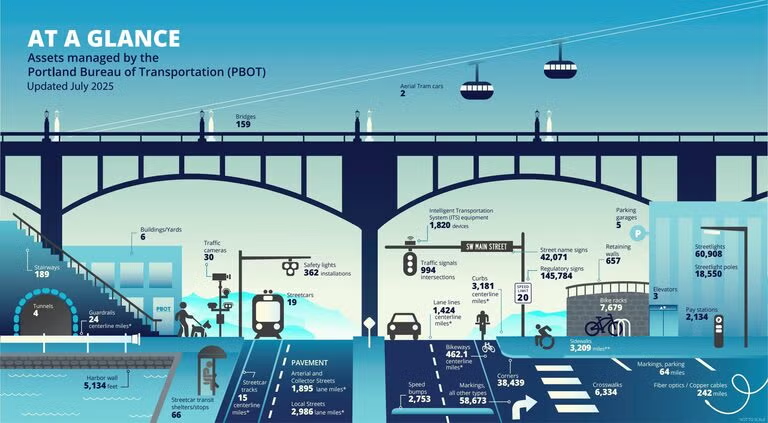
The two-hour event at 5800 SE Division Street saw visitors drop in between 6:30 and 8:30 p.m. as they moved through a self-guided arrangement of poster boards, with City staff available to ask questions and take notes. Portland transportation leaders have spent years warning the community and elected officials that its funding is overburdened by project-based restrictions, preventing 70% of PBOT’s budget from reducing a $6 billion maintenance backlog that impacts road conditions, sidewalks, bridges, signs, lights, and other infrastructure. Much of the funding sourced from Federal and Oregon State sources is for specific projects, such as new crossings or other safety infrastructure, and cannot directly fill potholes or repave roads. Even if a one-time grant were sourced to repair all of Portland’s transportation infrastructure to a “fair” condition, without an updated maintenance revenue source, PBOT assets would decline over the following decades, and a new generation of Portlanders would face the same systemic problem with infrastructure upkeep. In Wilson’s remarks, he painted a troubling picture of Portland’s $85 billion in street assets. “65% of our roads are in a state of not good repair. Most of the nation is above 50%, we are at 35% [for fair condition roads]. So we’re in trouble.”
Mayor Keith Wilson speaking to attendee at the February 25th transportation funding open house
The primary reason for the funding shortfall is inflation, with the presentation material noting that the costs of transportation, construction labor, and materials have increased rapidly while general funding sources have not kept pace. The mayor also pointed to the inequity and ineffective nature of a fixed gas tax that federal legislators have not increased since 1993. “I think we all know that fossil fuels and liquid fuels are going out of style. I drive an electric vehicle myself, and I don’t pay gas taxes. So when we think about paying our fair share, we have to think about the new generation, the new century, and not look to the last century for a failed taxing policy,” said Wilson. He explained the City is looking at “dozens of different options from around the country and the State” to evaluate for Portland transportation funding.
In the open house materials, PBOT has surfaced several proposals that may lay the groundwork for future street funding. Visitors read information about a possible “Street Damage Restoration Fee” that would be charged to utility companies, contractors, or other entities that excavate or trench in the public right-of-way, damaging streets and sidewalks. These crews, including other Portland bureaus, must repair the damage. However, that work often fails to adequately restore the full integrity of a street or sidewalk, and those assets can fail prematurely, a decade or decades earlier than expected.
Presentations also asked attendees to consider a “Transportation Utility Fee” as a funding source, as 31 other Oregon cities have implemented. It could be a monthly fee added to existing public utility bills, which residents and businesses pay. That money collected would support basic road maintenance, such as fixing potholes, and requested safety improvements. A “Retail Delivery Fee” concept would require major retailers to pay a fee for packages delivered to customers through the city’s transportation network. This would come from companies like Amazon, Walmart, Home Depot, Target, and eBay. Colorado and Minnesota have programs like this, but Portland could be the first city to enact this if the City Council adopts this idea. This approach could cover prepared-food transportation in addition to, or in place of, packages with a “Third-Party Food Delivery Fee” similarly proposed.
Asset graphic courtesy PBOT
The open house materials also stressed accountability through audits and transparency. Mayor Wilson’s remarks also centered on shifting taxes rather than simply layering new revenue sources on residents. “The one that we’re gonna be talking about is the transportation utility fee that is going to be a replacement for a gas tax… It’s a real fair way that all houses and/or businesses will pay a portion. My promise to you is if council passes this, I will work to phase out your gas tax for fixing our streets because it’s just not fair, and we have to start rethinking how we’re gonna move our city forward.
PBOT encourages people to visit portland.gov/pbotfunding for more information and share feedback by noon on Wednesday, March 4th, 2026. After that date, extending into May, Portland City Council members will deliberate on the presented materials and community feedback.
Correction: Updated a percentage in Mayor Wilson’s quote clarifying a statement that most cities in the nation have more than 50% of streets in “fair” or “good” condition and Portland is at 35%.
Promotion: Montavilla News is supported by contributions from businesses like Otter Wax, a neighborhood producer of small-batch specialty goods handcrafted in Portland. Using only natural ingredients, they make modern care products that are steeped in tradition. We thank them for their support.
The property, bordered by the Interstate 205 Multi-use-path on two sides, is currently secured with plywood “due to prior break-ins while vacant,” according to a real estate flyer. A modest commercial parking lot provides three parking stalls in front of the single-story building and one driveway leading to the eastern entrance. A gated back courtyard faces south and provides separation between two dormitory wings, each with a bathroom at the end. The most recent configuration of the space included five bedrooms, along with laundry, kitchen, office, and storage spaces. The north end of the building features an equally sized “family room” and “living room” flanking the large kitchen, which features residential-style appliances.
Gated back courtyard
A buyer could reconfigure the space and update the dated quarter-century-old interior in many ways, but the site’s residential zoning limits it to single-family, single-room occupancy housing, or similar group home uses. A new owner could also redevelop the large 16,460-square-foot lot into townhouses or other middle housing to increase density. Its location next to the pedestrian I-205 crossing bridge leading to the MAX light rail station and proximity to the Multi-Use-Path make it a good candidate for Transit-oriented Development.
Image of 9350 SE Taylor St from Portland Maps
Home Forward—renamed from Housing Authority of Portland in May 2011—is an independent Public Corporation that contracts with the federal government to administer housing programs. It owns around 110 properties. In past years, it has worked with partner groups to build affordable housing. This land, if fully redeveloped, would likely not be an impactful source of affordable housing for the organization that oversees 6,678 units. However, with an asking price of $499,999, selling it will not generate a significant sum to stave off operational budget shortfalls at the nonprofit. In a different financial landscape, Home Forward could have reinvested in this property for a similar group home use or other affordable housing option. The future buyer of this unique property will have an opportunity to reshape this residential block abutting the I-205 border of the neighborhood.
Article and Photos by
Jacob Loeb
Promotion: Montavilla News is supported by contributions from businesses like Otter Wax, a neighborhood producer of small-batch specialty goods handcrafted in Portland. Using only natural ingredients, they make modern care products that are steeped in tradition. We thank them for their support.
Leaders across Oregon want developers to build more homes. Governor Tina Kotek set a statewide housing production goal in 2023, aiming to add 36,000 units per year, and although that goal was not met, it remains a key talking point for the administration. Locally, past and present Portland City Council members, along with the Mayor, have tried to reorganize the City’s permitting structure and suspend specific fees to incentivize housing construction, which has declined post-pandemic. At a time when housing production targets and efforts to increase affordability would benefit from high-unit-count apartment construction within the Urban growth boundary, developers have reduced multifamily unit production, with outside investors choosing to build in other cities instead. Regional housing creators have likewise experienced diminished production, but recently, some Portland builders are finding a way to put crews back to work by reducing project unit counts to lessen permitting hurdles and bring in specialists who can navigate the convoluted City permitting process.
DK Homes owner Damir Karin began building Portland projects in 1991 and has remained a prolific housing developer in the region over the last 35 years. He points to the complex and opaque permitting process as the reason many of his projects have stalled over the past five years. However, he feels this is changing and anticipates a return to pre-pandemic levels of development for his company. Karin explained this change was not due to streamlined building code or reduced fees. Instead, he points to a new role within his company that focuses on breaking through the building permit bureaucracy while scaling down projects to get past “unexplained” rules that have caused years of delay. “What helped me is I hired a guy who just does permits for me, nothing else. He is running around, calling the City, and bothering them,” explained Karin.
380-foot-deep-by-80-foot-wide property at 2721 SE 101st Ave where DK Homes will build 8 new houses
Utilizing the added staff support for building permits, DK Homes intends to break ground in the next few months on three multi-unit developments in the Montavilla and surrounding areas, with a fourth from 2020 potentially reactivating as a smaller project. Karin appreciates the State and City efforts to make Middle Housing more enticing for housing producers. The Residential Infill Project (RIP), parts one and two, in effect since June 2022, added rules allowing many housing density options on parcels formerly restricted to single-family residences. It also ushered in Middle Housing Land Divisions within Single-Dwelling zones that allow houses to be on their own lots even if they are not directly connected to a city street, avoiding the need to create a condominium with homeowner fees. That has provided DK Homes with an avenue to convert its larger-unit projects into detached single-family homes that can sell for enough to cover the added expenses of holding high-interest-rate construction loans for a prolonged period and meeting the growing costs required by the City code.
DK Homes purchased a nearly three-quarter-acre property at 2721 SE 101st Avenue in 2017 with the intention of creating 11 homes. Now, the project will offer eight units off a shared driveway along the south edge of the property, with each house featuring a small garage, three bedrooms, two full bathrooms, and a half bath on the main level. “It was supposed to be 11, but going through the permit process and dealing with the City, fire code, this code, that code; they cut me to eight,” said Karin. “I want to do 11, but they cut to eight, I guess because of some fire rules.” He felt City staff never fully explained to him why the only way forward on this project was to offer less housing. Particularly because all homes on the 380-foot-deep-by-80-foot-wide property will have sprinkler systems to reduce the risk of fire spreading. Additionally, the driveway will extend to the back of the property in both designs. However, he is less interested in pushing against the rules and is instead trying to focus on moving these projects through the permitting process so he can start building again.
Portland Maps aerial view of DK Homes project sites on SE 101st and 103rd Avenues near SE Clinton St
The delay in development on the SE 101st Avenue project allowed him to use a new form of land division introduced through the RIP updates called cottage clusters. This project will not be a condominium with a Home Owner Association (HOA). Each home will have its own lot. The driveway and utilities will cross the adjoining homes’ easement, allowing access to the buildings located in the center of the large block. “It’s going to be separate houses, average is 1,400 square feet each,” said Karin. “But they are counting the garage, so it is 1,200 plus 200 [square feet] for the garage.” Most of the projects DK Homes has underway in the area will include attached vehicle storage as part of the design. Karin acknowledges that garages take up space in the home’s footprint that could serve as living space, and says his approach may be “old-fashioned,” but he feels it better serves his customers. “The City is pushing for no garages. I think Portland is not ready for that; people still have cars, especially in that area. So I decided to do houses with a garage. The people can park their car or use it like a storage unit,” explained Karin.
DK Homes will start a similar project one block over on the southwest corner of SE 103rd Avenue and Clinton Street. Because that site is on a corner, three houses will face SE Clinton Street, each having a driveway connecting to the city street. The other three homes will use a shared driveway accessed from SE 103rd Avenue. The 14 new homes on SE 101st and 103rd Avenues will use the Homebuyer Opportunity Limited Tax Exemption (HOLTE) Program. That affordability program for Single-unit homes lets qualified buyers take a property tax exemption on structural improvements for up to 10 years, as long as the property and owner remain eligible per HOLTE Program requirements. This provision will limit homebuyers for these projects to those earning at or below 100% of the Median family income for a family of four in the area. That income cap can increase for larger households.
2719 SE 103rd Ave vacant lot where DK Homes will construct 6 homes
Whenever possible, DK Homes will preserve the original homes on the development site and add newer units within the undeveloped yard space. However, the lack of building during COVID and the slow recovery left its structures south of SE Division Street unoccupied, attracting squatters who damaged the homes significantly. Karin opted to demolish the nearly unrecoverable original homes and remove the incentive for people to trespass.
47 NE 87th Ave post renovation
The dangers of sitting empty did not impact DK Homes’ project on NE 87th Avenue. The team worked to preserve the interior of the 1909-era house at 47 NE 87th Avenue as much as possible and refinished the basement for added living space. Karin Split that property back into two distinct lots and is now selling the renovated century-old house. On the vacant lot at 43 NE 87th Avenue, DK Homes will create two attached homes. One of the common-wall homes will have four bedrooms with three and a half baths. It will have one bedroom on the ground floor with a full bathroom, making it suitable for multi-generational homebuyers or those with other accessibility needs. On the top floor are the other three bedrooms and two baths. The neighboring unit will have a similar layout without the lower-level bedroom and ensuite bathroom. They will both have attached garages with a split driveway running down the center of the property. A later land division will create separate properties for the new houses.
43 NE 87th Ave awaiting permit approval for two attached townhouses
This project, just off os East Burnside Street, is different than his other work south of the site. It is less focused on maximizing land and may not include affordability incentives. “I can go all the way to four [units on the property], but then you bring four families [on a smaller lot], and it’s gonna be a problem for neighbors,” remarked Karin. “I’m still trying to figure out all my costs to see if I will be able to build under the tax abatement.”
2719 SE 103rd Ave vacant lot where DK Homes will construct 6 homes
Damir Karin said that he feels the overlapping and contradictory building codes, along with infrastructure improvement requirements placed on housing creators, are driving up costs and incentivizing people to build for higher earners. “They’re talking about affordable housing and a shortage of space for people to live, but on the other hand, all the rules they bring up just hold back developers and make each project cost more. More requirements add more expenses,” explained Karin. “When we have to spend an additional hundred thousand to improve the sidewalk and curb or add a bioswale, somebody needs to pay. As a professional trying to make my living, if I spend $100,000, I have to somehow get some money back.” He points to years of changing requirements that have added to the cost of a detached home, and he feels it is even harder to make apartment projects profitable.
2020 rendering of proposed 12-unit apartment building at 2444 SE 90th Ave provided by Concept Design & Associates
Karin points to his long-delayed apartment project at 2444 SE 90th Avenue as an example of one he could not get built in Portland. It started as a 12-unit apartment building with tuck-under parking. It faced delays and eventually became a smaller, five-unit project for sale rather than as a rental near a commercial corridor. “We have five attached townhomes, and my permit is in its fifth year with the City,” said Karin. After downsizing the unit count, the permits began moving forward. However, he said officials recently told him he will need to build a half-street improvement on the curbless section of SE 90th Avenue. He explained that this provision will require more engineering and further drive up costs, leading to fewer units at higher prices for future buyers.
Some builders are getting back to work as recent City programs have helped drive the creation of middle housing. Still, even a developer like Karin will point out that the number of projects underway is not the best measure of a successful housing policy. When the building permit process discourages apartment building density by adding costs and delaying project approval, builders will target lower-density land uses to get the project moving. He wants to build more housing units per property where it is appropriate, offering more affordable options for price-constrained buyers. He notes density is needed within Portland, recognizing that “no one is making more land,” but he needs the City to help builders like him navigate the system to deliver those projects. Not many local development companies can afford a dedicated person to shepherd projects through the permitting process, and they may still need to make unit-count concessions to gain approval.
People can expect to see work underway at the three DK Homes project sites in 2026.
Promotion: Check out East Portland News as it continues to advocate for and report on outer East Portland. You will find frequently updated articles and an archive of more than 5,000 stories written over the past 20+ years alongside a robust Community Calendar of events.
On November 6th, the Oregon Department of Transportation (ODOT) opened its fourth round of the Community Charging Rebates (CCR) program, which subsidizes the cost of installing electric vehicle (EV) chargers for businesses, nonprofits, public entities, Tribes, EV service providers, and owners of multifamily home complexes. Large sections of Montavilla and East Portland reside within the project’s “Priority” area, and organizations that add to the charger network could receive $8,000 per Level 2 charge port installed or up to 80% of eligible expenses.
EV Chargers in the Portland Community College Southeast Campus parking lot
Oregon’s Department of Environmental Quality won a $197 million federal grant for its “Climate Equity and Resilience Through Action” program in 2024. From those funds, ODOT will disperse $10 million to support the installation of Level 2 vehicle chargers in priority communities by providing rebates to eligible public and private entities. Past versions of the charger program, launched in 2023, used state funds. Officials plan to fund future rounds of the program with combined state and federal money.
EV Chargers in the Glisan Landing parking garage
The program aims to fill gaps in Oregon’s EV charging infrastructure by reducing the cost of installing charging stations in multifamily housing, public parking areas, and workplaces. People interested in the current funding round have until March 31st, 2026, to participate. However, the program reimburses eligible applicants on a first-come, first-served basis. Eligible projects can start the application process before they complete charging-station construction, as long as the unit is operational within 300 days. Otherwise, they could wait until work is complete and apply for a rebate within 90 days of installing an EV charging station.
ODOT Community Charging Rebates Program priority map showing Montavilla
Interested groups can visit ODOT’s Community Charging Rebates Program webpage or reach out to a Portland nonprofit partner, Forth, which is working with the Oregon transportation agency to provide technical assistance and support for applicants interested in installing EV charging on their property. Representatives from Forth are reachable at ODOTchargingrebates@forthmobility.org or (503) 724-8670. Residents in multifamily housing located within the priority area may want to contact building management to see if this program would incentivise building ownership to add a charger, and business owners with parking could also look into the feasibility of supporting EV charging for guests, as many area grocery stores have started offering in recent years.
Promotion: Montavilla News is supported by contributions from businesses like Otter Wax, a neighborhood producer of small-batch specialty goods handcrafted in Portland. Using only natural ingredients, they make modern care products that are steeped in tradition. We thank them for their support.
Crews recently replaced the speed and red-light enforcement cameras on 82nd Avenue after Portland City officials switched vendors this summer. The pole-mounted equipment appears inactive, with the Tuffak polycarbonate lens covers still donning its logoed protective film. However, drivers can anticipate the system’s activation, with a period of warning letters issued before the City switches to issuing citations for excessive speeds or failing to stop for a red traffic signal.
Nov 18, 2025, equipment installation on NE 82nd Ave facing E Burnside St(Weston Ruter)
Around the beginning of August 2025, crews working with the Portland Bureau of Transportation (PBOT) removed the newer intersection safety camera systems the City of Portland installed along 82nd Avenue the previous year. In summer 2024, crews installed new cameras along 82nd Avenue and in other areas of the City to deter speeding and running red lights in crash-prone areas. The camera system installed at 82nd Avenue at E Burnside Street monitored an intersection where a speeding vehicle killed an area resident in October 2023. Cameras at NE 82nd Avenue and Glisan Street monitored multiple directions of traffic where a driver hit and killed a wheelchair user in April 2023. The equipment removal was not an effort to reduce automated enforcement but instead supported a citywide effort to replace camera equipment with newer systems developed by NovoaGlobal, making that company the sole supplier and operator of the City’s speed and intersection safety camera program.
Left image shows original equipment on NE 82nd Ave near E Burnside St and then post removal condition (Jacob Loeb)
The City had 32 camera positions before the vendor switch, and the Portland Police Bureau operates two mobile Traffic Division speed enforcement vans that the City will also upgrade with NovoaGlobal equipment. For some City leaders, that is too few to reduce risky driving behavior adequately, and they advocate expanding the program. This summer, Portland City Councilor Steve Novick said in a KOIN News interview that he is interested in emulating other jurisdictions with fewer traffic fatalities per capita that have substantially more cameras in use. However, some residents oppose the automated cameras used in issuing citations. Objections voiced include concerns about excessive government surveillance, fining drivers instead of building infrastructure that encourages safety, and the inequitable distribution of cameras across the City that could penalize poorer communities.
NovoaGlobal equipment on NE 82nd Ave facing E Burnside St (Jacob Loeb)
PBOT notes that incidents involving speeds above posted limits are a top contributing factor to deadly crashes across the Portland region. Additionally, ignoring traffic signals causes a significant number of crashes. Some street safety advocates in favor of citation-based deterrents stress the importance of changing harmful road behavior through a variety of methods, including fines. Camera citations are not the only solution needed for safer streets. However, a majority of surveyed Portland residents support the expanded use of traffic cameras.
NovoaGlobal equipment on NE 82nd Ave facing NE Glisan St (Jacob Loeb)
Opponents of automated camera-based systems worry about privacy implications that could track drivers across Portland and the danger that city budgets will become dependent on fines, favoring revenue growth over correcting harmful behavior. Rules on camera placement and revenue use can limit the potential for misuse. PBOT’s website indicates that the program will only retain video footage not used in a citation for 30 days. Additionally, State law requires municipalities to spend the money collected from speeding tickets to cover the program’s costs or to pay for safety improvements and programs on the High Crash Network.
Drivers in Portland can expect to see up to 35 cameras operational by the end of 2025 if installation crews keep to schedule. Motorists should anticipate system activation at any time and travel cautiously.
by
Jacob Loeb
Correction: Updated to indicate Intersection safety cameras issue citations for speeding and red light running and removed yellow light running. PBOT notes that going through a yellow light in Oregon is a violation if you are able to stop prior to entering the intersection.
Promotion: Check out East Portland News as it continues to advocate for and report on outer East Portland. You will find frequently updated articles and an archive of more than 5,000 stories written over the past 20+ years alongside a robust Community Calendar of events.
The November 4th Special Election ballot has just one question for Portland voters centered on renewing and increasing a five-year parks levy first approved in 2020. Measure 26-260 asks property taxpayers to renew the Portland Parks and Recreation (PP&R) supplemental funding source at $1.40 per $1,000 of assessed value from the previous 80 cents per $1,000. Portlanders tend to vote in favor of supporting parks. However, a recent Portland Auditor’s Office report casts doubt on the Parks Bureau’s fiscal management to date, raising concern among some about increasing park funding taxes without a sustainable budget plan.
The report outlines several issues driving PP&R’s budgetary shortfall, including unfunded pet projects from past City Council members and politicized management under the last form of government. However, the report identified the expansion of Portland’s Park system, including new locations and amenities, as a substantial fiscal burden for the Bureau. Building new parks without first securing a maintenance funding source exceeded PP&R’s share of the City’s General Fund, leaving the Parks Bureau with few options other than reducing services or closing locations.
Five years ago, during the pandemic, voters approved the parks levy to support services provided by PP&R after the Bureau cut costs during a 2019 $6 million shortfall. Those funds kept the parks’ programs open but did not address a substantial maintenance backlog. All the while, during its budgetary crunch, PP&R had a sizable source of money from developer fees. However, State and City laws prohibit the use of those funds for maintenance activities. That created a situation in which PP&R could add assets to the parks system without the funding to maintain them.
Current District 3 Councilor Steve Novick also served previously on City Council under the Commissioner form of government during a pivotal time for parks, when its overbuilding phase ramped up due to City leadership’s increasing System Development Charges (SDCs) collected for parks from fees charged to development projects. His history with PP&R’s funding leads him to believe that Portlanders should approve 26-260 to give the current City Council time to rebalance park funding. “It would be rather absurd to take it as reason to vote against the levy because of what the auditor pointed out, which is true, we’ve been building new parks without the money to fix the old ones,” explained Novick.
Councilor Novick believes the PP&R leadership has taken the blame for a systems failure that predates the 2019 budget shortfall. “Five years previously, in 2015, when I was on the council, we voted to increase parks SDCs; [Commissioner Dan] Saltzman and I voted no,” recalled Novick. They expressed concern about its impact on housing costs. A concern supported by the current City Council, which recently suspended SDCs temporarily on new residential projects. Novick noted that at the time, he was also concerned that PP&R would build facilities they could not maintain without additional funding that the former City Leadership did not provide. “The attitude of the council at the time was build baby build and don’t really worry about the crumbling assets.”
In Novick’s opinion, the current City Council can address PP&R funding in a more sustainable way, but needs to stabilize the decline before it starts making hard choices. “I think arguing that adopting the levy defers tough decisions is sort of fair, but we shouldn’t be making those tough decisions at the point of a gun in the context of having to come up with a budget that savages the parks system,” said Novick.
Councilors Tiffany Koyama Lane, Angelita Morrillo, and Steve Novick representing District 3 in a March 2025 budget community listening session.
Conversations about park funding took center stage at City Hall during this last budget cycle, where PP&R competed for General Fund money alongside other large line items, such as police, fire, and homeless services. Some of the possibilities City leaders envision require changes to how the Bureau uses SDCs. “One thing that we’re going to do is go to the legislature and ask them to change the SDC statute so that SDCs can be used to repair existing structures, not just build new ones,” explained Novick. This change would allow PP&R to use development-fee-generated funds to maintain existing parks. This approach is favorable, as infill housing development brings more people into existing neighborhoods that may have languishing parks in need of attention to support new residents.
Another potential funding source comes from outside contributions. “I also think that there is a lot more thought now about trying to get some private money into the parks. The example that everybody always brings up is Central Park in New York City, [which is not funded by] City tax dollars. There’s a consortium of foundations and rich people to take care of Central Park,” said Novick. “I think that’s a conversation we need to have with our money elite in the city. Maybe there’s Nike branding or whatever all over the parks. Personally, I would live with that.”
Councilor Novick also noted that the city may need to issue a parks bond to address the backlog of repairs and reduce the operating expenses currently burdened by the system’s condition. “Hopefully, we can do the minor maintenance with this levy. That will prevent us getting to major maintenance costs in some facilities,” remarked Novick. He worries that without Ballot Measure 26-260, the City Council will have to make drastic cuts to parks without the time to plan spending reductions strategically. “What we learned [during the last City budget cycle] is that pretty much everything that parks does is really important to a bunch of people, and if the levy fails, then we’re gonna have to prepare a budget for next year which assumes we’re making massive cuts to parks.”
Ballot Measure 26-260 text says the median homeowner would pay $310 per year if the levy passes, which is just under $26 per month, and represents an $11 increase over what current property taxpayers have contributed to parks since the 2020 levy’s approval. Ballots are due by 8 p.m. on November 4th at a county drop site (multco.us/dropsites) or postmarked in the US mail system by November 4th.
Montavilla News does not endorse candidates or ballot measures.
On October 1st, Portland’s Fire Marshal lifted the citywide burn ban just in time for autumn outdoor recreation. The seasonal prohibition on recreational campfires, fire pits, and burning yard debris began on June 23rd; however, rules still permitted the use of outdoor grills, smokers, and similar cooking appliances. As Halloween approaches, and residents attempt to hold onto outdoor activities, more neighborhood gatherings center around the open flame for warmth and ambiance.
Although the Fire Marshal has lifted the burn ban, Portland Fire & Rescue’s leadership continues to ask people to follow fire safety rules. Residents should exercise extreme caution when using outdoor cooking devices or open flames and place them at least ten feet away from anything combustible, such as siding, fences, or shrubbery. People should only burn dried cordwood, keeping the flame shorter than 24 inches tall and contained in a raised fire pit or otherwise encircled. Officials also advise that Portlanders should have an extinguishing plan with an outstretched garden hose or filled water pails nearby, and never leave a fire or outdoor cooker unattended. Charcoal briquette ashes should be stored in a covered metal container away from combustibles after use, with residents keeping the ashes wet for a few days before disposing of them.
Many Portlanders find outdoor fires an essential part of their fall rituals. Still, for the safety of the community, people need to use caution, particularly as we adjust to drier seasons and shifting weather patterns. Individuals can contact Portland Fire & Rescue at 503-823-3700 for additional information about outdoor fire safety and rules.
Promotion: Check out East Portland News as it continues to advocate for and report on outer East Portland. You will find frequently updated articles and an archive of more than 5,000 stories written over the past 20+ years alongside a robust Community Calendar of events.
At the end of September, the nonprofit JOIN expanded operating hours at its day center through a partnership with the City of Portland. For over a decade, the organization dedicated to transitioning individuals and families experiencing houselessness into stable housing has operated from 1435 NE 81st Avenue, a block behind NE 82nd Avenue near Interstate 84. With the addition of weekday hours and new weekend services starting October 4th, City officials believe this location can meet a critical need in the shelter system, as Mayor Keith Wilson expands efforts to end unsheltered homelessness in Portland.
JOIN says it serves 80 to 100 individuals and families weekly at its Montavilla Day Space, which previously opened from 11 a.m. to 3:30 p.m. Monday through Friday. With the new City partnership, they will greet guests from 9 a.m. to 5 p.m. on Mondays, Wednesdays, and Fridays. On Tuesdays and Thursdays, JOIN staff will open an hour later at 10 a.m. and close an hour earlier at 4 p.m., but still longer than pre-partnership operating hours. Starting in October, JOIN Day Space will open for the first time on weekends from 9 a.m. to 5 p.m., filling an often missing gap in day center services.
Day centers are a critical component of the congregate shelter system, which does not provide dedicated individual facilities for people, unlike the recently opened sleeping pod sites in the area. JOIN’s Day Space, which they call “The House,” is a drop-in service center providing access to meals, restrooms, showers, laundry facilities, and hygiene products. People visiting regularly can also use it as a mailing address, a vital function for anyone trying to access supportive programs, reissue documents, or reconnect with people in their lives. The Day Space hosts weekly onsite medical services, providing a resource that can help reduce the use of the emergency medical system by unsheltered people. Additional services center around assistance with employment and addressing substance use disorder. Staff there can also provide support with navigating system resources, so willing families and individuals can work towards finding consistent shelter and eventually stable housing.
JOIN Day Space at 1435 NE 81st Avenue, Suite 100 (Jacob Loeb)
JOIN’s other work focuses on placing people with housing insecurities within stable housing. Their Primary Leasing work helps adults and families access private market units when they have significant barriers to housing by taking on responsibility for the rental through a direct relationship with the leasing company or property owner. They promote the Housing First approach, where they work to secure people in shelter and then continue to support them in addressing the issues that impact their ability to remain housed.
Day center placement can become polarizing within communities as some residents feel it attracts an outsized concentration of people with behavioral or substance use issues to their block. However, Day Centers provide a safe space for unsheltered Portlanders to care for themselves off the streets and in a facility where staff can offer support in making positive changes to their situation. In this instance, JOIN’s Day Space is well established in its location and is only expanding its operating hours. For people reliant on its services, this daily schedule should help people without consistent housing stay clean and safe during the daytime.