Jacob Loeb began writing for newspapers in high school, first for the school's publication and then for a Vashon, Washington, community paper. He graduated college with a degree in English Literature and Television Communications. After graduating, Loeb worked in film distribution for a pioneering DVD company that supported independent filmmakers. Years later, he wrote for a weekly newsletter about technology and ran a popular computer advice column called Ask Jacob. Moving to the Montavilla neighborhood of Portland, Oregon, with his family in 2005, Loeb firmly planted roots in the community and now writes for the Montavilla News. He is a Society of Professional Journalists member and volunteers with non-profit organizations serving East Portland.
~
In early March, crews with the Portland Bureau of Transportation (PBOT) started preparing underground infrastructure ahead of updating sidewalk corners along NE Glisan Street as part of the planned NE Glisan Pave and Paint Project. The updates will use the pavement maintenance budget to restripe and reconfigure the roadway from NE 82nd to 92nd avenues. Ahead of the planned summer work, contractors will begin rebuilding crossing points to Americans with Disabilities Act (ADA) compliant standards for curb ramps and updating stormwater catch basin placement to match the new ramps and better handle rainwater runoff.
The first wave of work closed the outer travel lane on eastbound NE Glisan Street from the 82nd Avenue Burgerville parking lot’s entrance up to 85th Avenue. In street excavation barricades and heavy equipment block NE 84th Avenue at NE Glisan, requiring vehicles and pedestrians to take a detour in the area. A new maintenance hole cone sits on the side street, awaiting installation just below the road’s surface.
Excavation barricades, new maintenance hole cone, and heavy equipment block NE 84th Avenue at NE Glisan
Pavement markings added to NE Glisan Street along the project path in January indicate the placement of new curb ramps and stormwater inlets. Nearly every corner that hasn’t already been updated needs improvements to assist people trying to cross this stretch of roadway, which has few marked crossings. Up to now, anyone crossing the busy east-west street has had limited curb ramp options. PBOT will need to complete sidewalk and in-road updates before major roadwork takes place, as the repaving project will repair the asphalt cuts made by crews, creating new sidewalk corners and stormwater management at the street’s edge. People can expect that work to take place this Spring.
PBOT planners anticipate that much of the in-traffic lane work will take place in the Summer of 2026, when crews use heavy equipment to grind down old asphalt and spread a new layer of aggregate bound with bitumen to create a smoother driving surface. Contractors will repaint the lane markings in a new configuration to support painted buffered-bike lanes along the curb for much of the project length. This section of NE Glisan Street implemented alternating outer lanes used for parking or an auxiliary travel lane, depending on the time of day. Collisions occurred on this street where cars were parked, but drivers may have assumed the outer lane was clear. PBOT engineers anticipate that removing that conflict point will yield significant safety improvements with minimal impact on vehicle throughput. This work will also increase safer bike and pedestrian infrastructure in the area this year, while later project work can build on the new configuration with hardened street elements for greater safety.
Illustration of the existing four travel and one turn lane over proposed configuration from PBOT’s NE Glisan St – 82nd Avenue Multimodal Safety and Access 2028-2030 RFFA Project Factsheet. Courtesy Oregon Metro
This stretch of NE Glisan received an Oregon Metro Regional Flexible Funds Allocation grant to add physically protected bike infrastructure sometime in 2030. The work included in the Northeast Glisan St: 82nd Avenue Multimodal Safety and Access project would require lane reconfiguration and repainting. PBOT Planners feel that this 2026 road surface maintenance presents an opportunity to save public funds by reconfiguring the street during the post-asphalt-work painting process, years before the larger safety improvement project. By doing road marking work now in the new configuration, PBOT can save taxpayer funds by lessening the reconfiguration costs four years later.
Travelers should anticipate construction on sidewalks and in the roadway along NE Glisan Street from NE 82nd to 92nd avenues as crews rebuild pedestrian and stormwater infrastructure. People walking in the area should anticipate detours when demolition and construction work ramp up. Drivers in the area should expect temporary outer lane closures on NE Glisan during construction, followed by permanent outer lane closures after crews paint new lane markings. Crews will work to maintain access to business and residential driveways. Details are available on the project website.
Correction: NE 84th Avenue was incorrectly identified as SE 84th Avenue.
Promotion: Montavilla News is supported by contributions from businesses like Otter Wax, a neighborhood producer of small-batch specialty goods handcrafted in Portland. Using only natural ingredients, they make modern care products that are steeped in tradition. We thank them for their support.
Across from Eastgate Plaza, the Meals on Wheels People nonprofit is transforming a full block frontage at 4035 SE 82nd Avenue into an East Portland food distribution hub and resiliency center for a community that depends on their system for regular sustenance. The warehouse portion of the building already houses frozen and shelf-stable meals for the nonprofit’s programs on this side of the river. When construction is complete, this site will serve as a backup kitchen for their westside primary facilities, a resource center, a counter-service restaurant for program participants, and an event space.
The organization purchased the property in July 2021 with the intention of quickly expanding its delivery network, which distributes prepared meals to collection locations across the region where people come to eat in groups, or where volunteers collect and transport those meals to homebound elderly recipients. “We originally thought we could do this pretty quickly because the [existing] warehouse was added on in 2014. We could start with a warehouse because we weren’t moving any walls or anything, just installing our freezers and coolers in there. That took forever, so we then said, ‘Well, let’s do the whole deal,'” recalled Suzanne Washington, the Chief Executive Officer at Meals on Wheels People. They began work in phases, using the completed sections as crews renovate existing structures and then begin construction on new structures. “Phase one was that warehouse. Phase two is some offices and then part of the service area, as I call it,” explained Washington. Most of the building is single-story, but the area under construction will have two levels, an event space upstairs and the main floor hosting a kitchen, cafe area, hub for senior deliveries, and additional space they intend to lease to another service provider group that would benefit from being connected to Meals on Wheels People patrons.
Rendering of expanded building on SE 82nd Avenue courtesy Meals on Wheels People
During the nonprofit’s phased buildout, the neighboring Eastport Food Center cart pod closed, with its owner moving out of Oregon. He listed the property at 3905 SE 82nd Avenue for sale, and Meals on Wheels People purchased it in August 2024 to support development logistics and provide future auxiliary vehicle storage space. “We own this lot across the street, which is right now our staging for construction, but it will become parking for the event space and the senior transportation vans,” said Washington. The main Eastside facility has a parking lot, but four stalls support Electric Vehicle (EV) charging for the growing fleet of battery-powered transportation used by Meals on Wheels People. The SE Center Street accessed parking lot dedicates a sizable amount of space to the “U” shaped driveway that will support the speedy loading of delivery vehicles. Having the expanded parking across the street allowed designers to focus on operational uses adjacent to the building. The large lot across the street also allows for the delivery and staging of produce directly to this location. “So fruits, vegetables, and supplementary food will be delivered here directly, so we don’t have to bring them from Multnomah Village. Multnomah Village is now only bringing those frozen meals,” Washington said.
Reducing the amount of food transported is a key component of this expansion project. Although the established network had served the 55-year-old organization, leadership identified vulnerabilities and operational inefficiencies that this East Portland hub could address. A primary labor and cost savings would come from reducing the number of site-to-site transport trucks needed. “We will be able to get rid of a diesel truck and use our electric vehicles to deliver to Gresham, MLK, and all the places on the east side,” explained Washington. “Right now, a big diesel truck, which costs us $8,000 a month, goes to 20 different sites. We can be better for the environment and get rid of it.” The organization received a PGE Drive Change Fund grant for a second EV to replace a diesel medium-duty delivery truck with an electric delivery truck and to install charging infrastructure.
Another key concept in building along 82nd Avenue is based on maintaining operations when a disaster or weather prevents cross-town traffic. “The goal was to get a hub for emergencies on this side of the river. Our central kitchen right now is in Multnomah Village, and that’s where we make every meal fresh daily. We cook, flash-freeze, and then package anywhere from 6,500 to 8,000 meals a day. All the home deliveries are frozen [with volunteers] dropping them off for a whole week.” In the event of road network disruption, demand for food from program participants increases, and the ability to continue operations will be a critical lifeline for elderly people trapped at home. The kitchen at this new site will primarily serve people walking in for meals, but it has the capacity to prepare 2,000 meals a day in times of emergencies. It also has substantial freezer space for storing food. “The warehouse freezer right now has 45,000 frozen meals in it,” said Washington. They circulate the stockpile every day to deliveries in East Portland, but keep a reserve for emergencies. They also keep another 20,000 shelf-stable meals that can further bolster food delivery capabilities in situations where not everyone may have access to power to store and cook deliveries. The building is served by dual-fuel generators to keep the facility operational even if the power grid is down, and contractors will install solar panels on the roof, further ensuring the building remains powered and reduces its daily dependence on utility power.
Rendering of expanded building on SE 82nd Avenue courtesy Meals on Wheels People
Suzanne Washington and others led the drive to buy this property because the organization is relying on leased space east of the river, and making this level of investment in someone else’s property would not have been a good use of resources. Additionally, the current locations are too small for the storage needs provided by the 82nd Avenue building. However, this new space will not immediately replace any existing site as the nonprofit needs those locations to continue serving its primary function. “We’ll keep those sites because people can only go so far. We do two things. For older traditional adults, we do home-delivered meals, and then we do congregate dining, where, if they can, we get them out of their homes to eat with other people. It’s much better for their health,” Washington said. “We still want to provide that service where they can come in and eat.”
Similar to other locations, the SE 82nd Avenue building is designed to bring people in to eat, but with more flexible hours and the ability to order something prepared to the individual’s tastes. “When somebody comes in for a meal here, first of all, they can come in at 8 o’clock and get a breakfast burrito; it doesn’t have to be lunch. They can eat at 3 o’clock in the afternoon, they order at the counter, and then we’ll bring it to them,” remarked Washington. “So we can serve the diversity of folks out here with their ethnic cultural needs and not your traditional lunch where you get one of two choices, and that’s it, because we control this space.” She describes it as similar to a Chipotle restaurant, where a person can customize flavors and mix and match base ingredients, all prepared fresh on site.
Rendering of tech hub courtesy Meals on Wheels People
Guests can stop in at this location on their schedule, but they must become program participants and are limited to one meal per day. “It’s not meant to open to the street, especially right on this street,” said Washington. “We had a place downtown that we closed because most of the older people wouldn’t come because we had so many homeless folks.” Meals on Wheels People’s primary mission is serving older adults 60 and over. Washington explained that about 30 percent of the organization’s funding comes from the federal government through the 1965 Older Americans Act. “That comes with requirements like we have to have certain dietary guidelines and we have to ask for donations [from recipients], but there’s no coercion for that donation.”
Although serving older adults is what most people associate with the Meals on Wheels brand, through other funding systems, they also help alleviate food insecurity among youth and their families. The Meals 4 Kids program serves families with at least one child under 18. “Last year, we served over 275 people within those families. We provided more than 300,000 meals,” said Washington. In this program, families receive frozen meals with supplemental foods like bread, milk, and fruit, or they can get the raw ingredients and cook them themselves. The program is based out of the SE 82nd Avenue facility and primarily serves East Portland residents. “The great thing about that program is that over 70% get the raw food and then they’re home with kids cooking, doing homework, that kind of thing. Not trying to haul somebody around on the bus or trying to figure out how to make a meal out of a school backpack,” remarked Washington. They have other dietary assistance initiatives, including one that delivers medically tailored grocery boxes to pregnant and newly lactating women.
Rendering of dining area courtesy Meals on Wheels People
Food is at this organization’s core, but this new location will help Meals on Wheels People further expand services beyond feeding people by offering a tech hub and community space within an environment where people can eat healthily alongside their peers and stay to discover other opportunities and services to enrich their lives. This project represents a significant milestone for Meals on Wheels People. Suzanne Washington has spent over a decade strengthening the organization. “They didn’t have enough money when I started. They were always in the hole. I focused on three things while I’ve been here. To do the best service possible to those we serve, we’ve got to support our staff the best way possible. To do that, we need resources, money. So by focusing on those three things, [service, staff, and resources], we’ve gotten more efficient, where we can put more money into the quality of our food and the type of food. We support our staff, I think, much more than we did when I got here for benefits, wages, just everyday support,” said Washington. She believes the new property allows the organization to significantly update its operational infrastructure, ultimately saving on recurring costs by lowering transportation expenses and better utilizing people’s time.
Halbert Construction Services will continue working on the project through November. Several delays with permitting and supply-chain disruptions have already pushed back the completion date, but Meals on Wheels People anticipates completion this Fall season.
Promotion: Check out East Portland News as it continues to advocate for and report on outer East Portland. You will find frequently updated articles and an archive of more than 5,000 stories written over the past 20+ years alongside a robust Community Calendar of events.
A novel condo project is nearing completion at 6909 NE Multnomah Street, where developer Neil Heller added two Accessory Dwelling Units (ADU) next to a 1,234 square foot 1951-era home. This approach seems similar to other infill housing projects, but its focus on reducing city-paid fees and lessening infrastructure buildout should produce a more affordable product for buyers, according to Heller.
As a resident, living just blocks away from his worksite, making space for more neighbors without upsizing the cost of entry to home ownership in the community is important to Heller. “I live here in the neighborhood, and I take my daily walk or two over to the project. It’s about seven blocks away from where I live,” remarked Heller. He also mentioned his commitment to keeping the original house on the site, which had been the home to Robert and Suzanne Matney, longtime residents who were central to the surrounding community. “They were the original owners, from what I understand. The guy even planted that big cedar tree that’s on the corner. When you see how big it is, you realize that they’ve been there a long time. They raise their kids there, and I guess they were a staple in that part of the neighborhood,” said Heller. “People just loved them, and so when they heard that we weren’t going to tear the house down and we would take good care of it, they were happy about it.”
Original 1,234 square foot 1951-era home at 6909 NE Multnomah St with tall cedar tree
The existing home spanned several lots but was massed near the corner, leaving plenty of yard space for the two 800-square-foot detached ADUs. “We removed some sheds and gazebos,” recalled Heller. His Heller Development Company then followed the condo plat process to create a micro three-unit condo he is calling “Cedar Corner Cottages.” Each of the new homes the contractor created has two bedrooms and a full bathroom on the top level. The main floor has a kitchen, a living area, and a half bathroom. Heller explained that people may recognize the construction style from other area homes created by Rees Bettinger Properties. “Rees Bettinger is my general contractor on this, and sort of my development advisor.”
Heller says this is his maiden project in which all the homes on the property are intended for individual sale. “This is the first project where we are not using owner-occupied finance strategies. We have investment partners, and this is the first time we don’t have to live in the construction dust.” He is not new to the housing creation process. He has tested out his work at his own property. “I added a basement apartment and an ADU out back so we turned our single-family lot into three households,” Heller said. Additionally, he spends a considerable amount of his professional life thinking about housing supply and its impact on communities. “I have an urban planning consulting firm, and I work with cities around the country to update their zoning codes. I’m [also] faculty with the Incremental Development Alliance. It’s a national nonprofit. And we teach local people how to invest in real estate and contribute to their communities.”
Street facing unit has a zero-step entry with an accessible bathroom but the lack of a sidewalk creates a step at the property’s edge
This condo project is Heller’s way of bringing his philosophy and professional experience close to home. “It’s nice being able to invest into the neighborhood that I live in, bring more affordable, diverse housing options to help people looking for homes,” Heller admits that there is a limit to how much of his style of infill housing is possible in the area, but he is committed to local contributions to the housing market. “I would ideally like to stay in Montavilla and continue to contribute to the vitality here. But I know that’s not always possible because deals do pop up elsewhere.”
These new homes are designed to be naturally affordable, without income restrictions. Heller accomplished this by building the units as ADUs rather than using some of Portland’s modern lot-division tools that do not require a condo Home Owners Association (HOA). “I did consider the middle housing land division. We felt like the ADU was going to be a bit more cost-effective. Right now there’s an SDC (System Development Charges) vacation, but at the time [we started] there was not. To not have to pay those SDCs, $25,000 per unit, that’s a lot of savings. And when you permit ADUs, the [city won’t] require you to improve the right-of-way,” explained Heller. “That would have been cost-prohibitive, either requiring us to build larger homes and sell them for more, or potentially leading to a project that just wouldn’t even pencil.”
Back unit with large patio and yard space. Each ADU has a 44-square-foot storage room with external door
In the case of this property, NE Multnomah Street is not fully improved, with gravel parking lanes on both sides and no sidewalks. Adding that infrastructure and the rainwater management required when you fully pave a street would have significant financial consequences. “Stormwater could be a $150,000 cost, which these small projects can’t really support,” said Heller. The original home received updates to the kitchen and bathroom, but Heller said it was in great shape, just a little outdated, until crews refreshed it. It also retained its single-car garage for onsite vehicle parking.
This smaller infill project joins others on this block, both by developers and by existing property owners. That scale of housing development pleases Heller, as it aligns with what the Incremental Development Alliance teaches. “We say ‘nobody’s coming to save you.’ If you’ve ever looked at a building and said ‘you know what that could be…’ then you’re probably that person who needs to figure out how to make it become that thing,” said Heller. “The idea here is to embolden and strengthen a whole swarm of local small-scale developers that can invest in their neighborhoods.”
Promotion: Check out East Portland News as it continues to advocate for and report on outer East Portland. You will find frequently updated articles and an archive of more than 5,000 stories written over the past 20+ years alongside a robust Community Calendar of events.
On Wednesday night, February 25th, community members and City representatives gathered in the cafeteria at Atkinson Elementary School for District 3’s local transportation funding open house. This is one in a series of four in-person events led by the Portland Bureau of Transportation (PBOT) to help inform the Portland City Council, which will consider new ways to fund the maintenance and operation of Portland’s streets. Mayor Keith Wilson spoke at the event, summarizing some of the alternative funding options under consideration. People interested in learning more and contributing their perspective can visit the online open houseand take a post-open house survey.
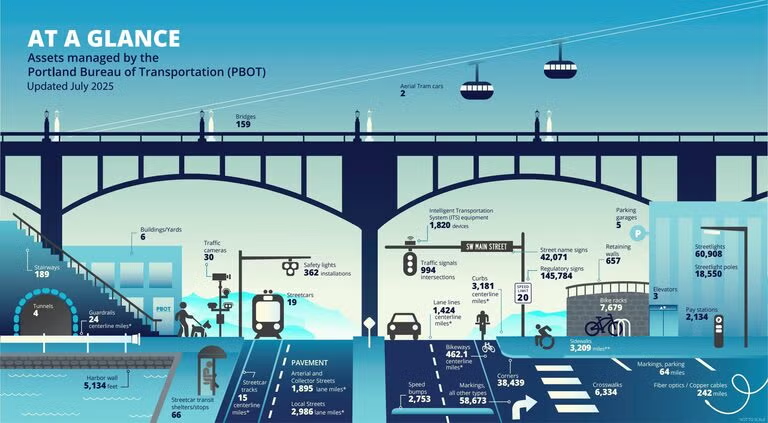
The two-hour event at 5800 SE Division Street saw visitors drop in between 6:30 and 8:30 p.m. as they moved through a self-guided arrangement of poster boards, with City staff available to ask questions and take notes. Portland transportation leaders have spent years warning the community and elected officials that its funding is overburdened by project-based restrictions, preventing 70% of PBOT’s budget from reducing a $6 billion maintenance backlog that impacts road conditions, sidewalks, bridges, signs, lights, and other infrastructure. Much of the funding sourced from Federal and Oregon State sources is for specific projects, such as new crossings or other safety infrastructure, and cannot directly fill potholes or repave roads. Even if a one-time grant were sourced to repair all of Portland’s transportation infrastructure to a “fair” condition, without an updated maintenance revenue source, PBOT assets would decline over the following decades, and a new generation of Portlanders would face the same systemic problem with infrastructure upkeep. In Wilson’s remarks, he painted a troubling picture of Portland’s $85 billion in street assets. “65% of our roads are in a state of not good repair. Most of the nation is above 50%, we are at 35% [for fair condition roads]. So we’re in trouble.”
Mayor Keith Wilson speaking to attendee at the February 25th transportation funding open house
The primary reason for the funding shortfall is inflation, with the presentation material noting that the costs of transportation, construction labor, and materials have increased rapidly while general funding sources have not kept pace. The mayor also pointed to the inequity and ineffective nature of a fixed gas tax that federal legislators have not increased since 1993. “I think we all know that fossil fuels and liquid fuels are going out of style. I drive an electric vehicle myself, and I don’t pay gas taxes. So when we think about paying our fair share, we have to think about the new generation, the new century, and not look to the last century for a failed taxing policy,” said Wilson. He explained the City is looking at “dozens of different options from around the country and the State” to evaluate for Portland transportation funding.
In the open house materials, PBOT has surfaced several proposals that may lay the groundwork for future street funding. Visitors read information about a possible “Street Damage Restoration Fee” that would be charged to utility companies, contractors, or other entities that excavate or trench in the public right-of-way, damaging streets and sidewalks. These crews, including other Portland bureaus, must repair the damage. However, that work often fails to adequately restore the full integrity of a street or sidewalk, and those assets can fail prematurely, a decade or decades earlier than expected.
Presentations also asked attendees to consider a “Transportation Utility Fee” as a funding source, as 31 other Oregon cities have implemented. It could be a monthly fee added to existing public utility bills, which residents and businesses pay. That money collected would support basic road maintenance, such as fixing potholes, and requested safety improvements. A “Retail Delivery Fee” concept would require major retailers to pay a fee for packages delivered to customers through the city’s transportation network. This would come from companies like Amazon, Walmart, Home Depot, Target, and eBay. Colorado and Minnesota have programs like this, but Portland could be the first city to enact this if the City Council adopts this idea. This approach could cover prepared-food transportation in addition to, or in place of, packages with a “Third-Party Food Delivery Fee” similarly proposed.
Asset graphic courtesy PBOT
The open house materials also stressed accountability through audits and transparency. Mayor Wilson’s remarks also centered on shifting taxes rather than simply layering new revenue sources on residents. “The one that we’re gonna be talking about is the transportation utility fee that is going to be a replacement for a gas tax… It’s a real fair way that all houses and/or businesses will pay a portion. My promise to you is if council passes this, I will work to phase out your gas tax for fixing our streets because it’s just not fair, and we have to start rethinking how we’re gonna move our city forward.
PBOT encourages people to visit portland.gov/pbotfunding for more information and share feedback by noon on Wednesday, March 4th, 2026. After that date, extending into May, Portland City Council members will deliberate on the presented materials and community feedback.
Correction: Updated a percentage in Mayor Wilson’s quote clarifying a statement that most cities in the nation have more than 50% of streets in “fair” or “good” condition and Portland is at 35%.
Promotion: Montavilla News is supported by contributions from businesses like Otter Wax, a neighborhood producer of small-batch specialty goods handcrafted in Portland. Using only natural ingredients, they make modern care products that are steeped in tradition. We thank them for their support.
As the Multnomah County Homeless Services Department (HSD) readies the Harrison Community Village Shelter at 1818 SE 82nd Avenue for future residents, they invite people to attend a Public Meeting on February 26th. Nonprofit provider Do Good Multnomah will operate the alternative shelter under a “clean and sober” model. Interested community members can attend the 6:30 p.m. in-person event this Thursday. Portland Community College will host the meeting in its Community Hall Annex at 7901 SE Division Street.
Shelter operators anticipate opening the facility in spring 2026 and have worked on a Good Neighbor Agreement with community and business stakeholders to lessen the impact of the Harrison Community Village Shelter on surrounding properties. Multnomah County purchased the former recreational vehicle dealership at 1818 SE 82nd Avenue in December 2022 for $2.015 million. This 34,000-square-foot parcel was the second Montavilla location the County bought that year for temporary shelter services. The other shelter, Oak Street Village at 333 SE 82nd Avenue, opened in February 2025 and is currently operating at full capacity. The Joint Office of Homeless Services — now renamed the Homeless Services Department — has held several community meetings, including one in April that announced that Do Good Multnomah would operate the site as a sober shelter. Presenters explained that residents and staff are subject to drug testing, and policy strictly prohibits the possession of non-prescribed intoxicants on the property. Selecting a sober format meets a specific need for people transitioning into stable housing who are in recovery from substance use disorder, and it better matches community desires for the site, which is near two Portland Public Schools.
HSD will contract with the operator to staff the alternative shelter site at all hours of the day. The adult residents will receive one of 38 private sleeping quarters, each with a shed-style pod design. Six converted shipping container units will provide office space for staff, participant services, hygiene facilities, kitchenette amenities, and laundry facilities. Residents and their pets will have on-site access to green space. The site will receive upgraded fencing with privacy inserts on all street sides and a wood fence between the adjacent residential property to the east. The site intends to offer more than short-term shelter. People in the program will have access to dedicated housing case management and abstinence-based recovery services to help with long-term substance use recovery and housing stability.
Promotion: Montavilla News is supported by contributions from businesses like Otter Wax, a neighborhood producer of small-batch specialty goods handcrafted in Portland. Using only natural ingredients, they make modern care products that are steeped in tradition. We thank them for their support.
On February 21st, Zwickelmania returns to Oregon, with two of Montavilla’s breweries joining more than 55 other craft beer makers from across the state. Host businesses offer attendees Zwickel tasting pours from the fermentation tanks and guided brewery tours. Montavilla Brew Works at 7805 SE Stark Street and Threshold Brewing & Blending at 403 SE 79th Avenue will again participate in this annual celebration of local beer makers. Event organizers will offer free sober transportation between sites via a network of shuttle buses, which should broaden participants’ exposure to Portland’s selection of independent brewers.
Zwickelmania is an annual celebration of Oregon craft beer during Oregon Craft Beer Month, organized by the Oregon Brewers Guild. Member breweries open their production facility to the public for a behind-the-scenes view of their operation and to offer unique sampling opportunities. The event’s name stems from the industry term Zwickel, describing the valve or sample port mounted outside a cask or tank. Brewers use those ports to test the product during fermentation, and this annual event allows people 21 years or older to taste beer from a producer’s perspective.
The 2026 beer-centric program offers a safe way for event attendees to visit more breweries through a free shuttle service that transports them to 16 participating Portland establishments. Attendees can catch one of six vehicles driving on two routes throughout the Eastside. This service allows drinkers to experience the event in several neighborhoods without getting behind the wheel or losing time taking indirect public transit. The participating businesses want people to enjoy the experience without overindulging while learning about the region’s craft beer producers. “We have bags of pretzels we’ll probably put on the tables to keep people eating and keep them hydrated,” said Michael Kora of Montavilla Brew Works. “Because if you get on the bus and even hit half of one of these routes, that’s a party.” During the event hours of 11 a.m. through 5 p.m., buses will depart from each location approximately every 30 minutes. The two shuttle routes overlap at Migration Brewing on NE Glisan Street for riders to transfer. However, there are too many participating locations to reach them all via the bus service during the event timeline, so people must plan to visit their favorite locations first or decide to explore some new beer makers.
Montavilla Brew Works at 7805 SE Stark Street
Kora explained that Montavilla Brew Works has always made beer production front and center in its tap room, with the fermentation tanks only protected by a table-height wall and a roped-off entrance. “I think you can go to a lot of breweries and there’s a pub out front and there’s some stainless [tanks in the back]. I guess there’s a brewery back there, but we’ve always liked to have it showcased,” Kora said. “So on a day like[Zwickelmania], it’s even more fun because people can cross the line and go into our workspace and hang out with us.” The brewery will be open from 11 a.m. until 9 p.m. on Saturday, with the last tour starting around 4:30 p.m. People on the tour can have free samples at the brewer’s discretion, but patrons must pay for anything ordered at the bar or from the Oi! The Sausage food vender working the event. Kora said he will release a new Scottish Porter at the event, adding to a line of brews he has created that honors his heritage. “My mom came here when she was eight years old with her family. Cruised into Ellis Island, signed papers, and moved to Michigan. My grandparents started a family and started a new life. So I get to be a first-generation American,” recalled Kora. “Scottish beers often are thought of as very heavy, big alcohol, dark, which is true in some of them. But the Scots drink a lot of lager, they drink IPAs, they drink porters. So we’re starting to look into more historical styles and bring them out. It’s a cool story to tell, and they’re really good beers.”
Threshold will open for brewery tours every hour starting at 11 a.m. People can also find special beer tappings, unique food menu items, a prize raffle, and a live DJ. The Threshold team also created an “Ultimate Zwickelmania Survival Kit” consisting of wearable snacks, hydration, energy boosts, Underberg digestif bitter, a shuttle map, and a glossary of brewhouse terms. These are offered on a first-come, first-served basis to Threshold visitors while supplies last.
Threshold Brewing & Blending at 403 SE 79th Avenue
Zwickelmania’s organizers gear the event toward craft beer enthusiasts who can sample directly from the Zwickel port, find unique beer releases, take tours, and meet brewers who provide educational talks. Kora also stressed how important it is to reach a wider audience that may not know about the breweries in Montavilla. “Zwickelmania sometimes brings out people that are not as familiar with us, or the brand, or the neighborhood. And so that’s where I get really excited.” Some host locations will offer food and beer pairings or specials. This non-ticketed event will only cost the price of beer and food at each location. Designated drivers can also find non-alcoholic drinks at the event. Oi! The Sausage will start selling grilled single sausages on a bun at Montavilla Brew Works in the afternoon. People interested in attending should visit the Zwickelmania website for more information and an up-to-date list of participating brewers.
Brewer lead tours, meet the brewer, zwickel samples
Promotion: Check out East Portland News as it continues to advocate for and report on outer East Portland. You will find frequently updated articles and an archive of more than 5,000 stories written over the past 20+ years alongside a robust Community Calendar of events.
Work is underway on four townhomes at 8426 E Burnside Street, built in clusters of two massings joined by a common trash room. The project is occupying a previously undeveloped parcel that once served as the extended yard of the adjacent home to the west of the property. Recently, cement masons erected the foundations for the new 1,000-square-foot homes. The two-story buildings will offer residents two-bedroom units with two and a half bathrooms, to be sold as condos without income restrictions.
North elevation of 8426-8432 E Burnside St courtesy Leon Simms
Although all units are attached, project developer Leon Simms explained that he and the architect, Bayard Mentrum, worked together to create three outer walls for each unit. “The nice thing is we were able to split them so there’s no middle units,” said Simms. The residences function as two duplexes with a small one-story utility structure sitting between them. The sidewalk-adjacent unit faces East Burnside Street, while the other home’s doors face east, connecting to a walkway. The back of the units connects to a small yard via large double glass doors. The alignment of the buildings should obscure the true quantity of homes, so that most people passing the site will not immediately detect the housing density tucked behind.
Simms said that the builder, Martin Kehoe with Portland Leeds Living, will construct the main floor with nine-foot high ceilings, and people will access the homes through eight-foot tall doors. This feature helps make the homes feel larger and of high quality. Each bedroom will have its own attached ensuite bathroom on the second floor, with the other half restroom located on the first floor.
East elevation of 8426-8432 E Burnside St courtesy Leon Simms
This project will take advantage of temporary System Development Charge (SDC) exemptions enacted by the Portland City Council that apply to permits issued from August 15th, 2025, through September 30th, 2028. These fees are typically paid by developers to support public costs incurred as the city expands public infrastructure for sewer, water, parks, and transportation to accommodate the additional demand on those services by new residents in an area. City leaders hope removing those construction fees will help builders start projects and deliver more affordable products to the housing market. “We’re going to be one of the first to take advantage of the SDC waiver program, so that there’s not any income restriction,” said Simms. He explained that these types of homes often use the Homebuyer Opportunity Limited Tax Exemption (HOLTE) program to remove property taxes for up to ten years. It has a homebuyer income limit of 100 percent of the median family income for a family of four in the region. This and other affordability program restrictions can exclude people who would benefit from a lower entry point into home ownership, but are making just enough to not qualify. “A lot of people that want to buy these more affordable, small new homes but make a little bit too much money,” remarked Simms.
Leon Simms is a fan of infill housing but has only recently started working on projects east of the Willamette River. “I’ve always been a Westside guy. I’ve been in the new home sales business for almost 40 years, but I’ve been 99% Westside,” Simms said. He likes this area and thinks these homes will be a “cute” addition to the neighborhood. They are walking distance from the historic Montavilla Downtown on SE Stark Street and near transit options. This section of East Burnside Street has curbside parking only on the north side, across the street from the development. However, it is often underutilized and buffered from passing traffic by a bike lane, making it a suitable place for residents to park. Work on the units is moving quickly, and people should expect to see them take shape over the next few months.
Promotion: Montavilla News is supported by contributions from businesses like Greg Beddor – SEO Specialist, an Oregon based digital marketing consultancy. The company markets customer’s websites and provide SEO services to grow their business. We thank them for their support.
Starting Monday, February 16th, westbound motorists on NE Halsey Street need to take a detour to NE 82nd Avenue during the next two months of construction on a new mini-roundabout. Eastbound travelers should not experience any significant disruption, but northbound users of NE 80th and NE 81st Avenues will continue to experience local-access restrictions from NE Clackamas Street to NE Halsey Street.
Crews recently completed half of a new mini-roundabout along NE Halsey Street as contractors working with the Portland Bureau of Transportation install street-level bike and pedestrian safety infrastructure, along with upgraded underground stormwater management pipes that connect with relocated catch basins. This street reconfiguration includes reconstructed sidewalks and curbs on sections of NE Halsey at notoriously challenging intersections with multimodal conflict points.
Portland Maps image with MV News illustrations
This work is part of the NE Halsey Street (68th to 92nd Avenues) – Safety and Access to Transit Project. It builds on substantial street safety improvements undertaken in 2024, when roadwork reconfigured NE Halsey Street between 68th and 81st Avenues, removing a lane in each direction while adding painted buffered bike lanes and a center turn lane. In this section of the project, the new mini-roundabout at NE 80th Avenue and Halsey Street will address a confusing intersection, located just before one of the three NE Halsey Street freeway overpasses. Renderings posted show that people will have access to high-visibility pedestrian and bike crossings. Rebuilt and extended corners will also shorten the crossing distance, and new sidewalk segments will guide users to pathways that lead to transit connections. When contractors complete work at NE 81st Avenue, cyclists will have access to a bi-directional buffered bike track on the south side of NE Halsey Street, extending up to NE 92nd Avenue.
PBOT provided illustration showing the NE Halsey, NE 80th, and 81st junction with mini roundabout
PBOT chose this intersection design to reduce crashes while keeping traffic flowing. The roundabout will slow drivers and reduce conflict points, without requiring drivers to come to a complete stop unless a cyclist, pedestrian, or other vehicle has the right of way. The infrastructure should have a lower lifecycle cost because it does not rely on electric traffic signal equipment. Buses and fire trucks can easily drive through the center of the roundabout to make tight turns when needed, improving safety without impacting critical travel routes.
The next phase of work will focus on the northern half of the mini-roundabout, following the recent completion of the southern portion. Crews will continue to work at the site from 7 a.m. to 6 p.m., Monday through Friday. All driveways on these blocks will remain open for people traveling to or from the worksite. However, street users should anticipate additional detours and follow all instructions from crews working in the area.
Promotion: Montavilla News is supported by contributions from businesses like Otter Wax, a neighborhood producer of small-batch specialty goods handcrafted in Portland. Using only natural ingredients, they make modern care products that are steeped in tradition. We thank them for their support.
On Friday, February 13th, TriMet leadership instructed the 82nd Avenue Transit Project designers to work toward creating 7 miles of Business Access and Transit (BAT) lanes along most of Portland’s portion of 82nd Avenue. The transformative project would convert the 72 bus line into a Bus Rapid Transit (BRT) system under TriMet’s FX (Frequent Express) moniker, with high-capacity vehicles, modern stations, traffic signal priority, and, now, transit priority on the outer lanes of 82nd Avenue. This updated project scope will increase the current project’s proposed $350 million budget by at least $8 million, and the project partners are depending on yet-unawarded $150 million in federal funding.
TriMet General Manager Sam Desue Jr. made the directive to advance the incorporation of significant BAT lane allocation in the design at the project’s Policy & Budget Committee meeting. This follows months of public dispute over restricting a lane of automotive travel in each direction on a busy north/south connector road that was formerly a state highway until transferring to Portland’s ownership in 2022. BAT lanes serve two primary functions in a transportation network. They are focused on providing local access for vehicles on congested streets and on providing transit systems with a less encumbered lane to move more reliably between stops. Advocates for the design note that driving to a business’s parking lot entrance on a busy road requires a visitor to wait in rush-hour congestion even if they turn onto the street a block away. In those conditions, it can also take a significant time for a motorist leaving a driveway to exit and merge into traffic. BAT lanes can help address those situations by requiring all outer-lane travelers in private vehicles to turn right within a block. Supporters also tout the BAT lanes used by emergency vehicles, which can speed through congestion when time matters.
BAT lanes are strongly supported by surveyed residents who favor a faster, more effective BRT system on 82nd Avenue. People who spoke in support at the 82nd Avenue Transit Project Community Advisory Committee (CAC) meetings also appreciated the anticipated reduced speed of BAT lanes on the curb adjacent portion of the road. 82nd Avenue once had parking along its outer edges that later became travel lanes, leaving pedestrians and fast-moving vehicles inches apart. However, many businesses are concerned about the economic impact of a sudden change in vehicle throughput. Although 82nd Avenue is not at capacity at all times of day, it does often become congested, and transportation models indicate that introducing this level of BAT lanes will divert 20 to 25 percent of traffic to other routes during peak times. Local businesses that started their ventures on a state highway years ago worry that this change will force them to relocate or close as their customers take a different route to avoid heightened congestion. People advocating for 82nd Avenue to transform into a more pedestrian-forward design say that new shoppers will come by foot and by bus, but that mode shift can take years, and many of the small businesses that have made up 82nd Avenue’s culture say they cannot survive the transition timeline, which is far from certain.
Feb 13 Business Access and Transit (BAT) lanes graphic courtesy TriMet with MV News directional notation
The TriMet adopted design for BAT lanes closely represents the community-supported design, and the project 82nd Avenue Transit Project CAC endorsed design, referred to as the “More BAT Lanes” option, with one notable exception. The nearly seven miles of transit-priority updates will stop before and resume after SE Powell Boulevard. During the January 28th CAC meeting, presenters explained that because that cross street is still a state highway, the Oregon Department of Transportation would require significant improvements at that intersection and on SE 92nd Avenue to accommodate the agency’s design standards for vehicle throughput. They explained that it would dramatically increase project costs or significantly delay the design process, seeking exemptions.
The project is targeting a 72 FX Line opening in 2029 and still has many milestones to meet before construction can begin. Planners need to find additional funds for the BAT lane portion of the project and secure federal funding in a challenging time for states seeking support from national leaders. TriMet says the Federal Transit Administration (FTA) gave the project a Medium-High rating, a strong indicator that it could receive those funds. Proponents of the BRT investment point to this corridor as an essential focus for efforts. TriMet’s Line 72 bus provides nearly 66,000 rides each week and is the busiest bus line in TriMet’s system. It also represents the highest-ridership bus line in all of Oregon, making it an ideal candidate for upsizing to strengthen the network’s backbone. Many riders use this route along 82nd Avenue to the Clackamas Town Center to connect with other lines. Transit designers say reliable and timely performance is essential to improving the network and reducing future congestion by getting more people out of personal vehicles for daily commutes. People can provide comments and learn more at the project website (trimet.org/82nd/).
Disclosure: The author of this article previously served on the 82nd Avenue Transit Project Community Advisory Committee (CAC).
Promotion: Montavilla News is supported by contributions from businesses like Greg Beddor – SEO Specialist, an Oregon based digital marketing consultancy. The company markets customer’s websites and provide SEO services to grow their business. We thank them for their support.
Recently, crews completed paving work on the NE 92nd Place-94th Avenue Alley off East Burnside Street, leading to 16 new two-story homes. Each of the back 15 units has attached garages, and the front home features a wide parking pad. This development project transformed a former automotive storageand wrecking yard into an urban subdivision with family-sized units.
Stormwater management on paved alleyway
The approximately 20-foot-wide asphalt-paved alley has a concrete center channel that connects to stormwater inlets, which will control rain runoff from extensive paving at this site. The developer widened the once-overgrown gravel alley that connects East Burnside Street to a private street serving a 1996-era housing development. The public right-of-way alley continues north to NE Glisan Street but is blocked by parked vehicles and overgrown vegetation beyond this recently improved loop. Although the alley is not for through traffic, work at this site built a street-grid connection that facilitated significant housing density.
Most of the new homes have a similar floor plan, with the frontmost home deviating from the design pattern in two notable ways. In addition to not offering interior vehicle storage, 9251 E Burnside Street has one less bathroom on the second floor than its 15 neighbors to the north. Designers also placed that unit’s stacked laundry closet on the ground floor rather than the upper level. All homes in this project have three bedrooms and an open concept main level. Each has a half-bath powder room on the first floor under the stairs. Six of the back units are designed to meet Portland’s visitability standards for universal access on the main level. They have a concrete ramp to the front doors that bypasses the steps and a larger ground-floor bathroom. Those larger restrooms extend past the outer wall, creating pop-out space with interior capacity to accommodate an unobstructed circle at least 60 inches in diameter. Both features help people in mobility devices enter the structure and use all the lower-level facilities. All 15 back-homes have a primary suite on the second floor with an attached bathroom and a double closet.
Six units with concrete ramps to the front doors that bypasses steps meeting visitability standards
The homes use a condominium land structure with a small monthly homeowners’ association (HOA) fee. Units also have fire sprinkler systems required in modern builds of this density. One of the units is currently listed for $439,900, with the others expected to become available soon. This site is walking distance from several transit options, including the MAX light rail system, and East Burnside Street has dedicated bike lanes. This location would be a good home for non-drivers or families that only have one car. However, this development still provides significant parking with space for up to two vehicles per home, along with infrastructure improvements that many opponents of some infill housing say must be part of density projects. The design team transformed a blighted commercial property into housing that fits the scale and style of the surrounding structures. Look for homes to fill with new residents over the coming months.
Promotion: Montavilla News is supported by contributions from businesses like Otter Wax, a neighborhood producer of small-batch specialty goods handcrafted in Portland. Using only natural ingredients, they make modern care products that are steeped in tradition. We thank them for their support.
Neighborhood news site focused on buildings and changing businesses