Jacob Loeb began writing for newspapers in high school, first for the school's publication and then for a Vashon, Washington, community paper. He graduated college with a degree in English Literature and Television Communications. After graduating, Loeb worked in film distribution for a pioneering DVD company that supported independent filmmakers. Years later, he wrote for a weekly newsletter about technology and ran a popular computer advice column called Ask Jacob. Moving to the Montavilla neighborhood of Portland, Oregon, with his family in 2005, Loeb firmly planted roots in the community and now writes for the Montavilla News. He is a Society of Professional Journalists member and volunteers with non-profit organizations serving East Portland.
~
On August 30th, My Voice Music (MVM) and Ascending Flow will host a Block Party with live youth music, DJs, and skateboarding to introduce the BUS-A-Flow mobile studio. The MVM youth-focused nonprofit organization opened its Montavilla facility at 8911 SE Stark Street in September 2023. Recently, muralists completed work on the outside of the building, highlighting this music-based after-school program provider’s activities within. People are invited to visit between 1 and 6 p.m. to participate in this free gathering.
Event organizers will close SE 89th Avenue north of SE Stark Street beside the MVM building preceding the Sunday, August 30th, activities. The block party will showcase performances representing the range of music being created by My Voice Music and Ascending Flow participants. Ascending Flow will use its converted transit vehicle dubbed BUS-A-Flow to bring a mobile recording studio, performance stage, and creative hub to communities across Oregon. This mural-painted, customized vehicle will further the nonprofit’s work, including free programs for young people navigating foster care, experiencing housing instability, and seeking to build positive life skills.
Ascending Flow works out in the community but lists the SE Stark Street address as its main location, joining MVM in its rehabilitated former bakery building. Since 2008, MVM has served young people by facilitating their artistic expression through writing, recording, and performing original music. Several setbacks delayed the opening of the Montavilla SE Portland headquarters, including the 2021 death of MVM’s founding Executive Director, Ian Mouser. For the last three years, the youth music center has helped expand the organization’s programs and supported efforts by similarly aligned organizations.
This co-hosted event serves as the annual Ascending Flow Show and showcases the new MVM mural created through a partnership between the two non-profits working from the location, with support from an Oregon Metro Community placemaking grant. Members of the MVM community shared the program’s significance to their lives, and young artists translated those stories and experiences into the mural’s imagery and design with guidance from Damon Smyth and OC Note.
The block party includes many activities with skate ramps, basketball, and face painting. Attendees can enjoy free food, Live DJs, and youth performances. The Portland Bureau of Transportation will have bike helmets and supplies for bike-decorating activities. The community is invited to experience the new mural, see the BUS-A-Flow mobile studio up close, and learn about the supportive programs at this East Portland resource destination.
By
Jacob Loeb
Promotion: Check out East Portland News as it continues to advocate for and report on outer East Portland. You will find frequently updated articles and an archive of more than 5,000 stories written over the past 20+ years alongside a robust Community Calendar of events.
The 10th Jade International Night Market is this Saturday, August 29th, from 4 to 10 p.m. within the Portland Community College’s Southeast campus at 2305 SE 82nd Avenue. Since 2014, this evening event has offered food, entertainment, and vendor booths from area groups while providing a space for the community to gather and celebrate the people who make up the multicultural district.
Jade International Night Market 2025
The one-day community gathering focuses its family-friendly events earlier in the afternoon, including a free plant-potting booth for youth sponsored by Portland Nursery. People ages 20 and younger can decorate a free pot and fill it with a selection of donated plants, while supplies last. Event organizers have added a scavenger hunt and brought back the Luminous Together’s Art Grove. “The Art Grove is back again and expanded. It’s put on by a former APANO staff member who offers forest bathing, therapy, and interactive art,” explained APANO Community Development Director and lead Jade Night Market organizer Alisa Kajikawa. The Grove will include a meditative arts workshop, exhibition tours, and the Our Little Free Diverse Library. People can find this part of the market west of the food vendors in the wooded area where the PCC Learning Garden is located.
Jade International Night Market 2025
For the first time, attendees can participate in a Jade District-themed scavenger hunt. To win a prize, people need to find nine spots around the Night Market that feature placards highlighting the people and history of the Jade. The quest begins at the APANO booth where participants can get the details. Scavenger hunt materials are available in simplified Chinese, Vietnamese, and English. “There are questions about what they read, and they’ll just write down their answer. We’re not looking for the correct answer… but people need to write down what they think the answer is,” remarked Kajikawa. Completed forms are brought back to the booth for a reward.
Jade International Night Market 2025
Activities are optional, and many people attend specifically for the unique food and shopping experience. This year, 38 food vendors and drink specialists will sell tasty treats to attendees throughout the event. Over 90 other booths feature people selling arts, distinctive items, or offering information to the community. Scheduled speakers and performers will begin the entertainment on the main stage at 5 p.m., with a program that runs until 10 p.m.
5:00pm
Portland Taiko
PACC Dance Team
Cambodian Dance Troupe of Oregon
KOICO Vietnamese Fan Dance
6:00pm
Ballet Papalotl
McDaniel High School Cheer
Nattasinh Lao PDX
7:00pm
Summit Wushu
White Lotus on Jong
8:00pm
At the Edge of Chinatown
Hula Halau ‘Ohana Holo’oko’a
9:00pm
Rachel Wong
White Lotus Blacklight Dragon Dance
The performances are always free to watch; still, event organizers wanted to make sure everyone has access to the cuisine and products available at the Night Market. Last year, the event’s leaders launched a program called Jade Dollars to lower financial barriers by giving out vouchers for both food and retail. “Everyone belongs [at the Night Market], and we do this for the community. There are tons of things that you don’t need money for to enjoy. At the same time, it’s still about commerce, and it’s still about supporting our small business owners. So we’ll have five-dollar increments of Jade Dollars that we will give out to folks in two different ways,” said Kajikawa. People can receive $10 worth of food vendor vouchers at the market information booth by showing government benefits like SNAP, WIC, or OHP cards. They only need to show the cards or prove enrollment; no individual data is collected. People can also complete a demographic survey to receive a $5 voucher towards retail items and participating booths.
Jade International Night Market 2024
Last year’s Jade International Night Market had an estimated 20,000 attendees, and they anticipate similar interest this year. The market will maintain last year’s layout, with food vendors along the west edge of the campus in the parking lot and booths lining the inner courtyard walkways. Unlike other fairs, Night Market organizers provide canopies, offering consistency and convenience to participants. “It looks nice because it’s all uniform with three different colors,” said Kajikawa. The main stage is north of the booths next to Tabor Hall.
People interested in attending the Jade International Night Market should plan on large crowds and limited parking options. Organizers recommend people take public transit via the TriMet 72 bus line or the SE Division FX 2 bus rapid transit system. People who bike, walk, or ride transit to the Night Market could earn a $10 gift card from the Portland Bureau of Transportation (PBOT) by stopping by their booth to claim the reward. Visitors who rent a bike to get to the Night Market will have a $25 credit from BIKETOWN by using code JADENIGHTMKT26 for applicable rides that start or end at the PCC campus during the event. Late August often brings warm temperatures. The campus has many shade-providing trees, but anticipate significant sun exposure while walking around. The Night Market’s web page and social media offer current updates about the event schedule and other information.
Promotion: Montavilla News is supported by contributions from businesses like Otter Wax, a neighborhood producer of small-batch specialty goods handcrafted in Portland. Using only natural ingredients, they make modern care products that are steeped in tradition. We thank them for their support.
Wendy’s has reportedly experienced several straight quarters of U.S. sales losses while Burger King has worked to rehabilitate its image and earn back customers. This comeback is attributed in part to property investments and the hiring of head chef Amy Alarcon, who previously worked at Popeyes, designing that company’s chicken sandwich, which went viral on social media in 2019. The company also began courting vegetarian and vegan customers in 2019 with the plant-based WHOPPER ® burger made with Impossible meat, which customers can order without mayonnaise and have cooked on a separate surface to remove animal products.
Burger King is predominantly a franchise chain, with this location operated by Ambrosia QSR and the underlying property owned by Weston Investment Co. Portland businessman and developer Joseph Weston recently donated his remaining commercial properties to the Weston Public Foundation managed by Oregon Community Foundation. The franchise operator, Ambrosia QSR, operates over 200 Pacific Northwest restaurants under the Burger King, Arby’s, and Popeyes Louisiana Kitchen brands. An Arby’s is next door to this location at 10071 SE Washington Street.
Investment in this area has rebounded among fast food establishments over the last few years, with the opening of a new Chick-fil-A a block over from the Burger King in January and Chipotle replacing a Baja Fresh storefront in 2024 across SE Washington Street from this location. City code allows renovation work at these pre-existing fast-food locations despite the area’s new zoning. City officials up-zoned much of the land in the Gateway Regional Center in the late 1990s, making this block Central Commercial (CX) which is designated for high-density commercial developments within Portland’s most urban spaces like the downtown area. If this were a completely new building project, the team would need to construct a much larger building to meet minimum density standards.
The remodel approach should also allow this store to retain its drive-through facility. A 2018 Portland City Council-enacted ban on new drive-throughs in commercial zones has prompted many existing Eastside restaurant locations to remodel. The pre-existing status has elevated the location’s value, as businesses seek to retain historical uses that would not be allowed under new building standards. This project is in the early planning stages and may change based on city feedback or other business decisions. However, it represents further investment in the Mall 205 area among fast food and established national brands.
Promotion: Montavilla News is supported by contributions from businesses like Catalyst Construction & Kitchen Remodeling, a top-rated general contractor specializing in kitchen, bathroom, basement, and garage remodeling, as well as ADU construction and home additions. We thank them for their support.
The owners of Portland Tool Peddler recently completed the move of their five-year-old tool repair business from SE 64th Avenue and Powell Boulevard to 7115 NE Glisan Street. Cindy Chambers Moreno and Matt Moreno formed the company in 2021 after Matt left O’Neills Tools & Equipment which was once located on the same block as their new storefront. The family-run shop services a wide range of power tools and is one of the only authorized repair centers in the area for many well-known manufacturers.
Although this new location was closer to home for the owners, and a return to a neighborhood they know well, Matt Moreno said the SE Powell storefront was a good space with ample parking and a secure gate. However, increasing rent at their original space and a better store layout on NE Glisan made the move to Montavilla appealing. “It’s about the same square footage. It’s just a different shape. The other store was longer. It was hard for me to get back there and do work because the door’s 100 feet away, the phone rings, and I got to go to the computer,” recalled Moreno. “10,000 steps in a day, walking back and forth, is a bit much.” The team kept the dark store colors from the previous tenant, Devout Rcrds. “I just left it black. If I painted it, I’d end up getting it dirty; black is good for the work,” remarked Moreno.
Early in his life, Moreno developed an appreciation for repair over replacement and the value of a good tool. “On my 10th birthday, my dad gave me a broken lawn mower and told me if I wanted school clothes that were different than what he was going to buy me, ‘fix this mower and go make some money,'” said Moreno. “And I fixed the mower, and I went and made some money.” Those formative skills brought him to O’Neills Tools, where he was the only non-family employee during his time there. After 13 years, Cindy Chambers Moreno suggested they strike out on their own. Already a skilled service technician working in the industry, Matt Moreno said the manufacturers were interested in working with the couple’s new company. They are currently an authorized independent service center for Ryobi, Ridgid, Greenworks, Hart, PowerStroke, BlackMax, Homelite, and Hyper Tough.
Matt Moreno decorates the shop with old items he has collected over the years
In addition to warranty repairs, people can bring them most other tool brands that need work. They can work on gas and electric tools but can not service riding gas lawnmowers due to their size and weight. However, Portland Tool Peddler will accept battery-powered riding mowers where many shops will not. Their wide range of repair offerings makes the business a destination for tool owners looking to keep their items in service. “We get them shipped in from California, Washington, a lot of people from the Seattle area,” explained Moreno. “The riding battery lawnmowers, we’re the only ones that will mess with those, any brand, any kind, anywhere in the entire state.”
Matt Moreno notes that not all tool brands are supported with parts at the same level as others. “If I have parts, I’ll fix it. No problem. Getting the parts sometimes is just a nightmare. Especially with the DeWalt and Black & Decker because they have a 14-day holding period.” He explained that because most modern tool makers share the same ownership, many parts are interchangeable. He also asserts that people often overpay for brand names when the tool quality is similar. “You’re buying a color because that orange Black & Decker has the same parts as the yellow $279 DeWalt. You’re paying $210 more for a yellow color over the orange color; it has the same parts in it.”
Moreno dislikes seeing anything thrown away and hopes people will bring in their old tools. He thinks people would be surprised by how long an old tool can last, as long as the manufacturer still makes parts, and many people are surprised to find some broken items still have warranties. There is no absolutely reliable tool, but having a good warranty is what makes a difference in Moreno’s experience: “I don’t trust any of them, but the Ridgid brand, there is no way in the world anybody can beat this brand in warranty, period. They offer a lifetime warranty, including batteries, chargers, service, everything for life, as long as you register the tool within 90 days.” There are limits to the Ridgid lifetime warranty, but his experience servicing that equipment has convinced Matt Moreno it is worth his money. “I probably have 35, 40 different Ridgid tools, I’ve been using them for 10 to 20 years, and you can’t beat it.”
The Portland Tool Peddler will sell some used tools with an in-shop warranty, but it is not their primary business, and they have inconsistent inventory. They do not buy tools, despite acknowledging the need: “It’s hard to find homes for [used tools], and that’s gotten worse in our area here because Ted’s Tool Shed closed down. He was the last actual tool buyer, so now without Ted around, there’s no more used tools besides the pawn shop, and they’re gonna offer you 10 cents on the dollar,” Moreno said.
The shop owners hope people will come by with their broken tools before throwing them out. “We service all [tool] brands, I mean, KitchenAid mixers, sheep shears. Pretty much, if you drag it down here, I’ll tell you if I can do it or not.” They have a $25 minimum repair charge, but they can look at most small tool items before quoting the full price, without charge. Anything that demands two hands to move around requires customers to put down a $60 deposit toward the repair; plumbing tools require a $100 deposit. “You go through a lot of gloves when you’re touching plumbing tools because you don’t know where that thing’s been,” said Moreno.
The shop is open six days a week, from Monday through Friday, 8 a.m. to 5 pm., and Saturdays, 8 a.m. to noon. People can walk in without an appointment, and most repairs are done within a week if parts are available.
Article and photos by
Jacob Loeb
Promotion: Check out East Portland News as it continues to advocate for and report on outer East Portland. You will find frequently updated articles and an archive of more than 5,000 stories written over the past 20+ years alongside a robust Community Calendar of events.
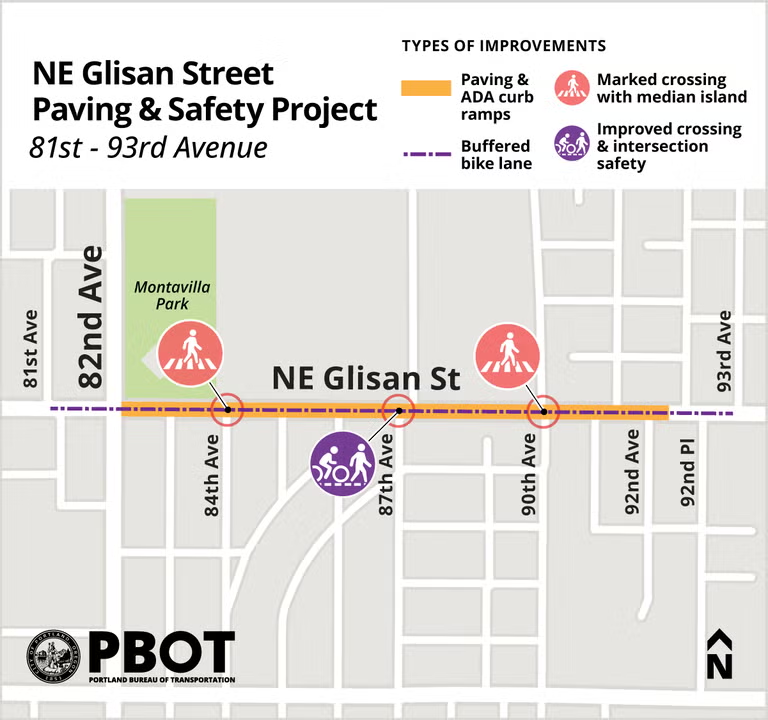
Road crews will begin repaving NE Glisan Street between NE 82nd and NE 92nd avenues on Wednesday, August 19th. The approximately two-lane-miles of resurfacing work will take an estimated twelve business days to complete as heavy equipment grinds off the damaged top layer of asphalt and lays down a fresh mixture of crushed stone and bitumen. The Portland Bureau of Transportation’s (PBOT) re-striping plans will create a paint-buffered bike lane next to a single travel lane in each direction and recreate the center turn lane. Cement masons will add two new pedestrian crossing islands along the busy High Crash Street, with an existing crossing at NE 87th Avenue updated to prevent some left turns while better protecting pedestrians and cyclists.
Existing RRFB on NE Glisan St at 87th Ave
This Fixing Our Streets-funded project included substantial updates to sidewalk corner curb ramps, bringing crossings in this area up to Americans with Disabilities Act (ADA)- compliant standards. Starting in May, Crews working with Portland’s Bureau of Environmental Services (BES) installed modern stormwater management sump drains under NE Glisan Street at the intersections of NE 91st and 92nd Avenues. In addition to creating a smoother driving surface for vehicles, this new phase of work will reconfigure the street to remove time-shifting outer lanes used for parking or as an auxiliary travel lane. Collisions occurred on this street where motorists parked cars during allotted times, but drivers may have assumed the outer lane was clear. PBOT engineers anticipate that removing that conflict point will yield significant safety improvements with minimal impact on vehicle throughput.
Project map courtesy PBOT
The new NE Glisan bike lanes will add a connection between NE 81st Avenue and NE 93rd Avenue. Early concepts for the cycling infrastructure showed the bike lane extending west to NE 80th. However, area business concerns over losing frequently used street parking on that block prompted a design that still helps people riding outside a car cross NE 82nd Avenue to meet up with side-street bike routes while minimizing impacts to adjacent commercial property users. PBOT planners anticipate further improving the bike infrastructure in 2030 with hardscape concrete dividers and flex posts to protect cyclists riding next to cars. The reconfiguration is happening during this repaving project to save money. Otherwise, contractors would need to grind off existing street markers and repaint as part of the 2030 work.
NE Glisan Paving and Safety Project 30% Design Concept illustration of NE 84th Ave. Courtesy PBOT
NE Glisan Street, from Interstate 205 to 82nd Avenue, is a notoriously challenging roadway to cross with vehicles driving quickly between the two points. Without any fully signalized intersections on this stretch and with a large hill blocking visibility, it can take an extended period to find a safe break in traffic to cross. In 2021, PBOT lowered the speed limit to 30 mph, but that still did not significantly improve crossing safety for people inside or outside a vehicle. The two new pedestrian crossings with concrete median islands at NE 84th and 90th avenues should help pedestrians cross in two phases, where they can focus on one direction of traffic at a time, and drivers can better see a person waiting at the high-visibility infrastructure.
NE Glisan Paving and Safety Project 30% Design Concept illustration of NE 90th Ave. Courtesy PBOT
The NE 87th Avenue crossing already features street-adjacent buttons that activate Rectangular Rapid Flashing Beacons (RRFB) to signal to drivers that bikes or pedestrians will cross soon. The updates will extend an existing concrete median island east with cutouts for cyclists crossing. This extended mid-street infrastructure will prevent northbound and westbound drivers from turning left at this intersection.
Updated median at NE 87th Ave with left turns prohibited for north and west automotive travel. Courtesy PBOT
PBOT notes that paving and painting work is weather-dependent, so that project work dates may change. Drivers can expect rougher roads during the grinding and resurfacing process and should anticipate traffic delays with detours from 6 a.m. to 5 p.m. weekdays, with some weekend work. Parking on NE Glisan in the project area will end a few days before work begins, but pedestrian access will remain open. Anyone traveling through the worksite should follow all traffic control signs and flaggers and use heightened caution.
Article and photos by
Jacob Loeb
Promotion: Montavilla News is supported by contributions from businesses like Otter Wax, a neighborhood producer of small-batch specialty goods handcrafted in Portland. Using only natural ingredients, they make modern care products that are steeped in tradition. We thank them for their support.
Work is underway on a housing development at 3128 SE 90th Place, where a local builder will create nine new homes behind the existing 1927-era house. It features four duplex structures and one detached home, accessed from a long private roadway along the northern edge of the lot. Each of the around 1,700-square-foot homes will stand three stories tall to allow space for attached garages and four bedrooms. Developer Ken Yu updated this project from an apartment concept to better match the street’s existing design context and balance housing with tree canopy.
Yu, a longtime developer of commercial and residential projects focused in East Portland, explained he looks for projects that integrate with the existing neighborhood while making space for new members of the community. He also said he likes to balance buildings and nature. “I’m a Chinese-American, and I grew up with the idea of the yin and yang balance,” explained Yu. “I don’t like too much building or too much landscaping. I think we need to strike the balance between the two. When you walk into a neighborhood with tall buildings and concrete, all that without any green space or natural landscape, it doesn’t feel right.” His personal discomfort in overbuilt spaces encourages his use of planted natural landscape while preserving existing trees. “Those big trees, we really love them,” remarked Yu. “That’s why we went out of our way to try to retain them [at this site].” The new development will provide a dedicated communal recreation area in the southeast corner of the property, with play equipment surrounded by greenery.
3128 SE 90th SE Pl site map, courtesy Ken Yu
When Yu first looked at this project, he imagined the site could hold three apartment buildings containing six units each for a total of 18 units. “We actually started the permit processing and submitted plans for permits,” recalled Yu. However, his team reevaluated the scale of that initial project, feeling it would not fit in with the existing housing in the area. So they decided to take a different approach focused on homeownership instead of rentals. “We had to cancel that permit and go with the four duplexes and one single detached home because we really think that this will work a lot better with the area, match the neighborhood, and also we want it to be more family-oriented,” said Yu.
The new three-level houses will have two and a half bathrooms. In addition to vehicle storage, the ground floor supports a bedroom with an ensuite bathroom at the back of the house. Yu explained this is a nice feature for multi-generation families or for people with mobility considerations. “If the family has older people that don’t want to go up the stairs, they can live in the ground floor bedrooms. making it more accessible for them.” The second floor supports a kitchen and living room along with a powder room/half-bathroom. The top level has three bedrooms and one shared bathroom.
Example of stamped concrete finish on an 82nd Ave raised median
The rescaled project took longer than expected to obtain approved building permits due to a required land use review. City code 33.120.206 says if the site is more than 160 feet deep, new dwelling units are prohibited unless the site has at least 90 feet of frontage on a street or meets certain exceptions. Yu said this 250-foot-deep site was only a few feet short of the frontage requirement, prompting a review. “They said the land use review takes six months, but it actually took a year, over a year,” recalled Yu. He said the permitting process went well with only one notable change to the proposed plans. The city requested that the shared private access road use a stamped concrete finish. That process utilizes rubber pads with a design pressed into the drying concrete to create patterns that mimic stone or brickwork. Several newly created raised medians on 82nd Avenue used this process to create a red brick appearance, while still keeping installation costs lower than using bricks.
City standards required the development to create curbs and sidewalks in front of the property as the street did not already have them. Yu was required to remove the existing driveway used by the original home to create the new curb cut leading to the private lane. Many developers install the sidewalk at the end of the project to prevent damage by construction vehicles and allow easy access as they dig up the property for utility lines. Yu likes to install the frontage improvements early on in the process when possible. “We try to do those first because we try to improve the scenery for the neighbors, shortening the disturbance as much as possible. We think that this will benefit our neighbors.” Pedestrians walking in the area can now use the less than 100 feet of new sidewalk. It will likely take over a decade for this infrastructure to connect to other sidewalks on this street, but it sets a framework for the future streetscape planned for the neighborhood. That could come from other infill projects like this one or public investment similar to the 2025 work done on SE Clinton Street.
New sidewalk, planting strip, and curb along 3128 SE 90th Pl frontage
The developer expects these homes will appeal to a range of families, as they will use sturdy materials like water-resistant luxury vinyl plank flooring and granite countertops. “I think it’s a great location, conveniently close to a shopping center and the light rail. Our vision is that these would be a great home for working families and also new immigrants that rely on public transportation or bicycle rather than having to drive a long way to get to a shopping area,” explained Yu. “This is within walking distance to Eastport Plaza and all the Asian shopping centers. So it’s a really convenient location.”
Work is underway now but tucked behind the newly updated street frontage and the existing house. Ken Yu hopes the months of construction work will not be overly disruptive to the neighborhood and that people will appreciate the project’s adjusted scale. When completed, the homes will sell under a condominium model, similar to other developments in the area that share a private access roadway.
Promotion: Montavilla News is supported by contributions from businesses like Catalyst Construction & Kitchen Remodeling, a top-rated general contractor specializing in kitchen, bathroom, basement, and garage remodeling, as well as ADU construction and home additions. We thank them for their support.
On September 7th, 2024, the Belmont Library closed for renovations that tripled its original size with a two-story addition to the 1924-era brick building. Demolition crews removed portions of the building added in 2000 and part of the parking lot to make way for the now-completed addition. Despite its modest 5,420-square-foot capacity, this branch was one of the busiest locations in the entire Multnomah County Library system before closing. During the closure, patrons visited a temporary branch at 3557 SE Hawthorne Boulevard. Library staff provided extra effort to keep the temporary location open even as they worked to ready the new facility for this opening weekend. However, the community has been without a local pickup location since August 3rd, and the hold shelves at the new location are already populated with an impressive number of reserved books, according to staff.
This work is part of a voter-approved library expansion initiative and represents the last major update to complete the work. Bora Architecture and Interiors designed this cross-laminated timber expansion featuring wood products from Oregon and Washington. Crews created dedicated areas for different age groups of readers. The entire century-old part of the building serves the youngest patrons and their caregivers with interactive and tactile displays, size-appropriate furniture, and shelves of children’s books. This area also features remembrances of Jeanie Diaz, a youth librarian killed by a driver who crashed into a bus stop near the library where she was waiting in 2023. People can see a note from one of Diaz’s two children inside an interactive display. Library representatives say a plaque honoring Jeanie Diaz is also planned for the space.
A note from Jeanie Diaz’s child included in the Belmont Library’s kids reading room interactive display.
In addition to the kids’ room, holds pick-up area, and Lucky Day items shelves, the first floor also features a large reservable community space for gatherings and events. Other amenities and the primary book shelves are on the second floor, accessed by two elevators and a public staircase at the front of the building. Visitors can find flexible meeting spaces with updated technology, laptops for on-site work, and fixed computer stations. Library staff understand the changing role of the public resource they provide. Consequently, high-speed internet throughout the facility is a key feature of these upgrades, along with access to printers and other digital tools people require to connect with job opportunities and services. This top-floor space also offers a teen area with facilities for homework and creative expression, alongside young-adult book titles on the adjacent shelves.
Fabric artwork mimicking large scale pages torn a spiral notebook created by Britt Howard
Above the teen space is the fabric artwork by Britt Howard that looks like a paper airplane made from a lined spiral notebook page. A paper fortune teller and a crumpled ball flank the classic folded flyer. Its exaggerated scale and playful, soft-sculpted schoolroom shapes provide a sense of place where young people fight boredom and embrace their own interests. The upper walls of the second floor feature a mural with over 200 handmade objects integrated into the artwork. It is the creation of Pacific Northwest artist Emily Counts.
LED lights with device charging ports at a reading table in the library shelves
The new library offers four on-site parking spaces. Two are reserved for people with a Disabled Person Parking Permit to use without a time limit, and the other two are available for quick visits that are less than 15 minutes. Crews reconstructed the sidewalk around Belmont Library, making more space for pedestrians and adding locations with enlarged bicycle parking that can support cargo bikes. Landscapers have planted new street trees to replace some cut down during construction and have also installed other public amenities around the property.
Automated material handling equipment sorts returned books into bins
Technology improvements in the facility also assist staff with automated material handling, which sorts returned books into bins for transfer or reshelving. Kiosks throughout the building allow people to find titles and resources or check out items without needing to find a person for assistance. However, public feedback made clear that people visiting this branch also enjoy the human interaction. So the library features strategically located desks in public places so that an employee is often accessible to visitors and staff can see if people need help. They also use an in-building communication system that lets everyone stay in contact wherever they are for support and collaboration that isn’t tied to a desk.
People interested in joining the weekend celebration starting at 9:30 a.m. on August 15th can park in the Walgreens lot to the north of the library or take public transit to the location. After the office opening, the library will resume its normal schedule and welcome back an eager public to this well-used community resource.
Promotion: Check out East Portland News as it continues to advocate for and report on outer East Portland. You will find frequently updated articles and an archive of more than 5,000 stories written over the past 20+ years alongside a robust Community Calendar of events.
On Saturday, August 15th, the PDX Adult Soapbox Derby returns for its 27th year of gravity-induced fun. Starting at 10 a.m., people will gather for this free event along SE Reservoir Loop Drive and at locations around the Mt. Tabor Park course to watch contestants roll down the extinct urban volcano at increasing speed. Over 150 volunteers will assist racers and attendees on the derby day until the event concludes at 4 p.m. Montavilla residents can cheer on the local business entrant and sponsor, Covert Cafe.
PDX Adult Soapbox Derby 2025 (Jacob Loeb)
In the summer of 1997, Paul Zenk and Eric Foren loosely organized a small group of friends to race down Mt. Tabor’s winding roads in an event that would create the inaugural PDX Adult Soapbox Derby. The annual community gathering has grown yearly to include 42 racing teams and between 7,000 and 10,000 spectators. This free-to-attend day of races features highly engineered carts and some haphazardly crafted contraptions that all rely on gravity for propulsion. People wishing to attend should anticipate walking some distance to the event and bringing water or other refreshments. Some concession items and merchandise are available for purchase at the event.
PDX Adult Soapbox Derby 2025 (Jacob Loeb)
In 2016, Justin James and his ‘Team Rusty Rocket’ secured the track’s fastest run at 71.10 seconds. Each year, participants put in significant effort to create fast, thematically creative entries. Some carts travel up to 50 MPH down the paved park roads as they try to secure the quickest time or the biggest cheers. The Soapbox Derby is a family-friendly event, but volunteers must clear the track before each run for safety, and responsible adults need to remain close enough to ensure their children are out of the way when a race starts. Parking in the park and neighborhood is limited, and people should plan to bike, walk, or take transit.
This article will update with photos of the 2026 Adult Soapbox Derby
Promotion: Check out East Portland News as it continues to advocate for and report on outer East Portland. You will find frequently updated articles and an archive of more than 5,000 stories written over the past 20+ years alongside a robust Community Calendar of events.
On Tuesday, August 11, and Wednesday, August 12, road crews will close the Interstate-84 Entrance and Eastbound traffic on the overpass above NE 82nd Ave and I-84 for microsurfacing work. Contractors working for the Portland Bureau of Transportation (PBOT) will apply a fast‑curing asphalt treatment to the road surface, filling minor ruts and improving the pavement’s condition. During the application process, motorists will need to use temporary detours.
Portland Maps image with MV News notation of detour routes. Red for I-84 Westbound and blue for eastbound Halsey
PBOT recommends eastbound drivers on NE Halsey use NE 81st Avenue at the Halsey Street roundabout, then turn onto NE Wasco Street. Next, people can use northbound NE 82nd Avenue to then turn onto NE Jonesmore Street, which reconnects with NE Halsey. Travelers intending to use I‑84 westbound should continue west on NE Halsey, turning south onto NE 60th Avenue, then take a right at NE Glisan Street to access the I‑84 westbound on‑ramp at NE 59th Avenue. Contractors will keep the I‑84 on‑ramp open during peak travel hours, but drivers should be prepared to use the detour if directed to by the onsite crew or signage.
New two‑way protected bike infrastructure on NE Halsey St
The two-day project work is just one phase of the overpass updates needed to complete this leg of improvements. Future installation of protective fencing over the bridge, striping of a new two-way bike facility over the bridge, and vertical separation of the two-way bike lane are tentatively anticipated in October 2026. That work will also require temporary lane closures. This activity is part of the NE Halsey Street (80th to 92nd Avenues) – Safety and Access to Transit Project, which aims to improve safety for those traveling outside of cars along this busy High Crash street. The new two‑way protected bike infrastructure on NE Halsey provides a continuous connection from the new mini-roundabout at NE 81st Avenue to NE 92nd Avenue. This upgrade links cyclists directly to existing bike infrastructure and creates new sidewalks for people walking to the NE 82nd Avenue MAX station from the business corridor and nearby residential neighborhoods.
Work schedules are subject to change. PBOT will update reader boards positioned along NE Halsey Street and the project website with the latest schedule information.
Promotion: Montavilla News is supported by contributions from businesses like Otter Wax, a neighborhood producer of small-batch specialty goods handcrafted in Portland. Using only natural ingredients, they make modern care products that are steeped in tradition. We thank them for their support.
Crews recently cleared an overgrown parcel where a fire-damaged house at 2826 SE 87th Avenue had caused years of concern for neighbors who witnessed repeated illegal dumping on the property. The 95-by-180-foot lot is slated to support 10 new townhomes, offering future residents just under 1,000 square feet of living space across two floors. This development abuts the back of the three-story Jade apartments, nearing completion at 2905 SE 89th Avenue.
Portland Maps image with MV News illustration showing the The Jade apartments in red, right of 2826 SE 87th Ave
This area is zoned Residential Multi-Dwelling 1 (RM1), allowing low-scale multi-dwelling construction, generally two or three stories tall, with a 1:1 Floor Area Ratio (FAR). That provision would allow a single-story building to cover the entire property or two floors to occupy 50% of the land. Affordable housing can trigger a density bonus increasing FAR to 2:1. The zone also has a Minimum Density requirement for new housing of 1 unit per 2,500 square feet of site area. For this site, it is around a 6-unit minimum, but that can be adjusted based on site conditions.
The recent site activity cleared several mature trees and the remaining debris from the lot, which had sat vacant for years. A 2017 fire damaged the house owned by the Baker family for decades. The property was later sold, but suffered a catastrophic fire in 2021, which firefighters allowed to burn due to unsafe conditions inside the residence. In 2023, the city began foreclosure proceedings on nine distressed properties, including the one on SE 87th Avenue. Later, it failed to find a buyer at a foreclosure auction in January 2025 after a previous failed attempt in late 2024. According to Multnomah County records, Community Revitalization LLC acquired the property in March 2025 and sold it to its current owner a year ago for $265,000.
Site condition on September 12, 2022
The redevelopment work will provide ten new homes and replace a longstanding problem property. The units will not have attached garages. However, site development permits indicate it will offer some on-site parking for cars and bicycles, along with an outdoor common space and a shared trash enclosure. Building permits are still Under Review and could take several months before contractors can begin work. The recent clearing of the property should help alleviate area residents’ concerns about dumping, now that the site is visible from all angles, including from the back of the property, where a 40-unit complex will soon start welcoming new residents, providing additional eyes on 2826 SE 87th Avenue.
Promotion: Montavilla News is supported by contributions from businesses like Otter Wax, a neighborhood producer of small-batch specialty goods handcrafted in Portland. Using only natural ingredients, they make modern care products that are steeped in tradition. We thank them for their support.
Neighborhood news site focused on buildings and changing businesses