Jacob Loeb began writing for newspapers in high school, first for the school's publication and then for a Vashon, Washington, community paper. He graduated college with a degree in English Literature and Television Communications. After graduating, Loeb worked in film distribution for a pioneering DVD company that supported independent filmmakers. Years later, he wrote for a weekly newsletter about technology and ran a popular computer advice column called Ask Jacob. Moving to the Montavilla neighborhood of Portland, Oregon, with his family in 2005, Loeb firmly planted roots in the community and now writes for the Montavilla News. He is a Society of Professional Journalists member and volunteers with non-profit organizations serving East Portland.
~
Earlier this month, people raised concerns about boarded-up windows at Ya Hala‘s 8005 SE Stark Street. However, the wood coverings were part of an effort to replace the single-pane glass with energy-efficient glazing at the neighborhood restaurant. The grant-supported window work is part of a broader investment by the multi-location business, including expanding Ya Hala-branded grab-and-go products available post-security at Portland International Airport (PDX) in the family business’s own Barbur Foods store, and at two other reseller locations.
Barbur Foods at Portland International Airport’s Concourse E
Commercial wIndow breakage has plagued some Portland business districts, and Montavilla’s historic downtown on Stark Street was no exception. So when Ya Hala had boarded up windows, some observers assumed it was due to vandalism. But in this case, the boards were part of planned upgrades to the building’s older storefront. “At Ya Hala, we’re using the grant to upgrade our windows, HVAC, and refrigeration systems,” explained Pascal Attar with Ya Hala.
New energy-efficient windows at Ya Hala on SE Stark St
These upgrades offer environmental benefits by reducing energy use and should lower operating costs. However, it is not always easy to budget for these behind-the-scenes expenditures that do not directly impact customer experiences or restaurant performance. That is why Attar values the additional funding they received. “Prosper Portland’s BEE (Building Energy Efficiency) grant has been a great opportunity for small business and property owners because it helps make meaningful energy-efficiency improvements more accessible,” remarked Attar. “These are major investments for a small business, and the program has allowed us to improve the building in ways that should make it more efficient and functional for years to come. I would absolutely encourage other local business and property owners to look into the program.”
Ya Hala grab-and-go foods at Portland International Airport
In March 2026, the company added another location in the Portland International Airport’s Concourse E under the Barbur Foods brand. It joins two other stores, East Bank Market in Concourse C and Washington Park in Concourse D, offering packaged food items created by Chef and family matriarch Mirna Attar. “Our Ya Hala grab-and-go program is an extension of the prepared foods we already produce for our grocery stores,” explained Pascal Attar. “We make the products fresh and deliver to the airport three days a week. The assortment includes hummus and pita, Mediterranean wraps, salads, mezza packs, sandwiches, and other ready-to-eat items designed for travelers.”
Attar said Barbur Foods was created with guidance from the Port of Portland to create a store that feels unique, with snacks and beverage products from local vendors. “We wanted it to feel like a small version of the Barbur World Foods shopping experience rather than a traditional airport convenience store,” remarked Attar. The store also offers post-security visitors curated selections of products including international and local chocolates, snacks, specialty grocery items, and convenient foods that store managers feel travel well.
Visitors to Ya Hala on SE Stark now have a clear view out of energy-efficient storefront windows set into the 100-year-old building that houses the restaurant and other neighborhood shops. People heading out from PDX will also have a familiar menu to select from when grabbing food for a flight, taking a Portland staple with them.
Promotion: Check out East Portland News as it continues to advocate for and report on outer East Portland. You will find frequently updated articles and an archive of more than 5,000 stories written over the past 20+ years alongside a robust Community Calendar of events.
Heavy equipment is on-site at SE 89th Avenue, north of Brooklyn Street, grading the former gravel road ahead of crews laying asphalt. This segment of city street was never paved in its over 100 years of existence, connecting to SE 90th Place. Now a 40-unit complex at 2905 SE 89th Avenue is nearing completion, and contractors with that project will create a modern street on the west side of the road with a sidewalk buffered by a curbside planting strip. The new curb will channel rainwater toward a low spot on the hill, where a recently installed stormwater inlet will collect rainwater from the paved street section.
The Jade apartments broke ground in January 2025 as a joint venture between APANO and Gorman & Company on a 1.1-acre property. The nearly complete building at the SE 89th Avenue site will offer affordable family apartments in a dual-courtyard configuration. Development at this scale in Portland requires builders to create sidewalks, stormwater management, and a paved road to city standards. This work often only extends to the center line of the street along the property’s frontage. However, the work underway now will pave 20 feet from the new curb towards the center of the road and extend about 100 feet north and south, widening to connect with existing pavement. Eric Jacobson with Gorman & Co. explained that the improved street will flare out to the full road width where it connects with the paved SE 89th Avenue at SE Brooklyn Street and SE 90th Place.
SE 89th Avenue gravel road with potholes looking north from Brooklyn St in 2025
Oregon Metro owns the property along the east side of the street in this area. It purchased the 1.46-acre property in July 2025 for planned Transit-Oriented Development (TOD). Community advocates have long envisioned the large Metro-owned property as a neighborhood park. Organizers will hold an open house on October 1st about community interests, including public green space in that development. That site’s redevelopment will include street paving and sidewalk frontage improvements on the east side of SE 89th Avenue with new sidewalks that should wrap around the corner lot along its frontage on SE 90th Place, which is paved but lacks curbs and sidewalks in most places in this area.
West sidewalk on SE 89th Ave looking south from existing sidewalk towards new sidewalk path
This month, cement masons working on the new curbs and pedestrian infrastructure will add six-foot-wide sidewalks on the west side of the street, adjacent to the Jade Apartment development, connecting to the existing sidewalk to the north. They have also created four-and-a-half-foot-wide planting strips for trees, greenery, and utility poles. Through-traffic along the SE 89th Avenue is blocked between SE Brooklyn Street and SE 90th Place. When completed, this will reconnect the city street grid with a paved north-south route that poor road conditions and large potholes often blocked. Although the street is only partially paved, it should still be wide enough for people to drive, walk, or bike along the mostly paved sections.
Promotion: Montavilla News is supported by contributions from businesses like Catalyst Construction & Kitchen Remodeling, a top-rated general contractor specializing in kitchen, bathroom
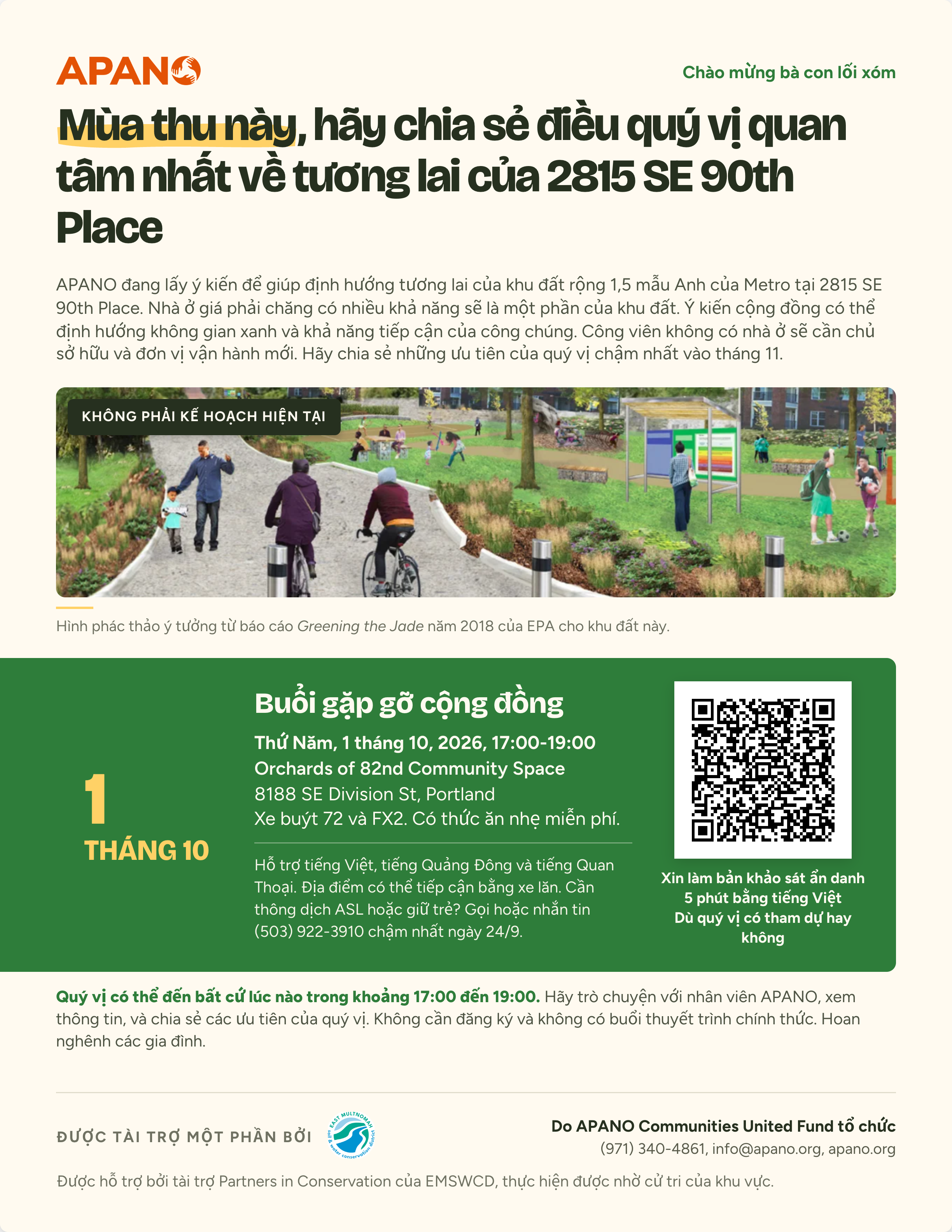
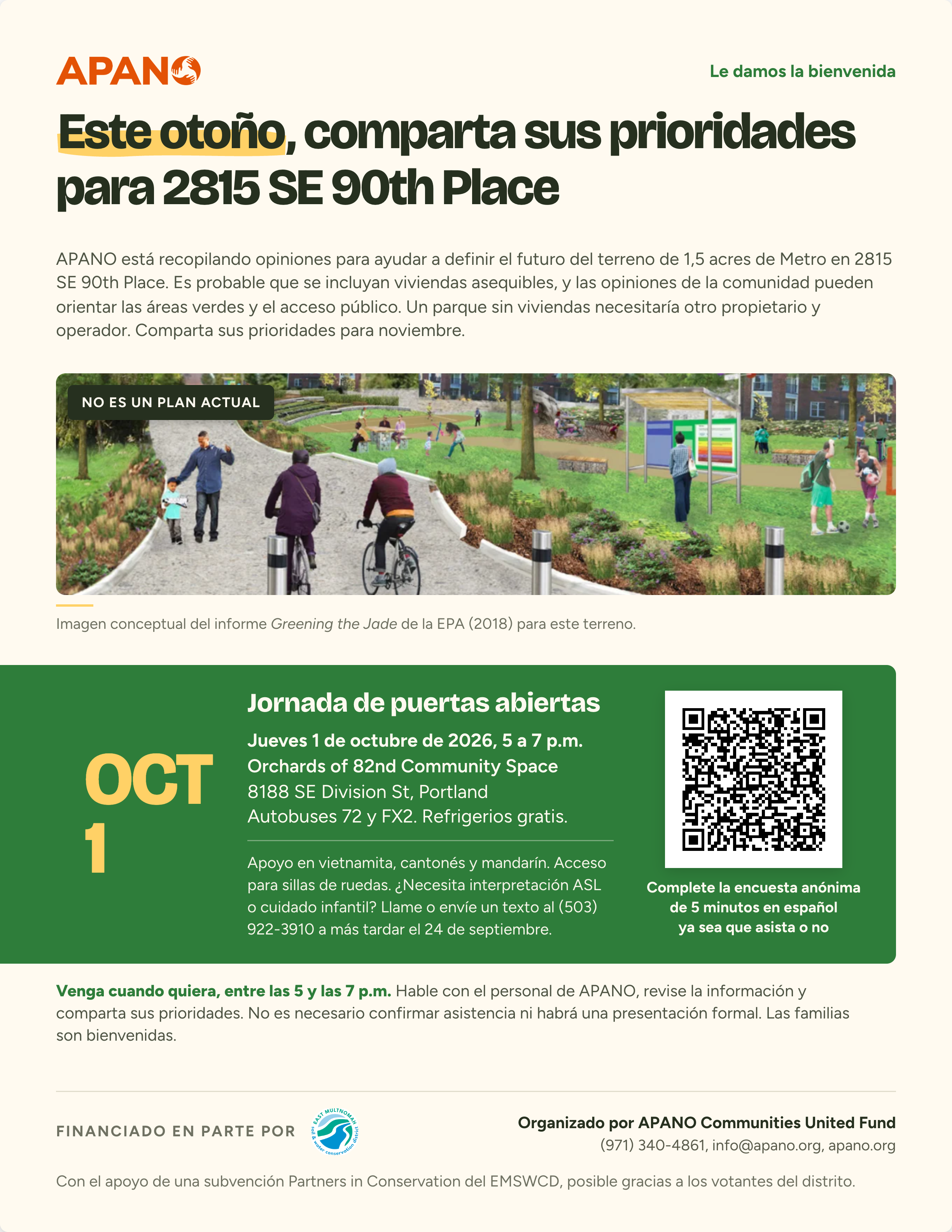
On October 1st, APANO Communities United Fund will host an open house from 5 to 7 p.m. to gather Jade District residents’ perspectives on access to green space. Participants attending the drop-in gathering within the community room at 8118 SE Division Street will join a focused conversation about a roughly 1.5-acre property owned by Metro on the southeast corner of SE 89th Avenue and 90th Place. All area residents, whether or not they attend, can complete an anonymous online survey to share their opinions.
Oregon Metro owns the large parcel at 2815 SE 90th Place after purchasing the property in July 2025 for planned Transit-Oriented Development (TOD). Community advocates have long envisioned the large property as a neighborhood park and recently sought support for that project. Last March, APANO collected 149 community member signatures on a letter calling for meaningful engagement and substantial green space at the site. This support follows the 2014 Jade District community visioning plan and the 2018 EPA Greening the Jade project work. That previous community outreach recorded in those documents showed a desire and expressed need for green space across all groups in the neighborhood.
Since sharing that letter, organizers have focused on developing plans based on current capacity for new parks, indicating the need for a practical shared-use model for the site. A standalone park or community garden without housing would require another organization to purchase the property from Metro and take responsibility for long-term maintenance. A mixed housing and green space approach could include shared outdoor areas for residents or a combination of affordable housing and publicly accessible green space, community gardens, paths, or gathering areas. They expect the open house and survey results will help rank community priorities for affordable housing, outdoor recreation, and public access to green space. APANO will compile the results into a community engagement report for Metro to inform its plan for the site and shape Request for Proposal (RFP) language used to secure future development.
Although creating a full site park is less likely, APANO staff expect an opportunity for public use of part of the 1.5-acre site, and survey and open house input could support that initiative. The open house will have language support in Vietnamese, Cantonese, and Mandarin. People needing childcare or American Sign Language support to participate should call or text (503) 922-3910 by September 24th. The venue is wheelchair accessible and off the 72 and FX 2 TriMet bus lines. No registration is needed to attend this family-friendly event.
Promotion: Montavilla News is supported by contributions from businesses like Otter Wax, a neighborhood producer of small-batch specialty goods handcrafted in Portland. Using only natural ingredients, they make modern care products that are steeped in tradition. We thank them for their support.
Portland is recognized as a bikeable city that invests in infrastructure that makes this transportation and recreation activity more accessible to new or vulnerable riders. On Wednesday, September 30th, the New to Portland 2026 Rides series will gather in the Montavilla Plaza at SE 79th Avenue and SE Stark Street for a 5:30 to 7:30 p.m. moderate-paced 6- to 8-mile bicycle ride. The event is geared towards people who are new to town, new to cycling, or want to explore low-stress bike routes on the east side of Mount Tabor.
This Jade District and Montavilla ride is free and open to everyone, and people without a bike can ride free on a BIKETOWN e-assist bike. People interested in that offer will need to ask the ride leader for a free ride code to cover the cost of the bike ride and download the BIKETOWN app or the Lyft app. Participants can expect to roll past several neighborhood parks along current and future bikeways while discovering lesser-known features of the area.
This is a slower-paced ride, and participants can expect to travel in the group at 8 to 10 mph. Event organizers want to direct people to one of Portland’s bike shops to rent or buy a bike if they are interested in this event or in adopting cycling as one of the many ways to navigate the city. This Portland Bureau of Transportation-hosted event is made possible with support from Oregon Metro and the Federal Transit Administration. People are encouraged to check the BIKETOWN map for station locations near the event if they plan to use the program. The City also offers a checklist to help you get started on a bike and prepare for a ride on city streets.
Promotion: Check out East Portland News as it continues to advocate for and report on outer East Portland. You will find frequently updated articles and an archive of more than 5,000 stories written over the past 20+ years alongside a robust Community Calendar of events.
On September 10th, the public and private organizations responsible for creating the Legin Commons apartment building at 7755 SE Division Street celebrated its opening with a ribbon-cutting ceremony. Soon, new residents will begin moving into 124 new regulated affordable homes on Portland Community College’s (PCC) Southeast campus, prioritizing families with children and low-income households.
The new four-story building sits on the site of a former Kaiser Permanente one-story medical clinic built in 1964. PCC acquired the land several years before Kaiser’s closure and demolished the building in 2015, using the land as an auxiliary parking lot with a large grassy spot where the building once stood. PCC had always planned to repurpose the space for more effective uses than parking. In 2021, College leadership worked to develop a twenty-year facilities plan for the educational institution’s properties. During that evaluation, PCC determined that portions of the school grounds should support low-income affordable housing. Instead of student-only dormitories, they opted to focus on attainable housing open to the community. From internal student surveys, PCC staff learned that housing insecurity is a significant concern. They also observed that students often spread their education out over many years with inconsistent enrollment. As a result, PCC determined that tying housing programs to school affiliation would not alleviate housing insecurity among the student population, so planners opened this housing to all who qualify.
A previous PCC campus expansion razed the former site of the Legin Restaurant, a beloved Chinese eatery and community hub. Housing developers APANO, Our Just Future, and Edlen & Co. chose to honor the area restaurant by naming the building Legin Commons and incorporating central gathering amenities to match its namesake’s role as a community hub. Located in the Jade District and the Montavilla neighborhood, blocks from SE 82nd Avenue, it offers access to some of Portland’s most active transit lines and walkable destinations. The building also offers secured on-site parking for some residents with dedicated EV charging stalls.
Security gate leading to resident onsite parking with EV charging stalls to the left
The Portland Housing Bureau awarded this development $3.78 million from the Portland Clean Energy Community Benefits Fund (PCEF) to install a solar array and high-efficiency heating and cooling split systems. Other public funding came through a $1.67 million allotment from the voter-approved Metro Affordable Housing Bond and a Metro-awarded $250,000 Transit-Oriented Development grant. Legin Commons residents also enjoy natural cooling from a mature tree canopy on its eastern edge and new greenery planted around the property to help replace the shade once provided by older trees removed during construction.
Rooftop mounted mini-split heat pump condenser units and solar array
PCEF Program Manager Sam Baraso explained during the Thursday event that green investments in this building benefit residents and the environment by reducing off-property energy consumption and lowering costs. “We invested in 294 in-unit mini-split heat pumps and 22 common-area mini-split heat pumps, three high-efficiency whole-building ventilation systems, 33 energy recovery ventilators, which means we can bring in fresh air into the building constantly, make sure folks are breathing clean, fresh air and do so in a way that actually uses the outgoing air to cool or warm [incoming air].” On the roof is a 180-kilowatt solar array that further reduces the energy demands of these residences on the grid. Claire Parisa with the nonprofit Enterprise Housing Credit Investments, which provided funding support for this project, highlighted the unique support for environmental construction in Portland. “There’s always a goal to make buildings green, but not necessarily the funding to go with it. And we’re so lucky to have PCEF in the city to make those dreams a reality.”
Outdoor play area and resident courtyard
Lower energy bills and cleaner indoor air are just a few of the key features of this complex. Designers used the natural amenities to create significant outdoor space for residents, including an outdoor play area off a large community room. On-site laundry and bike storage are available on multiple floors. Private meeting rooms throughout the building provide secluded workspace or an area for private conversations away from home. Elevators offer seating in an adjacent lobby on each floor so people with mobility considerations can navigate the property with less impact on their comfort. A ground-floor classroom can also host community meetings or events, as long as it remains open to all residents in the building. APANO will provide resident services, leveraging its headquarters’ proximity to the site to be an integrated partner in the building’s supportive services.
Ground-floor classroom
For over a decade, APANO has looked for opportunities to increase housing in the district, making good on a community-driven concept for the area. “Our vision for Jade is for it to be Portland’s most transit-rich, most affordable, and most climate-resilient part of town. We have Legion Commons opening today, we have Jade Apartments opening next month, and we’re in pre-development at Canton Grill,” explained Metro Councilor Duncan Hwang, who also works for APANO. “Part of the housing piece is our work around anti-displacement. We have some time right now to really build up these community assets to make sure we can stay in place.”
Quisha Light, interim director of the Portland Housing Bureau
Quisha Light, interim director of the Portland Housing Bureau, celebrated the addition of these new housing units but noted it is just an early step in a larger effort to meet the community’s needs. “According to the city’s housing needs analysis, Portland must add about 28,000 homes that are affordable to families in that 0 to 60% of AMI (Area Median Income) range by 2045. So we still have a lot of work to do. It’s a big lift, but I have lived here for 20 years now, and I’ve seen Portlanders step up and really accept the big challenges. So I know all of us standing here today can make that happen. Legin Commons makes stability real. With 124 new affordable homes, including 20 deeply affordable homes at 30% AMI, and more than half of all units sized for families, this development reflects the community it serves,” said Light.
Katy Ho Interim President PCC and Councilor Tiffany Koyama Lane
Speakers at the ceremony noted the importance of creating high-quality affordable housing in an area that has historically supported generations of the city’s minority populations. “This stretch in the Jade District and the 82nd Avenue corridor in particular has long been home to one of our most diverse communities in the city. Immigrant families, refugees, students, working people who bring so much to Portland,” said Portland Councilor for District 3, Tiffany Koyama Lane. “This is a place where we can hear more than 140 languages spoken, where we can find our culturally specific food and markets that reflect our beautiful diversity. This neighborhood was built by people. The character comes from families who have been here for generations, and also from folks who crossed oceans and borders to get here.”
Metro Councilor Duncan Hwang, Lynn Fuchigami Parks, and Councilor Tiffany Koyama Lane
Koyama Lane explained how preserving communities through anti-displacement and naming is a significant step for a city whose past leaders excluded many non-white voices. In 2024, Sameer Kanalwe and Koyama Lane became the first two Asian Americans ever elected to Portland City Council. Beyond naming the building after a community gathering space, residents will use the Minoru Yasui community room. “Legin Restaurant was more than just a great restaurant. It was a center of community life, and today, Legin Commons carries that spirit forward as a place where people can gather, connect, celebrate, and build community. This is especially meaningful that the community room bears the name of Minoru Yasui,” said Lynn Fuchigami Parks, Executive Director Emeritus of the Japanese American Museum of Oregon. “The night of March 28th in 1942, Minoru, who was only a 26-year-old attorney at the time, walked the streets of downtown Portland to deliberately violate the military curfew imposed on people of Japanese ancestry. He did so to challenge the constitutionality of that order. That’s the order that led to the unjust incarceration of over 120,000 men, women, and children, the majority of whom were American citizens.” The plaque that will be in the community room touches on Yasui’s story and adds to the sense of place created in the building.
PCEF Program Manager Sam Baraso
Residents will start moving into Legin Commons soon, with the 30% AMI units mostly committed to people. Many 60% AMI-priced units are still available for qualifying renters. Those homes are restricted to households whose annual income does not exceed $53,940 for one person, $61,620 for two, and upward based on the number of residents. Homes restricted to 60% of AMI earners are currently rented at near-market rates. Still, this new building offers far more amenities than other multifamily buildings in the area, and the protected rental rate can help provide housing stability when market rates rise faster than median income. Consequently, the building should fill to capacity slowly, allowing a gradual influx of new neighbors to the residential area around the new apartment building.
Article and Photos by
Jacob Loeb
Promotion: Montavilla News is supported by contributions from businesses like Otter Wax, a neighborhood producer of small-batch specialty goods handcrafted in Portland. Using only natural ingredients, they make modern care products that are steeped in tradition. We thank them for their support.
As residents begin moving into the recently completed Legin Commons apartments, road crews prepare to add an enhanced pedestrian crossing at the adjacent intersection of SE Division Street and SE 77th Avenue. Contractors working with the Portland Bureau of Transportation (PBOT) will construct new curb ramps at the northwest and southwest corners, leading to a new concrete median island placed along a painted, high-visibility crosswalk.
This work follows the recent completion of a similar upgrade at 64th Avenue. Both TriMet-designed safety improvements are part of the SE Division Street Crossing Enhancements project supported by Fixing Our Streets funds. These crossings were originally slated for reconstruction during planning stages of the FX-2 Division transit upgrade but were cut due to station relocation. PBOT is using Safer Streets Projects category money to implement the designs to help people cross the busy street and provide Americans with Disabilities Act (ADA)- compliant infrastructure in key locations along Portland’s pedestrian and bicycle network.
This intersection is a connection point in the 70s Neighborhood Greenway. PBOT says these improvements will bring the western crossing up to current standards and improve visibility of people walking and biking through the intersection, addressing deficiencies identified by citywide pedestrian and bicycle plans. Construction of this safer crossing at SE 77th Avenue is particularly useful now that 124 individuals and families will soon call the new affordable housing development home and start crossing SE Division frequently.
Intersection design graphic courtesy PBOT
The in-street infrastructure protects pedestrian crossings with a concrete median island created by a curb-height pad in the center turn lane. A roadway-level cutout in the concrete at the crosswalk intersection offers a mid-crossing refuge for people rolling or walking across the street. These waypoints allow pedestrians to cross in two phases, focusing on one direction of traffic at a time, and help drivers better see a person waiting at the high-visibility infrastructure. Drivers will not lose any turning ability at this intersection. However, east-traveling vehicles waiting to turn north will remain in the travel lane until it is clear to proceed. The project scope also calls for one new streetlight on a wood utility pole to improve nighttime visibility.
Crews have added painted markings on the street to indicate where the new median island will sit and the shape of the reconstructed sidewalk corners. A PBOT letter to residents indicated that project leaders planned to begin construction here this summer, but work is weather-dependent and could be delayed.
Promotion: Montavilla News is supported by contributions from businesses like Catalyst Construction & Kitchen Remodeling, a top-rated general contractor specializing in kitchen, bathroom, basement, and garage remodeling, as well as ADU construction and home additions. We thank them for their support.
Mt. Tabor CrossFit at 8028 NE Glisan Street sold to new owners Lindsey Overbay and Ryder Williams in mid-June 2026 and changed its name to Iron Keep Fitness. At the same time, the gym relocated less than a mile north to 2310 NE 82nd Avenue across from the Leodis V. McDaniel High School athletics field. Despite the changes, the organization retained most of the coaches and the people who use this fitness community for their regular workout routines.
Iron Keep Fitness owners Ryder Williams and Lindsey Overbay
Alexis Jaramillo opened Mt. Tabor CrossFit on NE Glisan Street in January 2012. She grew that business over the following decade, outlasting many other larger gyms in the area. Williams explained that he learned about the opportunity to take over this established business over a year ago when deployed overseas with the Mississippi National Guard. “I was in Kuwait, and I had previously worked for the Mississippi University for Women as their strength and conditioning coach.” Williams wanted to find a better-fitting workplace with more team-level participation when he returned. “I sent my resume out to a bunch of different people all over the country. The previous owner saw my resume, and we had some Zoom interviews where Alex mentioned that she was looking for a general manager to hand over ownership to,” said Williams.
Closed Mt. Tabor CrossFit location’s sign at 8028 NE Glisan St
After a visit to Portland to ensure the community was a good fit for Overbay and Williams, they relocated from Kentucky. “We just love the community, love the people. And we stayed here for about a year and a half as the general manager. Then we decided this does look like a viable business for us and we moved forward with the purchase,” recalled Williams. Overbay added that it was important that the gym community knew them before trying to make a change. “We got pretty close to the members and know them well. Because an ownership change is naturally a lot. So being able to trust us as the new owners made a big difference, I feel.”
The new ownership team decided to make all the changes at once to minimize disruption. “We thought that it was just going to be more manageable if we ripped the band-aid off all at once. So when we moved, we changed the name, and we changed the website,” explained Williams. The name change had geographic and ideological justifications. “First, we moved a little bit out of the Mount Tabor area, so keeping Mt. Tabor CrossFit didn’t really make sense. Second, we wanted to break away from CrossFit as an organization. Its stances and values are not conducive to our stances and values, specifically their stance on trans athletes, and their recent big event was sponsored by the U.S. Border Patrol. In a climate like today, we said, ‘That’s not our values as an organization.’” The gym still uses the functional fitness approach it has always taught, focusing on strengthening users for everyday movements that improve people’s active lives and mobility.
Set on changing the company’s name, Overbay and Williams looked to their own recreational interests for inspiration. “We’re both huge Dungeons & Dragons nerds—we’re frequent visitors to Board Bar Games on Stark Street—and we wanted to have something that works with that image of dragons and castles,” remarked Williams. They found most members supportive of the name change and adaptable to the move. “Some people do have to bike instead of walk, but I think that’s been pretty manageable, especially for Portland,” explained Williams.
A tall bay room offers hight for ropes and other vertically demanding workouts
The new building offers around the same amount of gym floor space, but it has the added advantage of greater equipment storage capacity, and the fenced parking lot has more spaces. Williams noted that the slower neighborhood streets behind the new location are safer for the members running as part of a workout. “It is nice just to go out and run in a neighborhood back behind here rather than busy NE Glisan where you sometimes have to stop because of cars. Yeah, it’s been a very positive move for us.”
Retail space offering tape, apparel, and nutrition
The gym retained much of its past structure but with a challenge rating system. “It’s based on Dungeons & Dragons, where you choose your challenge based on how difficult you want something to be,” said Williams. They want to assess members’ current status and then adjust expectations on where they are and what goals the member has. “We can assign challenge ratings based off of where they’re at and then give people a super clear path forward.” Members span a wide age range, and they want a comfortable space. They currently have a little over 100 members. Participation fluctuates through the year as people’s schedules change. Williams said membership is month-to-month, with no long-term commitments. On weekdays, they open at 5:30 a.m. with pre-work classes. They also offer midday classes and after-work sessions ending at 7:30 p.m. Outside the Monday through Friday structure, there is room for people to bring in guests or take on harder challenges. “On Saturdays we run a 9 a.m. class, which is generally a partner workout where we encourage people to bring friends and try it out. At 10:15 we run a two-hour competitor class; that is for people that want to do a longer session with more high skill stuff like climbing ropes or carrying heavy sandbags,” said Williams.
Iron Keep Fitness has programs for 55-and-older people who may be new to or returning to fitness. They have a teen class with sports-oriented goals and many levels in between. The owners want everyone to feel comfortable coming into their gym. They explained that people shouldn’t worry about not having enough strength to work out because becoming fit is why people should work out, and they want to help individuals achieve that goal. Interested people can visit ironkeepfitness.com or call 888-271-4194 to find out more and schedule a trial visit.
Promotion: Consider visiting Montavilla New’s supporter East Portland News as it continues to advocate for and report on outer East Portland. You will find frequently updated articles and an archive of more than 5,000 stories written over the past 20+ years alongside a robust Community Calendar of events.
Amaye International Restaurant celebrated the opening of its second location serving Somali food in July. The larger space at 10114 SE Division Street made room for its growing success as a community dining destination. A month later, they closed the original space at 8000 NE Glisan Street for renovations. At 5 p.m. on September 4th, the corner space on NE Glisan will officially welcome HK Smash alongside many of its traditional Somali menu items. Guests can now order Halal smash burgers, wings, fries, and milk cakes from this Glisan Street location.
Posted sign saying the location closed for a new look and menu rollout
Amaye International Restaurant took over the NE Glisan storefront from Paitong Thai Cuisine in late 2022 and steadily grew its regular customers. Weekends saw hours of full tables as people cycled through the space for food and connection with friends. The new SE Division Street shop offers three private sections for women-only events and families. They now advertise seating for over 50 guests and room for people to enjoy their renowned meals comfortably.
HK Smash uses Halal meat—butchered from permitted animals that have been slaughtered according to Islamic dietary laws—to create popular American fast casual foods. The new embedded restaurant was created by Hamza Kassim, the son of Amaye’s owner. His team will serve the signature pressed burgers alongside smoothies and slushies, with Milk Cakes and other dessert options to expand the menu. HK Smash pop-up events received many positive reviews, and now fans can find it as part of the permanent menu.
Recently repainted black and red highlighted interior at 8000 NE Glisan St with new flooring in a gray finish
The shop has received new flooring and paint as it readies for customers. After the Grand opening this Friday, people can order the Halal smash burgers Wednesday through Thursday from 1 to 10 p.m. Friday through Sunday, the hours shift later, with service from 3 p.m. to 1 a.m. HK Smash is closed on Mondays and Tuesdays.
Promotion: Montavilla News is supported by contributions from businesses like Otter Wax, a neighborhood producer of small-batch specialty goods handcrafted in Portland. Using only natural ingredients, they make modern care products that are steeped in tradition. We thank them for their support.
Montavilla Jazz is back this weekend for a three-day, village-style festival spanning locations inside and beyond the neighborhood. Over the Labor Day Weekend, the 13th Annual Montavilla Jazz Festival celebrates Portland’s music scene between September 4th and 6th. Montavillajazz.org has a detailed schedule of ticketed and wristband-accessed performances. However, many Montavilla locations will present live music featuring student, youth, and emerging artists as official Village Stage hosts. Those performances will not have a cover charge.
2024 Montavilla Jazz Festival’s SoundsTruck NW stage located in the Montavilla Plaza
Threshold Brewing & Blending at 403 SE 79th Avenue hosts a live music Village Stage and serves Polish favorite foods, including pierogi, sausage dogs, and zapiekanka. Replicant / Mudd Work Cafe at 7033 NE Glisan Street will also host Village Stage music throughout the weekend. Vino Veritas Wine Bar & Shop at 7835 SE Stark Street has often hosted live jazz throughout the year, and its Village Stage is booked throughout the festival weekend. Montavilla Brew Works at 7805 SE Stark Street has two nights of Village Stage music paired with food vendors. They will allow all ages in the brewery during the event.
Montavilla Brew Works Saturday, September 5th, Live Performances and meals by Korean Wagon food truck 2:00–3:00 PM Ian Arellano Trio | Clark College/PSU 4:00–5:00 PM Ian Arellano Trio | Clark College/PSU 6:00–8:00 PM MHCC Kane St. Combo
Montavilla Brew Works Sunday, September 6th, Live Performances with food by Oi!The Sausage pop-up 2:00–3:00 PM Tommy Blize Jazz Trio 4:00–5:00 PM Swingin’ Sounds Community Combo 6:00–8:00 PM MHCC Division St. Combo
Academy Theater at 7818 SE Stark Street will show Thelonious Monk: Straight, No Chaser (1988) on Thursday, September 3rd at 7 p.m. and Breathless (1960) on September 4th at 10 p.m. for those looking to enjoy jazz on the big screen. Primary Venues this year include Caldera Amphitheater at Mt. Tabor Park. Alberta Rose Theatre at 3000 NE Alberta Street, Portland Metro Arts at 9003 SE Stark Street, Show Bar at 1300 SE Stark Street, and the SoundsTruck NW located in the Montavilla Plaza at 79th Avenue and SE Stark Street. The Montavilla Jazz Festival has grown beyond the neighborhood where it started, but it still works to boost the area businesses that support musicians year-round. People are invited to purchase tickets within their means or visit Village Stage locations to join Portland’s annual jazz celebration.
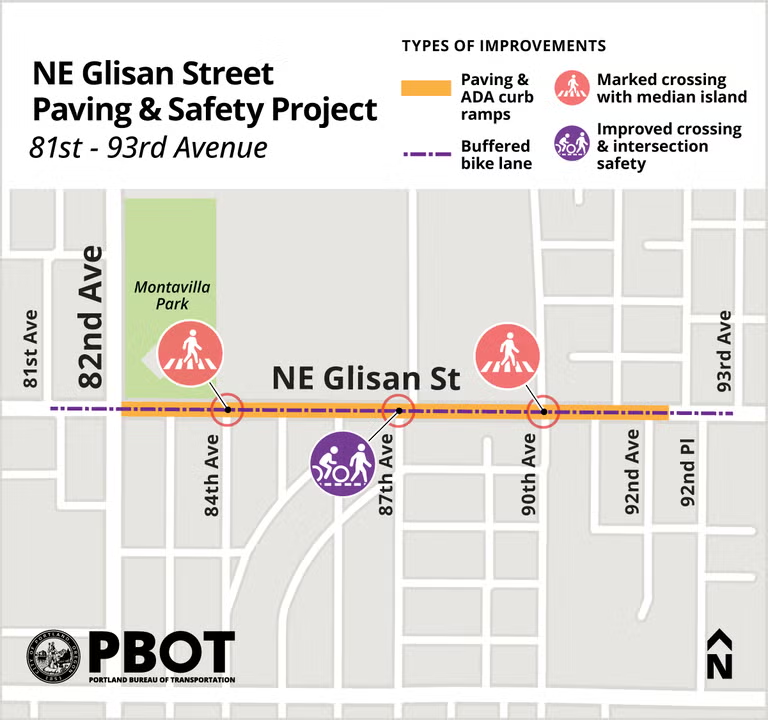
This week, crews with the Portland Bureau of Transportation (PBOT) will continue road work that began on August 19 along NE Glisan Street between NE 82nd and NE 92nd avenues. Drivers in the area are encountering new traffic patterns and slower speeds as re-striping teams add painted bike lanes on completed segments of the project site and new signage arrives from NE 81st to NE 92nd Avenues. Workers have not restored all lane markings to the repaved half of the project site closest to NE 82nd Street. Road users should use extra caution until work is completed and anticipate delays during the 7 a.m. to 6 p.m., Monday through Thursday work schedule.
New eastbound bike lane segment started on NE Glisan St near NE 83rd Ave (Jacob Loeb)
This Fixing Our Streets-funded project included substantial updates to sidewalk corner curb ramps, bringing crossings in this area up to Americans with Disabilities Act (ADA)- compliant standards. In addition to creating a smoother driving surface for vehicles, this new phase of work will reconfigure the street to remove time-shifting outer lanes used for parking or as an auxiliary travel lane. Collisions occurred on this street where motorists parked cars during allotted times, but drivers may have assumed the outer lane was clear. PBOT engineers anticipate that removing that conflict point will yield significant safety improvements with minimal impact on vehicle throughput.
The new NE Glisan bike lanes will connect NE 81st Avenue and NE 93rd Avenue. Early concepts for the cycling infrastructure showed the bike lane extending west to NE 80th. However, area business concerns over losing frequently used street parking on that block prompted a design that still helps connect side-street bike routes for people crossing NE 82nd Avenue outside a car, while minimizing impacts to adjacent commercial property users. PBOT planners anticipate further improving the bike infrastructure in 2030 with hardscape concrete dividers and flex posts to protect cyclists riding next to cars. The reconfiguration is happening during this repaving project to save money. Otherwise, contractors would need to grind off existing street markers and repaint as part of the 2030 work.
NE Glisan St existing crossing at NE 87th Ave that crews will upgrade
NE Glisan Street, from Interstate 205 to 82nd Avenue, is a notoriously challenging roadway to cross with vehicles driving quickly between the two points. Without any fully signalized intersections on this stretch and with a large hill blocking visibility, it can take an extended period to find a safe break in traffic to cross. Crews working with PBOT will install two new pedestrian crossings with concrete median islands at NE 84th and 90th avenues, along with enhancements to an existing crossing at NE 87th Avenue. These in-roadway waypoints allow pedestrians to cross in two phases, focusing on one direction of traffic at a time, and help drivers better see a person waiting at the high-visibility infrastructure.
In the coming days, crews will grind down the eastern segment of the roadway and lay a fresh road surface. Cyclists should consider safer routes until NE Glisan is fully re-striped, and all street users should plan extra travel time as people adjust to the new configuration and speed limits on this segment of NE Glisan.
Article and photos by
Jacob Loeb
Promotion: Montavilla News is supported by contributions from businesses like Catalyst Construction & Kitchen Remodeling, a top-rated general contractor specializing in kitchen, bathroom, basement, and garage remodeling, as well as ADU construction and home additions. We thank them for their support.
Neighborhood news site focused on buildings and changing businesses